Co-sell partnership strengthens bond with cloud market leader
Boston, MA – August 24, 2022 – EditShare®, the technology leader that enables storytellers to create and manage collaborative media workflows, announced it has joined the Amazon Web Services (AWS) Independent Software Vendor (ISV) Accelerate Program, a co-sell program for AWS Partners that provides software solutions that run on or integrate with AWS. The program helps AWS Partners drive new business by directly connecting participating ISVs with the AWS Sales organization.
Members of the AWS ISV Accelerate program are held to the industry’s highest standards and must undergo a comprehensive architectural and security evaluation to gain acceptance into the program. Proof of customer excellence was also reviewed to validate the successes EditShare customers have achieved across industry verticals. EditShare has an excellent track record in integrating cloud video storage into practical solutions which are used by media organizations from national broadcasters to boutique post houses. In turn, this makes it a proven partner for the AWS Partner Network (APN) Customer Engagement Program.
“More and more media industry leaders are making the transition towards cloud and hybrid production workflows, because they support new ways of engaging with creative talents as well as providing the resilience and security of business continuity,” commented Said Bacho, chief revenue officer at EditShare. “The AWS ISV Accelerate Program gives us another route to provide our FLEX cloud storage and asset management applications to AWS customers.”
“Participation in the AWS ISV Accelerate program is more than just signing a form,” Bacho added. “A company is invited to join when it has demonstrated both the technical strength of the solutions and their relevance in the ecosystem, through multiple sales and significant revenues. This is an important accolade for the EditShare platform, and we are proud to be a part of this program.” EditShare’s cloud and hybrid technologies for storage and workflow can be seen at IBC2022 on stand 7.A35.
EditShare is a technology leader that enables collaborative media workflows on-premise, in the cloud, or in a hybrid configuration. With customer and partner success at the heart of EditShare’s core values, our open software solutions and robust APIs improve workflow collaboration and third-party integrations across the entire production chain, ensuring a world-class experience that is second to none. The high-performance software lineup includes media optimized shared storage management, archiving and backup, and media management, all supported with open APIs for extensible integration.
EditShare’s cloud-enabled remote editing and project management technology was recently recognized by the National Academy of Television Arts and Sciences (NATAS) with a prestigious 2021 Emmy® Award for Technology and Engineering.
Storage and asset management for broadcast and post facilities
Boston, MA – July 26, 2022 – EditShare®, the technology leader that enables storytellers to create and manage collaborative media workflows, is exhibiting alongside its local partner CIS Group at SET Expo 2022 (22 – 25 August, Expo Center Norte São Paulo, stand 81). The company will present a demonstration of integrated post production workflows supporting multiple edit software systems.
EditShare’s robust and reliable tools used by content creators around the world include its EFS networked shared storage and FLOW workflow and media asset management system, that easily integrate with leading editorial tools such as Adobe® Premiere® Pro and DaVinci Resolve. Through a partnership with AWS, EditShare also offers a seamless route to cloud and hybrid architectures for scalable, remote operation and storage protection applications.
On the EditShare demonstration area at SET Expo will be an EFS300 storage node running the FLOW workflow software. FLOW’s practical tools allow users, locally and remote, not only to access their content on the shared storage, but to edit using any of the popular edit platforms. FLOW even synchronizes between the platforms, allowing users to move between edit users. The workflow also provides browse resolution proxies, allowing remote editing even over modest internet connections.
“FLOW is a proven, simple and flexible set of workflow tools,” said Cristiano Barbieri, EditShare regional sales director LATAM. “Users can catalog, browse, collaborate, edit, archive and manage all assets from a single layer user interface. It is the perfect partner for the high performance EFS storage appliances.”
Visit EditShare on the CIS Group stand 81 at SET Expo 2022. For more information on EditShare solutions, please click here to get in touch.
About EditShare
EditShare is a technology leader that enables collaborative media workflows on-premise, in the cloud, or in a hybrid configuration. With customer and partner success at the heart of EditShare’s core values, our open software solutions and robust APIs improve workflow collaboration and third-party integrations across the entire production chain, ensuring a world-class experience that is second to none. The high-performance software lineup includes media optimized shared storage management, archiving and backup, and media management, all supported with open APIs for extensible integration.
EditShare’s cloud-enabled remote editing and project management technology was recently recognized by the National Academy of Television Arts and Sciences (NATAS) with a prestigious 2021 Emmy® Award for Technology and Engineering.
There is no right or wrong way to post produce a project: there is no right or wrong software package for each part of the process. How you choose to complete the work is down to a number of factors, not least individual preferences.
Except that for most organizations, they are locked into a specific toolset because that is the only way they can move projects around and work collaboratively. Everyone using the same suite of software applications may limit the operators, but it means projects can be (reasonably) seamlessly exchanged.
At EditShare we wanted to take a fresh approach to this. Our users told us that it would be great to have more flexibility. This is why we created Universal Projects, which allows you to move between platforms as easily as possible.
The idea is that you can start a project in any tool – including EditShare FLOW to set up bins and even rough cuts – and work in any other.
In the real world it may be unlikely that a single project will be worked on by multiple editors each using different NLEs, so you might ask why we have devoted our development efforts to this. But there are real-world use cases.
Imagine, for instance, working on an episodic series at an Avid post house. During the edit, the production company or broadcaster needs to start on the marketing campaign, and the in-house trailer editor prefers Premiere Pro. Having to go back to the raw footage and start the search for clips from scratch is clearly not an economic option. Being able to look into the programme edit, browse bins for each episode, and with key moments tagged by the producer, saves days of effort and leads to a much better result. When the pressure is always on to deliver things faster, this is a big benefit.
The idea of being able to share projects between platforms is sound. What does it mean in practice? Inevitably, there are differences between platforms.
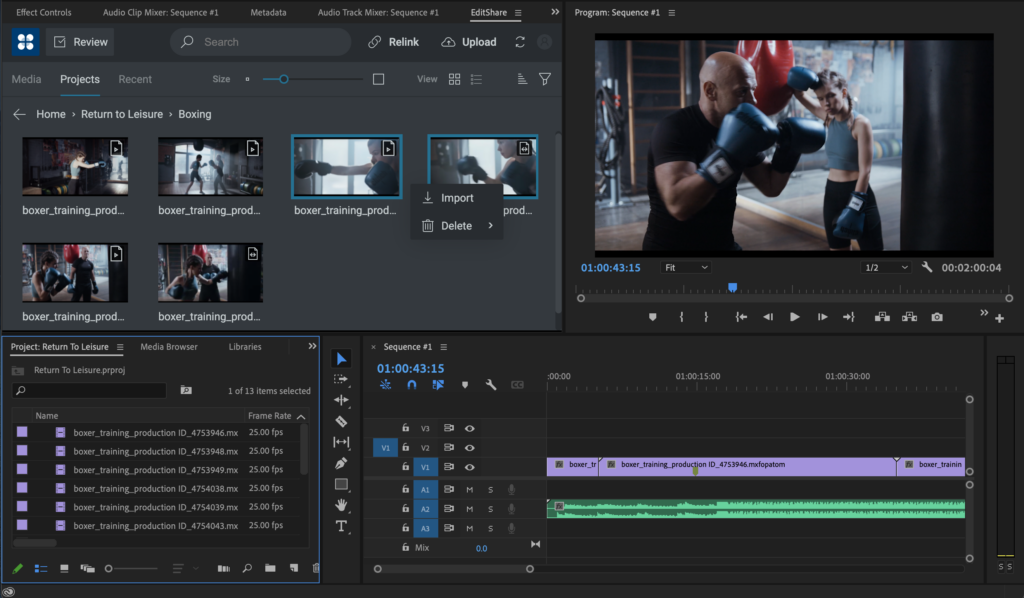
FLOW is the EditShare media management platform. In 2021 we introduced FLOW Panels – plug-ins – for Adobe® Premiere® Pro and for DaVinci Resolve, which were very well received. The Panels provide a means of accessing FLOW media management from within the familiar editor user interface.
FLOW panel connected directly into the Adobe® Premiere® Pro UI
More importantly, it is a simple means to swap bin structures, content, and all the metadata around the edit. Where it can, this is all maintained completely automatically. So you can create a project structure in advance in FLOW and have it pop up ready when you log in to your editor. If you add bins or sub-divide timelines or make any other structural changes, these are immediately reflected back into FLOW, and are available to any other user who logs in.
Avid Media Composer takes a slightly different approach and lacks the simple hooks for tight, cross-platform integration. But it would not be a very valuable cross-platform integration if it did not include Avid. So we have now brought Media Composer under the Universal Projects umbrella.
We think we are pioneering the universal projects concept. We are certainly the first to be able to integrate Avid technology and workflows into cross-platform collaborations.
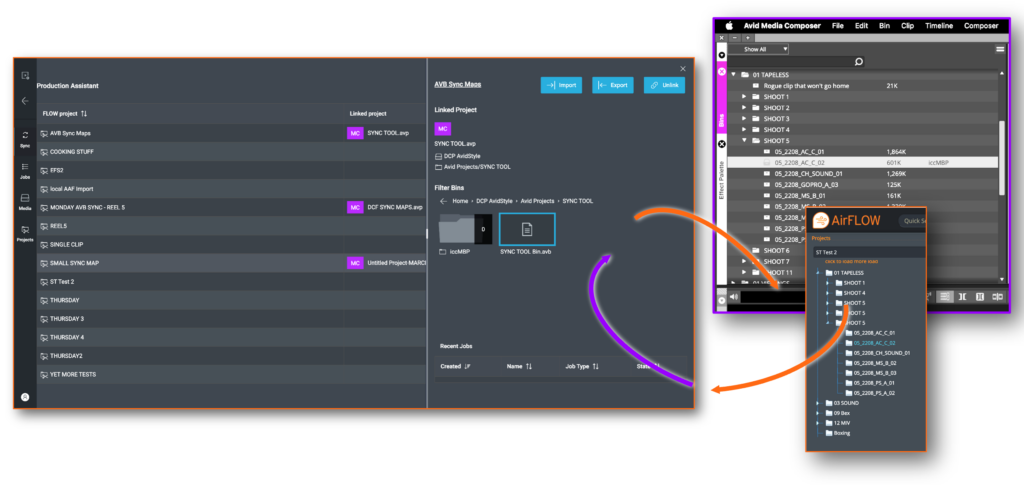
Our implementation respects Media Composer’s way of working, like locking bins when a user has logged into a project. To allow it to be always available to other collaborative users, we implemented a routine that automatically generates a copy of the structure which is then reconciled again when the original user logs out or publishes.
This works in conjunction with the Avid Attic, so projects are backed up both here and in FLOW, ensuring each user can always access the history of a project as well as the latest version.
In effect, EditShare FLOW appears as another user in the Media Composer environment. It becomes a very powerful edit assistant, either manually through other portals into FLOW or automatically.
Sync between FLOW and Media Composer respecting bin locking
The original Universal Projects links are already available; the complete system including Media Composer integration is currently in advanced beta trials with a number of organizations from boutique post houses to major national broadcasters.
Whatever the application, it gives you an overview of every project and a means of planning and optimizing workflows. As a side benefit, it also helps engineers plan for future expansion, showing where the bottlenecks are in projects, and facilitating data-lead decisions about where to optimize workflows.
Ultimately, it is part of the new metadata revolution, whereby a strong, common, resilient set of information is used to drive complex workflows and automated processes from the camera to the screen.
Want to find out more? See it in action at IBC, book a meeting or a demo here, or request a follow-up
Latest investment includes storage, automated workflows, quality control and archiving
Boston, MA, July 28, 2022 – EditShare®, the technology leader that enables storytellers to create and manage collaborative media workflows, has extended its shared video storage solution at Ba Ria – Vung Tau Radio and Television Station (BRT), including the platforms for archiving and increased automation. The new facilities also include an additional four 160TB EditShare EFS-300 storage nodes to add capacity for production requirements.
BRT is the broadcaster for Ba Ria – Vung Tau Province, in the south-east of Vietnam. It has been using EditShare storage for a number of years. Now, with production and transmission demands increasing greatly, it has become necessary to provide automated media management and quality control functionality to boost workflows.
The new installation calls upon the functionality available in the EditShare FLOW media management and workflow software. This gives BRT the ability to manage remote log-ins and to automate content flows through production to delivery. New material arriving at the station must pass local conformance checks and quality control, and thanks to FLOW’s AirFLOW and FLOW Automation, these can now be performed remotely if required.
Ever-increasing amounts of content, completed and in production, meant that it was important to add archiving capabilities, and the extension includes EditShare ARK. This includes LTO-8 tape drives and associated software to ensure automated archiving against business rules, and speedy recovery when required.
“EditShare has proven an excellent storage platform for us, that helps us to be more proactive and flexible during production, playout and storage and we particularly like the system’s flexible user permissions” said Mr. Le An Thi – Technical Manager at Ba Ria – Vung Tau Radio and Television. “As our production and broadcast demands have grown, we have recognised that we need to adopt more automation to reduce the amount of manual work, while also ensuring that we maintain our high standards. After researching the various products in the marketplace, EditShare was quickly identified as being the best option and they have been able to provide a complete solution – from ingest to storage to playout, including the facilities we need for file quality, transcoding and censorship.”
Based on the end-user’s requirements and initiatives, Editshare’s partner, Danmon Asia with its headquarters in Hanoi – Vietnam, designed the system in conjunction with application engineers from EditShare.
“We are very pleased that we have been able to work with BRT again, to automate their workflows and provide cost-effective content management,” commented Said Bacho, Chief Revenue Officer at EditShare. “This is a great example of the flexibility of our architecture, in that it allows users to start with accessible storage and add functionality and automation as they need it, while always preserving the investment at each stage. We are also grateful for the expertise and understanding of our local partner on the ground, Danmon Asia Ltd.”
EditShare is a technology leader that enables collaborative media workflows on-premise, in the cloud, or in a hybrid configuration. With customer and partner success at the heart of EditShare’s core values, our open software solutions and robust APIs improve workflow collaboration and third-party integrations across the entire production chain, ensuring a world-class experience that is second to none. The high-performance software lineup includes media optimized shared storage management, archiving and backup, and media management, all supported with open APIs for extensible integration.
EditShare’s cloud-enabled remote editing and project management technology was recently recognized by the National Academy of Television Arts and Sciences (NATAS) with a prestigious 2021 Emmy® Award for Technology and Engineering.
Automated workflows, quality control and archiving at the center of its Amsterdam show
Boston, MA – July 26, 2022 – EditShare®, the technology leader that enables storytellers to create and manage collaborative media workflows, will use IBC2022 (Amsterdam RAI, 9-12 September, stand 7.A35) to showcase how its latest technologies boost quality and efficiency for production and post production. Demonstrations will show how remote working and the cloud can interwork to give creative artists seamless and secure access to the tools they rely on.
Central to this is the ability to use EditShare post-production storage spaces and FLOW workflow tools to synchronize projects across the popular NLE platforms, including Media Composer, Adobe® Premiere® Pro and DaVinci Resolve. The latest release of core FLOW media asset management system allows complex projects to be moved as needed between EditShare media management and whichever edit environment the creative team needs to use.
Having its first showing in Amsterdam will be the latest suite of EditShareFLEX software solutions for out-of-the-box cloud and hybrid workflows. FLEX reflects the powerful business trends in post today, including the migration to a “work anywhere” environment, with ready access to content wherever the creative staff need to be. In adopting video cloud storage and processing, it also meets the move towards an OpEx financial model, with the cloud hosting and storage fees flexing to reflect the level of business.
“The post industry is changing, in part reflecting the changes enforced by the pandemic, and in part because creative talent is looking to shift the work/life balance,” comments Said Bacho, Chief Revenue Officer at EditShare. “What we now present is an eco-system where editors and other post artists can choose their preferred tools, and work where they like, when they like, without it in any way compromising their creativity or limiting the quality, even as we move to 4k and higher resolutions, and to HDR.”
EditShare’s EFS Multi-Site will also be on the booth for the first time this IBC. Multi-Site allows users with multiple locations to leverage built-in file acceleration to synchronize project storage between EFS clusters in different facilities. This ensures that users have ready access to content, wherever they choose to work. FLEX Cloud Sync extends the capabilities of Multi-Site to cloud storage, providing added flexibility in access as well as security in archiving.
For news and sports fast turnaround editing, FLOW supports direct ingest of NDI contribution feeds for immediate editing. Working in conjunction with the Helmut orchestration platform from MoovIT, IBC will see demonstrations of practical high-pressure editing operations linking EditShare storage with Adobe software.
Content security and availability is vital to professional users, and EditShare has added new hardware and software in this area. The new EFS 60NL nearline storage provides 60 drive bays and nearly 1PB of storage in just 4U of rack space. This offers secure storage for large amounts of content which is needed but not immediately worked on, ready to be transferred to the online servers with virtually no delay. The 60NL is also the first hardware platform to utilize the new EFS capability for erasure coding-based storage goals, eliminating the need for hardware based RAID.
Rolling updates to EditShare’s FLOW software platform ensure that the latest raw formats from popular camera systems like RED and Blackmagic Design are accepted, with LUTs imposed in real time, both on full resolution material and on proxies, boosting remote working using intelligent proxy management.
“IBC has always been very important to EditShare, a real opportunity to exchange ideas with our users and partners from around the world,” Bacho added. “The whole team is excited to be returning to Amsterdam, seeing our users and partners face-to-face, and discussing the creative and operational challenges they encounter and how EditShare can provide proven solutions today and into the future.”
See EditShare on stand 7.A35 at IBC2022. For more information on EditShare solutions, please click here to get in touch.
About EditShare
EditShare is a technology leader that enables collaborative media workflows on-premise, in the cloud, or in a hybrid configuration. With customer and partner success at the heart of EditShare’s core values, our open software solutions and robust APIs improve workflow collaboration and third-party integrations across the entire production chain, ensuring a world-class experience that is second to none. The high-performance software lineup includes media optimized shared storage management, archiving and backup, and media management, all supported with open APIs for extensible integration.
EditShare’s cloud-enabled remote editing and project management technology was recently recognized by the National Academy of Television Arts and Sciences (NATAS) with a prestigious 2021 Emmy® Award for Technology and Engineering.
We’re so excited to be heading to Amsterdam! On Thursday 8th September we’ll be holding a short meeting followed by a drinks reception in the Koelschip room at the very top of the Heineken Experience. Please join us to hear the latest on what we’ll be doing at the show, have a drink or two and chat with our team.
In the media industry right now, a lot of people are publishing opinions on the cloud. But they tend to focus on the features of the cloud, not the benefits.
We are all very aware of the features offered by outsourcing storage and processing. It is scalable, so you can turn things on and off, giving you the agility to try new things. But what are the things you might want to turn on and off? What, in short, are the benefits.
Take the case of a post house. You have a building, a fixed amount of space for which you pay rent. In that you build some facilities – edit suites, grading rooms, audio mixing and so on – and equip it with the necessary hardware and network connectivity. That is the limit of what you can offer, short of taking on more space, paying more rent, and buying more hardware.
If you are in a market, like London or New York, which expects city-centre facilities, it may not even be possible to expand. It will certainly be very expensive.
Today, if a regular and important client comes in with a large and interesting project, they may well say they want to edit from their location. Or the set. Or from the editor’s home. Blocking out an edit suite for the project, knowing that the room will be empty and the editor working over Teradici – looks like a poor use of your expensive real estate and resources. The client will certainly want to negotiate a discounted rate, but all you are saving is the runner’s time making cappuccinos. Rent, business rates, power and all the other overheads will still be there.
You could, of course, say that they can be in the building or they can be on the other side of the world: the rate for the edit suite is always the same. The client would then most likely shop around and either find someone else to do it for them, or potentially put something together on Amazon Web Services (AWS) themselves. Either way, you’ve lost this project, and perhaps the client, forever.
Or maybe you are a broadcaster, and your commercial team win the rights to a high profile sporting event. Suddenly you are asked to add a huge amount of editorial capacity, for a short time. Taking the conventional approach of building the extra edit suites – buying hardware and converting office space to creative rooms, even renting OB trucks – is not commercially viable if it is all going to be redundant the day after the event finishes.
Perhaps you want to experiment with augmented reality in one of your studios, because someone wants to try it on a pilot production which may turn out to be a one-off or may become a series. To support it, you need to add a lot of processing and storage for design and rendering, in order to create the virtual elements and give the show the wow factor.
These are the sort of opportunities for which the cloud can deliver real benefits. This is why we talk about scalability in the cloud, about being agile enough to add facilities and functionality quickly when you need it, without heavy capital investment which may never be amortised.
But the cloud is a great leveller. If we agree that you can do all these things in the cloud, then any disruptor could come in and win these sort of contracts from a blank sheet of paper.
The reason that the cloud opens up these opportunities for established businesses is that you already have proven strengths. The cloud just gives you the added capacity. To take advantage of it, you must move your existing business to be cloud-ready.
Importantly, you are not abandoning anything you already have today. Your capital investments, your business reputation, your physical location and working environments: they all stay exactly as they are, carrying on winning you business.
Now is the time to start building some experience in the cloud, no matter how small, so that you have the wheels greased, you have the systems in place so you are ready to go when the call comes. People across your business need to become comfortable with the cloud, allowing you to confidently guide clients who want to take advantage of your remote capabilities, or your pop-up extended functionality.
The reason that we call our cloud video storage and asset management platform FLEX is that it is built, from the ground up, to be completely flexible for both on the ground and in the cloud. That includes the ability to scale up and down, in compute as well as storage, without any changes to the user interface or working environment.
Making a small investment to start your experiments with FLEX in the cloud will help you realise just how simple it is to operate, how to add capacity as you need it, where it shines, and what changes you made need to adapt your workflows.
Armed with that knowledge and understanding, you now have a big advantage in the marketplace, because you’re ready to ramp up capabilities on demand. Your cloud experience becomes a demonstrable asset when pitching. You can punch well above your weight, simply because you can turn on the capacity you need at any time.
That is the real benefit of the cloud: it allows you to step up to any business opportunity and deliver creative quality, whatever the requirement and wherever the location.
Choosing the right type of post production storage for media production and post production is critical for enabling creative teams to collaborate effectively and deliver work on time. The needs of media workflows are quite different from other applications and also from traditional IT-oriented considerations. Instead of focusing on the number of operations (IOPS) available from the storage layer, the critical metric for working with high resolution video is throughput: how many (typically) large media files can be read from (and written to) shared storage simultaneously by multiple editors and other users of the system.
The simplest form of storage used in media production is DAS: direct attached storage. That is, a disk drive (or maybe a RAID array of disk drives) attached directly to a workstation, typically via USB or Thunderbolt or other external protocols such as SAS. It is fast and, by definition, there can be no contention because only one person can use it at a time. If more than one person needs access to the media on the drive, they will have to unplug it from one workstation and plug it into another. The alternative is for each person to have their own DAS, which quickly adds up in terms of raw drive costs and means a lot of copying files around, with the inevitable challenges of managing versions and keeping changes in sync.
To avoid all these limitations we need to move to an architecture which provides shared storage.
One flavor of shared storage is SAN (Storage Area Network) storage. This is a large server environment to which multiple clients can attach and access a shared pool of storage available from across many servers and drives. When a client connects to a SAN it appears the same as a local drive, essentially like DAS, and applications will talk to the storage at the block level.
While the SAN provides a pool of storage, meaning that each workstation attached to it can have access to a large amount of storage when required, a given segment of the raw storage can still only be attached to a single workstation at a time and so has many of the similar limitations for media workflows as DAS.
Also, to get its promised performance, the SAN typically uses fibre channel connectivity (today, more usually FCoE: fibre channel over ethernet), a protocol which delivers fast data rates, but which really only works on local area networks, so is not suitable for remote collaboration.
There may be times when you need blisteringly fast connectivity, like dealing in uncompressed 4K or beyond with data rates in excess of 2GB/sec for digital cinematography, film restoration, and high end finishing. In these cases, SAN could be the solution, however these workflows can also be achieved with other shared storage options that also allow for easier collaboration, further optimising workflows and reducing overall data storage capacity requirements.
The alternative storage option is NAS, network attached storage. EditShare’s software defined shared storage is a high performance scale out NAS, whether deployed on-premises or in the cloud. The EditShare File System (EFS) is renowned for its excellent performance in production and post-production. Whilst you might initially think of NAS as a low performance storage designed for smaller applications, with a clustered architecture and other optimizations NAS can deliver high data rates and all the flexible and cost effective advantages of NAS without the need to build out a SAN.
A NAS, as its name suggests, is storage which sits on your core TCP/IP network, not a branch off to a separate, dedicated network. Any other device on the network can access any part of the NAS, so collaborative workflows become completely simple and transparent.
Unlike a SAN, though, NAS is not accessed at the block level: file operations are sent over the network. This file-level locking has the huge benefit of making it simple to integrate with creative software and intuitive in use.
The question, then, is how to get the performance we need for premium post-production with shared storage on a NAS?
Typically, workstations and NAS servers communicate using standard protocols like SMB or NFS. These are designed to be suitable for whatever the computer needs, however can have limitations when pushed to the limits demanded by high bit rate editing and post.
So EditShare developed its own, media-specific network protocol, accessible using EFS Native Client file system drivers that are available on MacOS, Windows and Linux.
Media applications rely heavily on multi-threaded operations to present multiple video, audio and other data to be streamed to users in high resolution. The EFS Native Client takes advantage of this pattern to balance the throughput load across multiple storage nodes and determine the fastest way to deliver files back to the application. The result is much higher performance than with conventional network protocols.
EditShare EFS storage systems are also inherently scalable: when you need more space, you add additional nodes and hard drives to grow the overall capacity of the system. A major advantage of this approach is that you can get a two-for-one deal: providing additional protection by spreading data across servers but also gain throughput benefits when reading data from multiple nodes to avoid hotspot of contention on particular hard drives or server nodes.
The advantages of software defined NAS are many. You can freely mix SSD and spinning disks (although in the real world you may well find that you do not need SSD as much as you think you do). You do not need to define the number and allocation of clients. Multiple clients can access the same files: you would have to manually define copy tasks on a SAN. If you need to re-size volumes from project to project, you do it with a couple of mouse clicks, not the wholesale restructure you need for SAN. In addition, the commodity TCP/IP network connectivity infrastructure you already have can be utilized, instead of having to deploy costly and inflexible parallel SAN infrastructure or bespoke dual personality Fibre Channel/NIC cards.
Importantly, for solutions such as EditShare EFS, there is a focus on the aggregate performance of the storage across multiple workstations simultaneously accessing a large pool of media. Of course, individual client performance is critical and EditShare continuously optimises both client and server to align to the sweet spot for real media applications. But beyond the individual it is just as important to consider the overall capabilities of the storage layer to support many users collaborating together across a range of applications that put different demands on the storage throughout the production lifecycle. It is this focus on performance of the applications using the storage that is important: can multiple users edit multiple streams without latency, jitter or dropped frames? The answer with EditShare EFS is, they can.