There is no doubt that, with ChatGPT making waves with immediate writing capabilities and stable diffusion enabling creatives to create incredible imagery based on simple prompts, artificial intelligence is the hot topic of the moment. Making sense of it all is quite a challenge, especially for us in the media and entertainment industry.
The talk at the moment is about the “creative” capabilities of AI. But that raises a lot of ethical questions for content producers. Who is in charge of the work? Where are the boundaries between fact and AI generation? What are the intellectual property implications? When AI can create completely convincing images from a brief text description, what is truth, and when does it matter?
These ethical dilemmas can make media businesses a bit uneasy, but let’s not forget that AI can be a lifesaver in some areas. It’s like this: people are great at the fun, creative stuff, while computers excel at the dull, repetitive tasks. AI is just another example of this age-old truth.
It’s all about the metadata
Asset management is the way we find stuff in our content stores. We describe the content using metadata, and the more detailed the metadata, the easier it is to find what we are looking for. Indeed, with really good metadata – and maybe some AI help in the search – we may find content that will take our productions off in a new, unexpected and delightful direction.
At EditShare, we’re all about helping you keep track of your content. Whether you’re producing blockbuster movies or TikTok videos, our FLOW asset management software bundled with our storage systems is the way to go. One fundamental truth with all asset management platforms is the better the metadata the easier it is to find the raw material to tell your story.
The real timesaver: Intelligent software
Completing good, detailed metadata is a time-consuming business and sometimes, it is not an especially rewarding task – which can lead to human fatigue and, in turn, errors. Spending hours or even days in a darkened room manually tagging hours of video can be tough, but it is needed if you want to be sure you can later find the people, places and items you need; to sort the best takes from the OK; to find new and informative B-roll to tell the story.
But computers are good at repetitive tasks, so this is an ideal application for AI. If the software is intelligent enough, it can reliably tag objects, people, locations, and even emotions. It can process audio, transcribe the speech and lock the script to timecode, so that users can quickly jump to the part of the clip they need. Processing audio and video together helps fine tune the script tracking and understanding of emotions.
This all sounds great in theory – a real timesaver at the point of ingest, and throughout the extended life of the content. But can it be done in practice?
FLOW AI for Superhuman Vision
At EditShare the team studied the market, and saw that a start-up based in Berlin had all the right vision coupled with an incredibly powerful technology stack. The company is called Mobius, and their AI platform is called Superhuman Vision, which is pretty much what we wanted to achieve.
Facial recognition
So we have integrated it into our FLOW asset and workflow management system. We call the add-on FLOW AI. It adds yet another layer to our already highly automated environment. FLOW AI can process content for keywords in a scene, automatically tag people based on facial recognition and improve the post environment with intuitive scene and detection algorithms.
One of the operational considerations in AI is that it has to be trained to know what you know. FLOW AI is supplied with a lot of basic knowledge already in its database: as soon as you plug it in it can recognize more than 5000 objects, emotions, actions and even 10,000 famous people. And you can teach it more – you can add people to the database, for instance, and it will index them every time they appear in your archive.
Detailed image analysis
FLOW AI also includes intelligent support when searching for content. User requests can be very specific or quite vague, and the retrieval system will suggest relevant clips beyond the usual, so that stories become more interesting.
Obvious applications are systems with a high throughput of content, like newsrooms and sports broadcasters. Say a golfer hits a hole in one: you can quickly find all the other times this golfer has done it; or it has been achieved on this hole; or even disastrous triple bogeys at the same place.
It is a powerful tool for other users, too. Say you are producing a multi-part drama serial, and you need some cutaways to manage the pace of the story. By framing your request by mood, weather, time of day or people in shot, you can help the editor by offering clips that will match and flow seamlessly. For post houses versioning content for different markets, it can help by identifying the points which may need conformance editing, like nudity or swearing.
The partnership with Mobius is already proving very worthwhile. The algorithms in their software not only save time but offer more accurate, richer results, and as users get into the capabilities of FLOW AI, the benefits continue to grow. Object detection is just one string to our AI capabilities, with other integrations including speech to text and translation, but that’s something for a future blog!
It is said that AI is a powerful tool when used to support human decision-making. That is why we see FLOW AI as a great enhancement for our storytelling platform.
Want to find out more? click here to book a demo, or a chat with your local EditShare team member.
Continuing enhancements deliver a great leap forward for productivity
Boston, MA – February 2, 2023 – EditShare®, the technology leader that enables storytellers to create and manage collaborative media workflows, will use NAB2023 (booth N2100, Las Vegas Convention Center, 16 – 19 April) to unveil its latest productivity and creativity enhancements. The continuing development of EditShare core functionality is targeted at creative freedom and simpler, more resilient and secure workflows.
EditShare’s workflow solutions are driven by its market-leading EFS Storage and FLOW media management – these are combined in FLEX for fast cloud implementations. By integrating post-production storage on premises, at multiple locations and in the cloud, connectivity is at the heart of the workflow and serves multiple market verticals and applications in broadcast, production, post, education, sports, news, corporate/enterprise, and houses of worship.
Swift Sync gives users a way to share media across different EFS systems in the cloud, on prem or in between. Users can select all or some of their media spaces in any location and bring it into their workspace, whether they are in a facility, working at a remote location or using cloud editing via a desktop emulator. FLOW provides support for multiple streams of multiple codecs. In addition the latest EFS release delivers as much as a 60% increase in throughput for certain codecs/configurations from the previous hardware/software.
Editors use the tools of their choice because FLOW and FLEX integrate with software from Adobe, Avid, BlackMagic and others without having to change screens. Included in this spring release are a number of features and improvements to our FLOW Panel for use with Premiere® specifically. Collaborative teams can easily connect with each other using EditShare’s unique Universal Projects technology, providing a seamless means of exchanging projects between post production users and platforms.
EditShare’s advanced set of open APIs means it’s easy to integrate tools from partner companies and third-party vendors, whether that is capture software from Cinedeck, workflow orchestration from Helmut, cloud hosting from AWS, AI capabilities from Audimus and Mobius, NRCS systems and more, many of which will be demonstrated at the show.
To ensure that mission critical content flows – like channel playout or fast turnaround editing – are never compromised, users can now manage storage access bandwidth to guarantee quality of service for each workstation, user or group with EditShare’s new bandwidth control capabilities in EFS. The latest release also moves to streamline and simplify still further the new web user interface in FLOW, and to make FLEX Cloud Edit+ easier to deploy through intuitive user interfaces without the need for cloud specialists.
“At EditShare, our goal is always to let creative users get on with the storytelling, by making the technology transparent” said Sunil Mudholkar, VP Product at EditShare. “The more we make the infrastructure & services intuitive to use – whether it is on premises, in remote locations or in the cloud – then the greater the availability, the reliability and the productivity. That is what our users tell us they want, and that is what we are striving to deliver.”
The latest versions of all of EditShare’s proven storage solutions and workflow software can be seen at NAB2023, on booth N2100.
EditShare is a technology leader that enables collaborative media workflows on-premise, in the cloud, or in a hybrid configuration. With customer and partner success at the heart of EditShare’s core values, our open software solutions and robust APIs improve workflow collaboration and third-party integrations across the entire production chain, ensuring a world-class experience that is second to none. The high-performance software lineup includes media optimized shared storage management, archiving and backup, and media management, all supported with open APIs for extensible integration.
Technology has the ability to shape the way we work, sometimes for the better, sometimes for the worse. With the introduction of new technology, such as cloud-enabled editorial tools, it can be an opportunity to consider a better way of working.
The Evolution of Video Workflows: From Bespoke Hardware to Cloud Operations
It is worth reminding ourselves that up until maybe 10 years ago, all the equipment we needed for media production depended upon bespoke hardware. You bought a box to do a job, and your workflows were defined by the boxes you owned and how you connected them together. That applied whether you were shooting in the field, in the studio, or in post.
The twin-pronged revolution came when processing power developed to be able to handle video in real time, and when standards were established to share content as data files, replacing SDI (which of course also required bespoke hardware). By opening the option to use standard hardware and open standards, video workflows became more accessible and the ability to process video in software made these workflows more flexible.
Virtualizing Post Tools: The Benefits of Cloud Editing
The next step was to virtualize the software, and build systems on microservices. In simple terms, we have moved from connecting boxes that we happen to have into assembling the precise functionality we need, in precisely the order we need. With the infinite scalability of the cloud, the architecture can flex to do what we want without the requirement for large capital investment.
And that is why we have the opportunity to take a completely fresh approach. We need to decide what it is we are actually trying to achieve, and how best to do it.
Take editing, for example. Online editing has meant a largish room in a post house, with room for clients to sit around. That costs a lot in real estate, and power, and catering, and security, on top of the salary for a top editor and the cost of the equipment.
It is the way we have always done it, because it was the only way we could make it work. But if we are starting with a blank sheet of paper, is it the best way?
Collaborating Remotely: Enhancing Productivity and Saving Time and Money
At EditShare we talk a lot about how post tools, like editing, can be virtualized alongside the storage network and asset management platform. These are the industry standard tools that editors expect: tools from Avid, Adobe, DaVinci and others. With remote desktop access technology such as PCoverIP, the editor will work exactly the way they are used to, whether the processing and storage is in the machine room in the basement or in an AWS data centre hundreds or thousands of kilometres away.
The logical extension of that is that the editor doesn’t have to be in the expensive edit suite in the city centre post house. They can be anywhere which is convenient for them. The idea of editing high-value content on someone’s kitchen table has always been a security nightmare, but with cloud editing the video never leaves the central, controlled environment in the cloud.
But of course an editor rarely works in complete isolation. Producers and clients want to know what is going on, and directors may well want creative input. That is why the expensive edit suites have large couches for all these collaborators. And having everyone in the room may be right for some projects.
But for others, producers, directors and other collaborators will need to understand progress and approve material, without watching the whole process. With cloud-based tools it is easy for remote contributors to securely access proxy versions of rushes and cuts for comment. . If you need real time collaboration, there is no reason why you cannot use Zoom as the communication tool.
That saves time for producers and the rest, who are not sitting around while the dull parts of the job happen. They focus their attention where it matters most. And they save time and money by not travelling to the post house.
Balancing Work and Life: The Importance of Staff Welfare in Cloud Operations
The travel point is becoming increasingly important. Commuting every day, only to sit alone in a darkened room until late into the evening to meet a deadline can be demotivating and sap creativity and productivity. Connecting with people in person undoubtedly improves a quality of life, so it’s a balance of travelling when it counts. With the ability to start work in one location and continue somewhere else helps address work/life balance whilst still keeping to commitments. .
The cloud could, and should, be transformative for video creatives. It should be boosting staff welfare, business economics, and creative collaboration. That is why it is important to draw up a list of what is important to your facility, and fit the technology around it.
Want to find out more? click here to book a demo, or a chat with your local EditShare team member.
When you’re in a business like EditShare, the start of a new year means the time to think about what is going to be important in the coming 12 months. What are users going to talk about, what capabilities are they going to need, how will they challenge us?
Here is my view: this is going to be the year that hybrid production comes to maturity. Hybrid in the sense that it will be part on location, part remote; part using traditional tools onsite and part in the cloud.
Why 2023?
Before I explain why I think it is going to be important, let me just say why 2023 is the year when it is going to happen.
In media, we have a well-established four year cycle, driven by external forces, mainly sport. In 2024 and every four years from then on we have the Olympics (and a US presidential election). In 2026 and every four years we have the Winter Olympics plus the FIFA World Cup. In 2025 we have the European football championships. But in the other year of the four year cycle – like 2023 – we do not have any big events. So we have time to think, to develop sensible plans.
Think about this: there is no one size fits all post production workflow. If you are making a nature documentary you may be accumulating footage over years; but investigative journalism might be shooting almost up to the time of transmission. Movies will allow months for post production; sports broadcasters will want a fresh highlights package every time there is a break in play.
If you are planning a major sports event like the Olympics, or a major location-shot reality show that needs daily coverage, do you want to ship your post production team off to the location – where you will have to build facilities and pay for food and accommodation – or do you want to keep them back at base where they have set up their rooms just as they like them, and they know the quickest route to the best coffee shops?
Fast connectivity has changed everything
There are no right answers to any of these questions. But what has happened is that we have built workflows because, in the past, they were the only way that the technology allowed us to work. Now, thanks to fast connectivity around the world, we can take a step back and decide what is the best way to work on each individual project.
The cloud, of course, is central to all of this. That is not to say that it is compulsory: there will be plenty of workflows where traditional, in-place post is the best solution. The major nature documentary series I talked about earlier is a good example: getting all the content to a post facility for editing and finishing at a considered pace is probably the way to go (although you might want a security archive in AWS S3).
But if you do put all your content in the cloud, then you can access it from anywhere. You can call up processing resources when you need them, for instance for batch creation of proxies, or to do large-scale transcoding.
The real transformative technology, though, is cloud editing. All your media is in the cloud, as is all the metadata. With EditShare FLEX, you can host the edit software – whichever platform is your preference – within the storage network. If the post-production storage network is in the cloud, so too is your edit software. Remote desktop technologies like PC-over-IP (PCoIP) means you have the look and feel of a traditional edit suite, but it is all happening at some distant location.
You can access huge resources without the cost or time of moving large amounts of content. With good, automated proxy generation you can work with even a modest broadband connection.
Cloud editing is not for everyone, or for every project. That is not the point. What it does is open up new avenues and new workflows. You can take a step back and decide what is the best way for you to work on this particular project: what is best for staff welfare, for business economics, and for creative collaboration. Workflows your way.
In an earlier blog, EditShare CTO Stephen Tallamy looked at five top tips for remote editing using Adobe Premiere Pro. Avid Media Composer remains an industry standard and is still hugely popular, so here are five cool takeaways for improving your workflow by using it with EditShare.
1 – Automate Transcodes
EditShare FLOW does a lot more than metadata management. It allows you to offload routine tasks to avoid using up edit workstations for things that can be better done elsewhere.
Use FLOW for ingest, whether from a delivered file or direct from the camera cards. You can store the raw footage, and at the same time prepare the content in the MXF Op-Atom wrapper that is a native format for Media Composer managed media.
FLOW supports all the latest versions of raw formats, and as well as rewrapping, you can transcode to the house codec, which might be DNxHD, or XDCam, or whatever you choose.
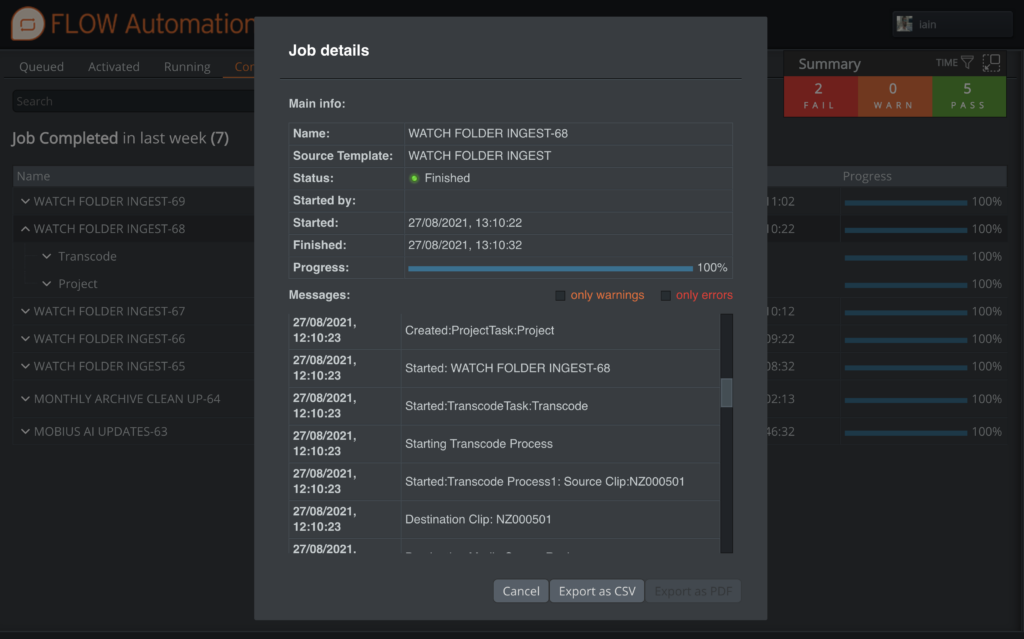
Easily track automated processes
2 – Prepare Bins Online
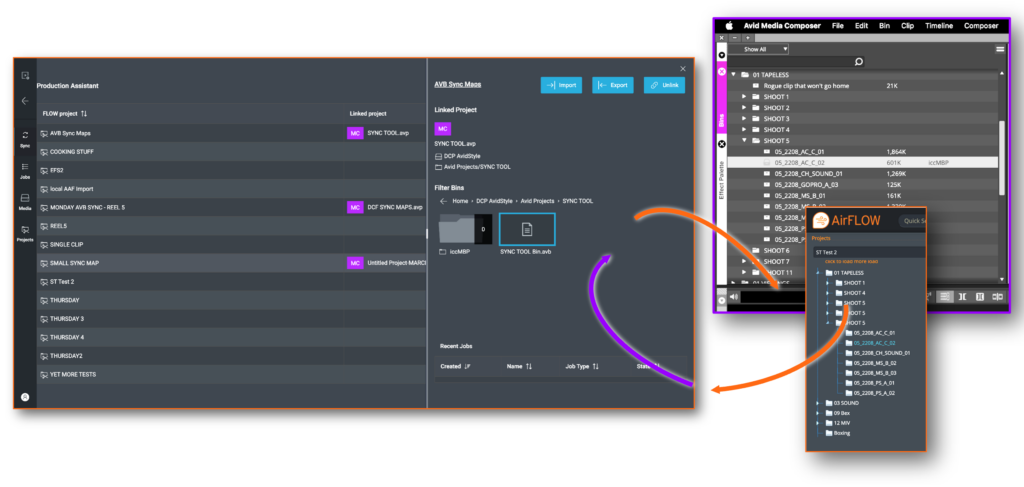
You can set up the bin structure before you get to the Avid workstation too. A core part of the Universal Projects software in FLOW is that it allows you to work from a central view of a project inside of FLOW and then synchronize that project to a range of editing systems, including Media Composer.
Working in a web browser, you can go through all the input material and organize it into logical structures such as folders for rushes, subclips and shot lists. This can be supported by automation when you need it, for example creating rules to create bins per day, to organize by metadata such as tape/scene information or even write a rule to ignore any clip that is less than three seconds long (or whatever duration you think is likely to be unusable).
Assistant editors, directors and producers can work collaboratively to review the dailies and only offer the editor the preferred takes. Once ready, all the work can be automatically synchronized into Media Composer bin files.
By doing all this in FLOW, it means you are transferring less material to the editing workstation, with all the bins set up and populated for the editor to start the creative work immediately.
Sync between FLOW and Media Composer respecting bin locking
3 – Work From Anywhere
The ingest processing, as well as storing the raw footage and transcoding to the house edit format, can also generate proxies, at a maximum bitrate determined by you. Proxies make it practical to view the content, in real-time, from anywhere with a web browser and a reasonable internet connection, on any device.
The producer and director might be on location but can still review dailies in exactly the same way that they used to, as soon as the content is ingested, rather than waiting for large files (or rush prints) to be delivered. The post facility could carry out automated sorting, the director could choose the best takes (on an iPad), and the edit assistant could set up and load the bin structure, all at the same time, from different locations.
Again, the key point here is that editors and edit suites are expensive entities and overheads for production teams. You want as much of their time as possible to be devoted to telling the story, and not wrangling data and waiting for timely transfers. This is a real boost to productivity.
4 – Bin Locking Support
Media Composer users will be familiar with the collaborative features available when using shared storage systems.
Bin locking is central to the Media Composer way of working, which allows users to share bins and projects, but provides a secure locking mechanism to ensure only one person is working on a file at a time. EditShare EFS supports this locking through AvidStyle spaces, allowing users to work with a familiar workflow whilst taking advantage of the other features of EFS and FLOW.
When using FLOW Universal Projects, bin locking is respected by FLOW itself when it updates bins, ensuring users don’t lose their work. Working in combination with the Avid Attic location, history of bin changes is retained as well, so if you ever need to go back to a previous version of a bin, it’s there for you.
5 – Review, Grade and Deliver Anywhere
Once you have completed the edit and rendered the output to the house master format, the next stage involves sending the file back to EditShare FLOW, where it is ingested and given its new identity and metadata.
At that point, a fresh proxy is generated. Everyone who is entitled to review the finished cut can then log in to view it and make comments, from anywhere and on anything that supports a web browser.
The project file is then ready to be transferred across to the colorist. If you grade on DaVinci Resolve, it will appear with all the project information, thanks to EditShare’s Universal Projects. If you are a Baselight post house, then you can mount the EditShare storage network as a source and directly access the file.
Once the project has been graded and signed off, you can leave the creation of all the deliverables to the automated processes in FLOW to handle. Again, it saves using an expensive and in-demand edit suite to do vital but uncreative and repetitive transcoding and rendering tasks.
At EditShare, the goal is to help you create amazing everywhere. I hope these tips help you get the best out of your post production resources by using the powerful intelligence in the combination of EFS and FLOW.
For more information on how you can optimize your Media Composer workflows, click here to get started.
I’m spending 2022 making up for lost time.
After a few years sitting in front of a screen on seemingly endless Zoom calls, I’ve spent most of this year in airplanes, on the road, and in front of partners and clients. And after a few particularly busy weeks of travel, I finally took a moment to look back on our first in-person IBC show in three years.
Like any good trade show, this year’s IBC was exciting, eye-opening, exhausting, and a little indulgent all at the same time. We won’t talk about the lines at Schiphol trying to leave Amsterdam! After some reflection, I wanted to share a short summary of what I took away from IBC, in one word, one theme, and one feeling.
One Word: Optimism
The only thing that people on planet earth do more than consuming video is working and sleeping and people are watching more video than ever before, and that trend is creating big opportunities for our creative clients. However, if you look across the economic climate, there’s a lot of heaviness out there too. The specter of a potential recession, a rising interest rate environment, and armed conflicts around the world are creating a lot of concern, and the need for many in our industry to do more with less. Despite that turmoil, I saw example after example at IBC of technology solving problems that enable creators to bring compelling content to subscribers faster and more efficiently. I see a real opportunity for our industry to come together and partner across our environment to solve the hard problems that need solving. Business models are changing from perpetual to recurring models. The industry is moving towards the cloud. As an industry, we need more innovation, more automation, and more simplification. Maybe this is an unpopular opinion, but I’m also hoping to see a little less of vendors beating down on price and more examples of innovation that helps creators do what they’re really great at: Making more cool movies, TV, and content.
Maybe this is a stretch of the concept of optimism, but I can’t tell you how good it felt to connect with people I’ve only had a chance to meet with virtually, and how much I’m looking forward to doing more of it in 2023. More than once I found myself closing a conversation on the floor with a handshake and a “good to see you again”, only to realize (or, on a few occasions, to be politely reminded) that I had only ever met the person over Zoom. Some of these folks have been customers of EditShare for multiple years now, and we are having our first in person introductions. So many of us still have so much catching up to do.
Our week in Amsterdam reminded me how much I’m looking forward to more of those connections later this year. For those of you joining us at NAB New York, or our channel partner training programs in Watertown, Basingstoke, and Thailand, I look forward to seeing you in November!
One Theme: A more flexible approach to Cloud
Cloud has been a hot topic for our channel partners and customers for some time now. But this year’s conversation around Cloud is noticeably different when compared to a few years ago. The conversation has shifted from “should we move to the cloud” or “I’m never going to the cloud” or “I just don’t get the cloud” to “I’m in the cloud” or “I need to know you can take me to the cloud when I’m ready” or “I don’t believe in the cloud, but… convince me because I might be wrong”.
At our last in-person IBC show in 2019, I remember a lot of “in or out” cloud conversations. Our industry was conceptualizing the cloud at that time as a full commitment, “either-or” proposition. You either kept everything local, or you moved it all into the cloud. There was no middle ground. That’s not the case anymore. Even the language people use to talk about the cloud is changing. The stuff we labeled “cloud” before is now much more likely to be referred to as “hybrid workflows.”
That’s a small shift, but almost everyone on our team noticed it. As we debriefed the show and discussed the changing perspectives on the cloud, the word that kept coming up was “flexibility.” Creative teams have different appetites, different needs, and are starting from different places as they consider how to equip their people. Some of our best conversations at IBC centered on how creators can make the “right first move to the cloud”, and helping our customers diagnose where they are and what they’re ready for in their cloud journey. My biggest takeaway? There’s no one right answer. Teams can and should take a flexible approach. But flexible approaches can also be daunting – there are so many options to consider. Having a framework to lean on sure seems to help. We have some good thinking to share here. Our CTO, Stephen Tallamy, will also be sharing some of his evolving point of view on a more flexible journey to the cloud in an upcoming IBC recap, and I encourage you to keep an eye out for that in a few weeks.
One Feeling: Pride
I walked out of IBC feeling proud. Proud of what our product can do, proud of what we’ve accomplished this year, but most of all, proud of the people on our team.
I won’t lie. I like to win. After being awarded a technical Emmy this spring, EditShare took home a Best of Show award for our Universal Projects approach at IBC. The team was elated. Being recognized for innovating in a room full of innovators is the kind of recognition you hope for in this industry. It’s validation for all the work we’ve done to translate what we hear from our customers into how our products work and what we choose to build next. It felt great.
But like I said, our win isn’t what I’m most proud of. What makes me most proud is simply how our team showed up. Every company out there talks about culture. But anybody who visited the EditShare booth got to experience ours and feel just how special our team is. They got to see firsthand how EditShare’s core values make this not only a great place to work, but also how they inform our product decisions and corporate strategy, and how they help us simplify storytelling for hundreds of clients around the world. We dig deep. We are all around athletes. We have deep customer empathy. We are humble. We win together. We’re EditShare. We are excited and optimistic about today and the future.
We’re looking forward to seeing many of you as we continue the [tradeshow tour] in Q4 and into 2023. In the meantime, don’t hesitate to drop us a line if there’s anything we can do – or if you’d like to hear more of what’s standing out for us so far this year.
Hope to see you soon.
Cloud-ready network forms bedrock of major new investment program
Boston, MA, September 21, 2022 – EditShare®, the technology leader that enables storytellers to create and manage collaborative media workflows, has supplied a FLOW asset management system to Brazilian production company Fabrika. The powerful new facilities are central to Fabrika’s bold plans to move into major productions and its own OTT streaming channel.
As well as producing its own content, Fabrika also provides the content storage facilities for the Office of the Presidency of the Republic of Brazil. With this, the company made the decision to invest in its own asset management facilities, as early as 2007.
With a shift in business model towards commercial production as well as long-form television, and plans for OTT services, Fabrika recognized the need for powerful new facilities and turned to systems integration company CIS Group and EditShare’s FLOW to help fulfil this requirement. Its first channel, the education-focused Cientik, will be launched in September 2022.
“We needed a new asset management platform, with more agility and good integration with cloud solutions,” said José Luiz Nogueira, Partner and Founder of Fabrika. “CIS has been our consultant and partner for many years, and we turned to them to support us in defining our requirements and the purchase decision.”
“CIS works regularly with EditShare, and when we tested their FLOW asset management system it was clearly the best choice for Fabrika,” added Nogueira. “It is a high performance, scalable solution, and it offers a complete orchestration of workflows and work processes. CIS and EditShare could point to successful deployments around the world, and we were very confident they could meet our requirements.”
The new installation at Fabrika is built on the EFS300 storage nodes, with FLOW asset management software tuned to the requirements of post-production workflows. It was installed by CIS in August and is now in use across all of Fabrika’s departments.
“What we have delivered to Fabrika is a compact and cost-effective solution that allows them to catalog, browse, collaborate, edit and archive, all from a single layer of user interface,” commended Said Bacho, Chief Revenue Officer at EditShare. “It is more than just asset management: it provides the complete post production ecosystem, allowing users to edit from wherever they are.”
Ricardo Freitas, Service Account Manager at CIS Group, stated, “As admirers and partners of Fabrika for quite some time, and on multiple fronts, we were well-equipped to understand Fabrika’s unique requirements, and operational preferences. Upon defining priorities and use cases, we were able to architect a solution, leveraging the capabilities of EditShare FLOW, in order to provide Fabrika with an ideal tool for their content management, editorial, and archiving needs in a secure, reliable, and scalable manner. With these workflows, Fabrika’s producers and editors will be enabled to create more content quicker, driving operational efficiencies by decreasing overall time-to-delivery”.
EditShare is a technology leader that enables collaborative media workflows on-premise, in the cloud, or in a hybrid configuration. With customer and partner success at the heart of EditShare’s core values, our open software solutions and robust APIs improve workflow collaboration and third-party integrations across the entire production chain, ensuring a world-class experience that is second to none. The high-performance software lineup includes media optimized shared storage management, archiving and backup, and media management, all supported with open APIs for extensible integration.
EditShare’s cloud-enabled remote editing and project management technology was recently recognized by the National Academy of Television Arts and Sciences (NATAS) with a prestigious 2021 Emmy® Award for Technology and Engineering.
About CIS Group
Established in 1988, CIS Group’s history includes a lot of evolution as a result of the team’s desire and ability to always stay ahead of the curve. CIS Group’s mission is to continue to be a true digital media solutions integrator to serve the content production market. Covering both Brazil and the United States extensively, CIS is considered a reference in the systems integration space as a result of its specializations in content production & post-production, solutions for broadcast & news, workflows for asset management systems, acquisition, shared storage, media services, graphics and multiplatform distribution on-premises or in the cloud. Headquartered in Davie, FL, CIS has offices and field presences in Brazil (Rio de Janeiro and São Paulo); Boston, MA; and Charlotte, NC, serving markets globally.
While it is definitely a hot topic at the moment, at EditShare we have been helping users create and operate successful cloud solutions for many years.
Those early adopters, and the many who have followed, tend to be organizations who are reasonably cloud-savvy. They are comfortable using EditShare FLEX Cloud Edit software, alongside tools like the Adobe® Creative Cloud suite and Teradici for remote desktop control.
To make the best use of the cloud for post-production, you have to be able to manage the processes and optimize post-production storage. The much-lauded advantage of the cloud is that you only pay for the computing power you use, so you have to be able to rapidly spin up instances as you need them, and equally quickly release them when you are finished.
Some organizations will have the detailed cloud knowledge to be able to implement their own management layer. For teams without this knowledge, we now offer FLEX Cloud Edit+. Essentially, Edit+ takes over the detail of the cloud management so you don’t have to get into its depths.
FLEX Cloud Edit has been around for a number of years, and gives post facilities the ability to edit in the cloud using their preferred software, including Adobe, Apple, Avid, Autodesk, DaVinci and more. What FLEX Cloud Edit+ adds is workstation management capabilities, and integrated file transfer acceleration.
As we are talking to customers, one of the biggest areas of concern about cloud migration is how to get the material up and down from cloud video storage. When you are dealing with the very large files of professional video, it is natural to see transfers as a potential major bottleneck.
To solve this, we have partnered with Data Expedition, a specialist in accelerated communication. Its product CloudDat can push data transfers up to 5 gigabits a second on a single instance, and instances can be stacked when exceptionally high performance is required. The EditShare integration allows for direct upload to FLEX storage for online use or to Amazon S3 for archive or to use with EditShare’s Seamless Proxy Editing feature.
This file acceleration is bundled into a turnkey system and it works out of the box. It also fits into the cloud philosophy in that you pay for it only while you use it: the license is by connected time.
The second major challenge is management of the cloud workstation environment to reduce costs and overheads for management. FLEX Cloud Edit+ integrates the HP Teradici Cloud Access Manager (CAM) to handle the management layer.
As an administrator of the system, the Cloud Access Manager allows you to allocate users to workstations, giving the flexibility to choose from allocating one user to one workstation, through to allowing all users access to a pool of workstations (or any combination between). From the end user perspective, they simply use the standard PC over IP client to connect to the CAM. Once authenticated, the user will be shown the list of workstations they have access to, which workstations are in use and the ability to remotely start a workstation if it is powered off. Not only does this simplify the user experience, it provides significant cost savings – you are only charged for the workstation whilst it is powered on.
FLEX Cloud Edit+ has built-in Active Directory management to support single log-in credentials for all users and functions, which can be used stand-alone or connected to existing Active Directories.
In summary, EditShare has worked with two other industry leaders, HP Teradici and Data Expedition, to build an integrated solution to cloud editing for users who do not want to get into the details of AWS administration. It is a seamless, turnkey experience: a fast on-ramp to the cloud for those businesses who would rather focus on their core creative skills.