In my last blog, I introduced the thinking behind our new workflow management layer, EditShare One. If you have not read that yet, you can find it here. In this blog I’ll explain how it is used in a real-world production.
Footage is shot, in a studio or on location. Those files are ingested into the shared storage, along with the metadata. That may include information from a production assistant on set, about good or bad takes and other details.
Depending on the nature of the production, a producer or director may want to make another decision on preferred takes, or an edit assistant will need to build bins making it clear to the editor which is likely to be the best material.
The editor then cuts the scene and hands it on for review. That may lead to rework later, or the scene may be locked ready for final assembly and finishing. In parallel, the sound designer will be mixing and sweetening the audio to match the cut.
The producer will be monitoring progress at all times and will be commenting on scenes as they are cut, giving notes to the editor and sound designer. The final cut will be passed to the colorist, and again the producer and director will make comments on the grade.
There may be other people taking note of the progress too. For marketing, there may be a second editorial team creating trailers and teasers, for example. Where an independent company is making programmes for a broadcaster, the executive producer will want to check progress.
The huge advantage of collaborative file-based workflows is that every stage is non-destructive. You can go back and tweak any stage of the post production until everyone is happy, because all of the material is still available in the shared storage.
EditShare One and the Produce Tool provide access to the material throughout the process. There is a single sign-on to all the content and metadata, but each user has different requirements, and will be presented with different tools, different media and metadata, and different capabilities.
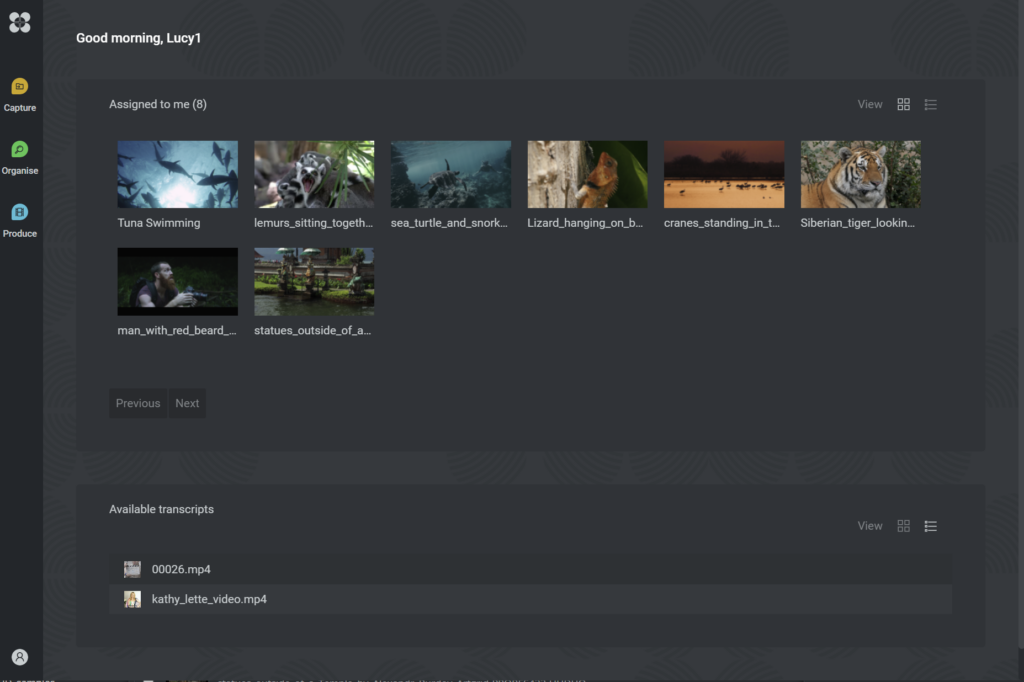
A producer could be alerted to new cuts that need to be reviewed and signed off. The user interface would simply offer the new material, a player, and a text tool for comments. No need to know how the underlying technology works, or even where the content is at that moment: just focus on the job at hand.
More generally, the Produce tool is a simple dashboard that saves time and potential confusion in searching through media spaces and folders. It is completely independent of all the other tools, so users simply see what is relevant to them.
For the editor, the EditShare One intuitive interface appears as a panel within the edit software itself. Editors are, of course, free to choose whichever software package works best for them, but within the Adobe or DaVinci user interface is a panel or integration tool which is linked to EditShare FLOW asset management and its management tools.
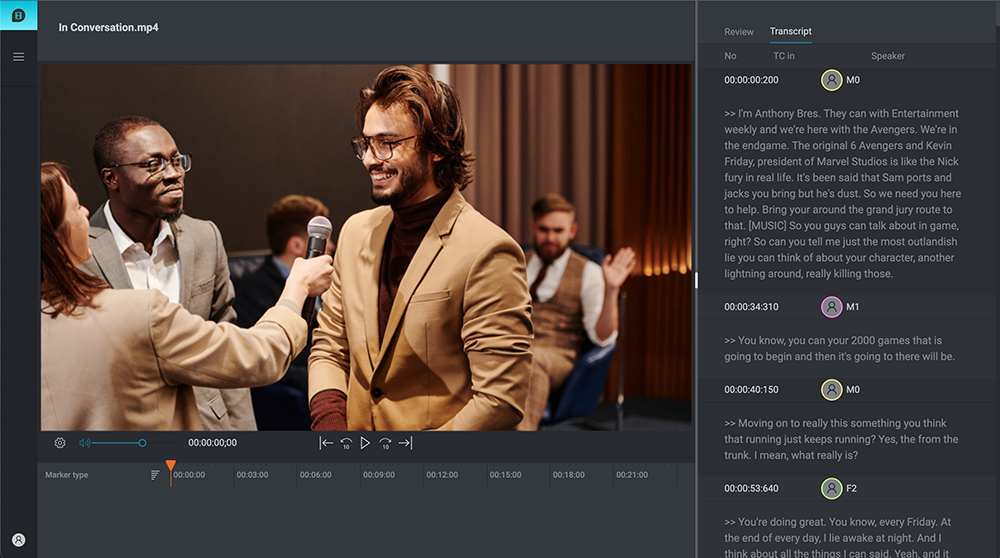
Producers can highlight interest points in transcriptions through EditShare One’s web-based UI, which editors can then import using the FLOW panel. Services, like AI speech-to-text transcriptions, can also be seen in the FLOW panel to speed up work even further. This automated process creates rough cuts or integrates selected clips into Adobe Premiere sequences, enhancing overall efficiency in the editing process.
Once the sequence or program is completed, the same simple user interface exports it as new material in the shared storage and drives it to other EditShare One users who need to see it.
The goal is to make it simple to create and expedite collaborative workflows, wherever the individuals are, by offering just the functionality and material each needs, at the time they need it. By simplifying everyone’s working environment, more time is available to concentrate on making great content.
Production workflows have become way more complicated than they used to for all sorts of reasons, but there are ways to keep the complexity under control.
The move from film or tape to files has had the incidental effect of massively increasing shooting ratios. It is simply easier to do more takes with more cameras, and keep them all, when they are “just” digital files.
It wasn’t that long ago when holiday-makers had to take one or maybe two rolls of 36-exposure film on a vacation and carefully choose the moments they wanted to capture. Now our cameras and phones get filled with hundreds, maybe thousands of pictures which we later need to sort out. The same has happened for the movie and television industry.
While shooting ratios have gone up, timescales have often been reduced. The goal is to get from set to screen as quickly as possible, especially to start recouping production costs.
More material; less time. We have to find a better way to work.
Many production workflows are still rooted in old, linear methods. Which is understandable: if you are trying to complete a project, then having proven and comfortable practices can be very reassuring. But it is definitely time to rethink the way we work.
The idea of having a central place for all the assets that make up a production is not new. All the material comes into a single server, and everyone who needs to access it can log in. Completed work gets written back to the same server, making the process convenient and streamlined.
This is great. But the challenge is that this “single server” might actually be a distributed set of storage nodes, on location, in a post house, at the production company, or in the cloud. The system that is tracking all the material needs a single database that covers all these locations.
Also, the content might come in different formats: the camera resolution (and there may be more than one camera type); the edit format (perhaps with a proxy for remote editing); and the delivery packages. Metadata needs to track not only formats and resolutions, but also the points at which value judgements are applied: quality control; editorial decisions.
But our main goal is to create the best possible television programme or movie, which means everyone, at every stage, needs to devote their energies on their part of the production without getting bogged down in the complexities of the underlying media management system.
The goal, then, is to have a high functionality, agile storage infrastructure that can handle multiple formats (and converting between them), is geographically diverse, and can manage metadata. That is exactly what EditShare FLOW was designed for.
But on top of that you need a simple, intuitive, role-appropriate user interface, so that each person in the creative team sees the information and content they need: no more; no less.
That is why we have developed EditShare One: the next generation of workflow management. One single sign-on; one place for capture, edit, review and deliver; one platform for production collaboration.
What makes this possible is a single user interface concept that is infinitely customizable. Every user has their own dashboard, showing them just the content and features they need. These dashboards are dynamic, so tasks can be assigned as needed, with all resources available.
We think EditShare One is a transformative leap forward in workflow management. It makes collaborative production environments practical and productive, and leaves creative people free to get on with creative tasks.
In my next blog I’ll look at a typical workflow, using the Produce Tool within EditShare One.
All-in-one storage and asset management package for leading Brazilian broadcaster
Boston, MA, October 26, 2023 – EditShare®, the technology leader that enables storytellers to create and manage collaborative media workflows, has provided an EFS 300 storage node to TV Cultura. The system was negotiated, supported and installed by EditShare’s Brazilian partner, CIS Group.
TV Cultura is a very highly regarded public television network, based in São Paulo in Brazil. Part of the Fundação Padre Anchieta (Father Anchieta Foundation) and funded by the regional government, it focuses on educational and cultural subjects, but also produces and broadcasts sport and entertainment.
The production requirements of a new programme demanded collaborative workflows, with multiple users accessing the same project for editing with Adobe Premiere Pro. TV Cultura needed to provide comprehensive and secure production asset management, along with supporting direct editing on the storage device.
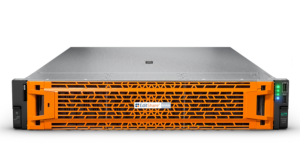
The EditShare EFS 300 is a compact, all-in-one storage appliance that provides high capacity storage – 128 TB in this installation – with transparent access for Windows, MacOS and Linux clients, and integrated production asset management software. In a 2U cabinet it holds 16 enterprise-grade disk drives, fully protected through RAID-6, and hot-swappable from the front. Storage can be increased at any time, either by fitting larger-capacity drives or by adding further nodes.
“We needed to create a new environment, where we could organize and categorize the media as well as provide secure storage,” said Nelson Faria, Director of Engineering at TV Cultura. “The key challenge was for a large production team to be able to work on the same project simultaneously: editors, colorists, graphics and producers. “The EditShare solution allows us to connect workstations and storage on a single network,” Faria said. “Users are still working in the software they are familiar with, but now have access to the organized material they need to finish the programmes quickly and accurately.”
Felipe Andrade, VP of Sales for EditShare’s Brazilian channel partner CIS Group, added “The application at TV Cultura is a perfect match for the EditShare design philosophy. We were able to demonstrate clearly how simple it is to integrate EFS storage, FLOW asset management and third-party tools like Premiere Pro. And, of course, we have a support team based in São Paulo so we were able to quickly configure and install the storage device, and provide training and guidance on workflows.”
“We are delighted to partner with CIS Group to provide TV Cultura with a storage and asset management solution that will enable them to collaborate more effectively and continue to produce high-quality content.” commented Said Bacho, Chief Revenue Officer at EditShare. “CIS Group has a deep understanding of the Brazilian market and has been instrumental in helping us to provide TV Cultura with the best possible solution. This partnership underscores our commitment to the Latin American market, ensuring that our innovative solutions continue to empower media professionals in this key region.”
The new storage and asset management system at TV Cultura went online in August 2023.
EditShare is a technology leader that enables collaborative media workflows on-premise, in the cloud, or in a hybrid configuration. With customer and partner success at the heart of EditShare’s core values, our open software solutions and robust APIs improve workflow collaboration and third-party integrations across the entire production chain, ensuring a world-class experience that is second to none. The high-performance software lineup includes media optimized shared storage management, archiving and backup, and media management, all supported with open APIs for extensible integration.
EditShare’s cloud-enabled remote editing and project management technology was recently recognized by the National Academy of Television Arts and Sciences (NATAS) with a prestigious 2021 Emmy® Award for Technology and Engineering.
About CIS Group
Since 1988, CIS Group has been a Media Technology solutions provider & systems integrator with core competencies across the professional services spectrum. Over the years our scope has evolved to include: Consulting & Workflow Design, Integration, Full System Commissioning & Installation, Technical & Operational Training, Maintenance & Support, DevOps, and Managed Services. Focused exclusively on the MediaTech space, CIS has delivered countless solutions aimed at a variety of use cases throughout the Content Supply Chain – including live production, post-production, archiving, and distribution. In relying on CIS’s expertise, our clients have been able to outsource a lot of their technical challenges, and focus their energy and resources on how the technology we implement ultimately delivers business value and creative value to their organizations. Enabling our customers to achieve their desired business goals and operational goals by effectively implementing our solutions is what we mean when we say that customer success is in our DNA. Learn more at www.cisgroup.tv
Broadcasters have been hard at work tackling the challenges of what the newsroom of tomorrow will look like. As broadcasters face the challenge of competition from social media, it’s become critical to look for new ways to collaborate remotely. There’s a tension between tried-and-tested workflows and the need for greater efficiency that comes through new technologies.
What are some of the key challenges facing broadcasters in this new era?
Cross-collaboration between industries
Dave Hoffman, business development manager for the Americas at Blackmagic Design, noted, “Broadcasters are starting to implement tools and techniques from cinema workflows like different effects and lenses, while production companies are implementing gear from the live streaming side, like switchers and routers, for multi-camera scripted shoots and virtual production.” Practically speaking, this means that film teams are broadcasting, and broadcasters are moving into cinematography. These changes bring new tools, skills and workflows to both sides of the equation.
Professional sports leagues are using more large sensor cameras to produce more cinematic images. Gimbals are showing up on the sidelines. Some shooters are experimenting with photo lenses and face-detection autofocus on cinema cameras. Mobile bonding wireless technology makes it possible to record in the cloud as well as in the camera itself.
Cinematographers who are used to working on images with a colorist in post now need to apply those grades on set as it is streamed to clients and producers around the world. Broadcast camera operators are embracing new kinds of optics, focus systems, and lighting demands. Learning new skills is always fun, but it can also be challenging when you are an expert in one discipline and a novice in another.
The great thing about this cross-collaboration is an openness to new tools and techniques on both sides of production and post. Production teams are streaming right from their cameras and post teams are incorporating new tools to accommodate new workflows.
Those new workflows produce a vast array of assets. Some platforms need widescreen deliverables, and some need vertical. Sometimes, you need to have captions delivered in a separate file, and sometimes, they need to be overlaid onto the video itself. And each of these variations needs to be reviewed and approved by multiple parties before they ship.
Asset management for multi-platform broadcasters
Broadcasters are no longer targeting a single medium. The increase in delivery platforms and the worldwide syndication of media means that the average video has to be delivered in multiple versions. Not only are numerous formats required, but each piece of media might have to be tailored to a geographical area, a demographic and a platform.
For example, All Elite Wrestling needs different specs for every show in every location and region. Pay-per-view, international partners, and in-arena LED assets are all different. With at least a dozen assets per talent and close to 200 wrestlers in their roster, it’s a lot.
All these assets need to be created, ingested, grouped, reviewed, revised, and approved. That’s where cloud-based tools like MediaSilo can really streamline workflows. Editors working in a shared environment now have the tools they need to work the way they want to and provide secure, reliable review/approval and presentation links.
A good example of this NLE agnostic approach in MediaSilo is integrations. If you use Adobe Premiere or DaVinci Resolve, you can install a panel right in your NLE. You can sync feedback on both platforms with MediaSilo so that your producers, directors and editors are always in the loop. If one collaborator is using Dropbox and another is Google Drive, MediaSilo can integrate with both (and others) so that you can avoid the hassle of uploading, downloading and transferring between multiple systems.
When you have hundreds or thousands of files, it’s important for your team to know how to find the right ones at the right time. Metadata tagging is a great way to keep track of assets and simplify searching. In addition to plaintext tags, you can now create categories like location, director, and client. Set your categories and tags and quickly find files with the advanced search and filters on every page.
Simplifying collaboration between broadcast production pros
Collaboration tools ought to respect the preferences of the creative teams while facilitating work with freelancers using other tools. For instance, some editors use Adobe, and many editors are adopting DaVinci Resolve for more than just the color grade. MediaSilo has panels for both of them. This “NLE agnostic” approach defines the workflow of MediaSilo. Users can choose to work on the operating system or NLE of their choice while working with others on a different system. Each team member has different needs, so it is important that collaboration tools support the whole team.
However, the challenge to unifying different tools is in tracking, versioning and securing your data. And there are really two sides to that coin. There are assets to track during production and post-production, and there is the versioning and secure presentation of assets during the review and approval process. MediaSilo takes care of both. You can see when someone has viewed a video, where they were viewing it from, and how much they watched.
Security is another major component. In the broadcast world, it’s essential to prevent leaks. Broadcasters want to be the first to break a story. SafeStream is MediaSilo’s powerful security technology. It applies visible and forensic watermarking. This means leaks can be tracked to their source, and potential leakers will think twice before sharing their work before it is ready for release.
Conclusion
With cross-pollination and collaboration between industries becoming so prevalent, new opportunities are abounding. The organizations that can marshall their forces to embrace change instead of resisting it will win in this ever-changing landscape. But the key factor in managing that change will be keeping people in the loop and on the same team. Collaboration tools like MediaSilo go a long way to bridging the gaps between remote teams scattered throughout countries and time zones. They help to deliver the flexibility that creatives need and the consistency that business demands.
MediaSilo allows for easy management of your media files, seamless collaboration for critical feedback, and out-of-the-box synchronization with your timeline for efficient changes. See how MediaSilo is powering modern post-production workflows with a 14-day free trial.
Reuben Evans is a director, an award-winning screenwriter, and a member of the Producers Guild of America. As the former executive producer at Faithlife TV, he produced and directed numerous documentaries and commercials. Reuben’s tools of choice are RED Cameras, Final Cut Pro, and DaVinci Resolve.
Just when you think everything is going well with your team’s project and the finish line is in sight, here comes the curveball. Someone was left out of the loop, or a senior executive gets surprised by a deliverable. The team scrambles to make last-minute changes and push back deadlines. Creative professionals know this can be discouraging. How can we improve our review and approval processes to ensure all stakeholders are included?
We all know that sometimes the approval process isn’t smooth. We’ll examine strategies for handling “curveball” feedback. So, let’s take a look at some specific, concrete steps that we can take along the way to give us the best chance at a smooth review and approval process.
Craft a solid brief
When you work with an agency, we may or may not deal directly with the client. But it is still our responsibility to ensure that the brief answers all of the key questions about the deliverable. Who is the audience? Where will this be seen? What are the goals of the campaign? What is the voice and personality of the brand? Getting as much information about the client’s goals as possible is critical to a successful end product. Here’s a great guide to crafting a brief.
Identify key stakeholders
It’s not uncommon for the task of creating a commercial to be handled by a Marketing VP or another higher-up. But sometimes, not everyone who needs to be involved is actually involved. Nobody wants to make the mistake of leaving out a CEO (who likes to be involved with everything) until the last minute. People who safeguard the brand visually and narratively must be all involved.
Another category of individual to consider is the “domain expert.” Companies often have individuals who really get the “heart” of the product and understand the customer’s desires. They might be in sales or even in product development. Getting those “domain experts” on your side can be vital to getting the final deliverable right.
A common decision-making framework is known as the DACI model. Each letter presents a key participant in the production and review process:
Driver: This individual doesn’t have sign-off authority, but they are responsible for moving the project forward.
Approver: You might have more than one approver. Usually, there is a chain of authority that needs to sign off. But overall, it is best to try to avoid having too many cooks in the kitchen.
Contributors: These individual contributors bring their talents to the table and help get the various aspects of the project done.
Informed: By keeping key people across the organization in the loop, you’ll avoid hearing “why wasn’t I consulted.”
MediaSilo delivers an environment for the members of a DACI team to collaborate. For instance, versioning helps to identify which export of a video a particular note applied to. And then, you can see how it was addressed in a subsequent revision.
Collaborate on the concept
When the stroke of genius hits you, and you draft that fantastic concept, view it as a rough draft. Sometimes, it’s hard not to be precious about a concept that works together on every level. So make sure your script and storyboard make the rounds to everyone who could kill it later. Help people to feel like they are a part of the process and that they are heard. This step will set you up for a successful review and approval process once the cameras have stopped rolling.
Work through legal and clearance issues
Keep in mind that your client may need to have their legal counsel provide input before and after you film your spot. Music and location clearances need to be in place to protect the company. And they will want to make sure that nothing in the piece could create unnecessary legal risk. It is key that the concept not rely on an element that might get struck down by a company’s internal legal team.
Gather broad internal feedback
When reviewing elements and deliverables, I like the saying, “Show your work early and often.” It can be scary to send out incomplete work, but platforms like MediaSilo provide a great way to get feedback at critical stages without slowing down the creative process. This way, the agency and client can feel like they have a handle on the process, and you can ensure buy-in along the way. Even then, it can still be tough to know who needs to see what at which stage. But getting early work in front of people can head off headaches. It also builds trust because it demonstrates a level of vulnerability. And your creative team will instantly know when you need to make course corrections.
This step is also where the presentation features of MediaSilo can make a big difference. When the work is presented online or in person, all distractions must be eliminated. It’s a key moment to control the messaging and ensure the work gets presented in the best light possible.
Handling creative differences
Inevitably, creative differences arise. These are the “curveballs” we’re talking about. It’s the director’s job to work through the client’s feedback and figure out ways to make them happy while still realizing the creative vision. This moment is where it can be really helpful to gain feedback from various sources so that there is a balance to offset the feedback from one influential individual. One executive may have a strong objection to a particular element, but if other voices like it, those voices can help soften the blow. As daunting as it may seem, gaining feedback from as many voices as necessary is ultimately helpful to get the deliverable across the finish line.
Avoiding defensiveness is key when hearing feedback. The temptation to defend the work is always present, but it is more effective to take notes, and give a little time to try to get to the core of the objection. When you are in the moment and receiving pushback, your stress level rises, and it is hard to think clearly and respond well. Sleeping on feedback is honestly one of the best methods for processing it. Take some time to process it, gain input from other voices, and allow for creative solutions to present themselves after a night of sleep.
Curveball feedback can yield even better work than originally planned. Sometimes, that feedback reveals a weakness in the spot, even if the person giving the feedback could have been more precise in articulating the exact problem. When people try to explain what they feel in their gut, there is often a significant disconnect, but there is still something real there. An experienced storyteller can digest that feedback and uncover the real reason a piece isn’t working. That insight can yield new creative solutions that fix those underlying problems.
Focus groups can help
Once your commercial is “finished,” a helpful step can be to get feedback from people outside of the process. Sometimes, we are so “head down” in the work that we miss obvious things. So, feedback from internal focus groups or even beta testers of software products can point out things that we would miss. It’s important to hold this feedback loosely, but it can also be illuminating.
When feedback from focus groups is obtained, it is important to consider their similarity to your main audience. For instance, sometimes, the hardest core fans of a particular product do not represent the majority of the customers of that product.
Final sign off
When it is time for the finished piece to make rounds, ensure everyone gets included again. The two critical junctures for broad approval are the storyboards and the final sign-off before shipping. Hopefully, the rounds of internal feedback have helped finesse the deliverable to perfection. However, it is still worth asking, “Has everyone who needs to see it had eyes on the final version?”
Conclusion
Keeping everybody in the loop can be challenging with the best of plans. That’s why it’s critical to have tools like MediaSilo that reduce the friction and help keep everyone in sync. See those curveballs coming, and the team will hit them out of the park. And that’s the kind of teamwork that leads to repeat clients, happy teams, and creatively fulfilling work for all involved
MediaSilo allows for easy management of your media files, seamless collaboration for critical feedback, and out-of-the-box synchronization with your timeline for efficient changes. See how MediaSilo is powering modern post-production workflows with a 14-day free trial.
Reuben Evans is a director, an award-winning screenwriter, and a member of the Producers Guild of America. As the former executive producer at Faithlife TV, he produced and directed numerous documentaries and commercials. Reuben’s tools of choice are RED Cameras, Final Cut Pro, and DaVinci Resolve.
My first few weeks as CEO, EditShare’s vision, and the evolving role of AI
Towards the end of the show, a few folks asked me to sum up how it felt to see our team in action so soon after joining the company. The word I chose was “inspired.” I’ve come to appreciate the rich legacy of empowering storytellers that EditShare upholds, and seeing first-hand our team, products, and plan-of-attack coming together at such an important event, it’s hard not to feel wildly optimistic about what the future holds.
Where AI Is Headed
IBC 2023 also brought with it more and more conversation around the most compelling trend in our space today: the emergence of AI. In particular, we noticed an explosion of smaller AI-enabled companies aiming to streamline critical workflows within the content creation processes, from video editing to transcription and beyond. However, there’s a common challenge – harmonizing those workflows within one intuitive interface. I’m proud to say this is an area where EditShare is positioned to shine with the introduction of our new solution, EditShare One, which we unveiled at IBC 2023.
EditShare One, Transcription View
It’s been fun to hear the early feedback from customers and partners who have had a chance to see what EditShare One can do. We heard from more than a few people how useful the AI-integrated Transcription View will be to their producers – and the seamless integration we’ve built through FLOW into Premier Pro and Resolve also stood out at the show.
At EditShare, we’ve already made waves in post-production with innovations like Universal Projects, which lets teams work with whichever editing software they prefer. We’re pushing that idea of openness even further with EditShare One. My commitment to our customers is to keep building products that meet them where they are, and helping them balance the tension that comes with creating exceptional content within tight, demanding timelines. EditShare One is a natural next step in delivering on that promise, and we can’t wait to get it into the hands of more of our customers.
A Powerful Combination
As I look at our combined portfolio of products, I’m especially thrilled about the integration of the MediaSilo product into the EditShare ecosystem. We built MediaSilo to bridge the gap between creatives and non-creatives. It provides a platform where content can be effortlessly shared, organized, reviewed, and approved, unsticking collaboration between teams, with the security features such as watermarking and DRM to provide confidence that when media is shared, it is only being shared to the right eyes and ears.
This merger not only bolsters our commitment to providing comprehensive solutions but also opens up new horizons for creative professionals and organizations seeking to streamline their media workflows. It’s an exciting chapter in EditShare’s journey, and one I’m so excited to help shape in my first few months as CEO.
Thanks to everyone who stopped by to see us at IBC, and looking forward to meeting many more of you before we close out 2023.
Ramu Potarazu
EditShare®, a technology leader that enables storytellers to create and manage collaborative media workflows, today announced it has entered into a definitive agreement to merge with Shift Media, a leading cloud-native video solution provider that helps creators manage, present, and collaborate on their high value projects. The combined business will operate as EditShare, with Shift Media’s well-known products – MediaSilo, Wiredrive, and Screeners.com – folding under the EditShare corporate brand.
Over the past several years, video creation has continued to accelerate in myriad industries globally, including entertainment, advertising, corporate communications, higher education, house of worship, and many more. Corresponding with this increase in content production, an explosion in video technology has occurred, leaving video professionals with an ever-growing, complicated stack of tools and vendors to integrate to get their jobs done effectively. The combination of EditShare and Shift Media will deliver a comprehensive, open solution that enables creative teams and content creators to seamlessly store, edit, collaborate, and share their content, whether they choose to work on-premise, in the cloud, or with a hybrid solution.
EditShare’s high-performance workflow focused product suite includes EFS media optimized shared storage and FLOW intelligent media management. In 2022, the company launched EditShare FLEX built on AWS, ensuring professional production and post companies can build remote and collaborative workflows that suit their creative and commercial needs.
Shift Media’s cloud-native, software-as-a-service solutions include MediaSilo, Wiredrive and Screeners.com. MediaSilo provides a video collaboration HQ, helping the biggest names in media get projects approved faster. Wiredrive helps commercial production companies and agencies quickly and easily create custom pitch materials and showreels. Screeners.com provides the industry standard virtual screening experience for press review and sales opportunities of high value pre-release content.
Ramu Potarazu, Shift Media’s CEO, will lead the combined company under the EditShare banner following the close of the transaction; current EditShare CEO Conrad Clemson will leave the business to pursue other opportunities. “The tireless work of Conrad and the EditShare team has put us in a position of strength for the future,” Potarazu said. “Shift Media was built on the principle that video workflow technology should be completely intuitive and customer friendly. EditShare and Shift Media are highly complementary businesses with market leading products and services and shared commitment to putting the power of video production in the hands of creators. As a combined company, we will create a one-stop shop with a more comprehensive range of products and global network of channel partners, enabling us to better meet our customer needs around the world.”
“Our two companies have very strong businesses and powerful product offerings,” said Stephen Tallamy, CTO of EditShare. “Together, we will be better positioned to deliver a powerful, comprehensive, and intuitive content management and collaboration offering to the broad middle market, which is where most of the industry sits.”
ParkerGale Capital and Marlin Equity Partners, previous backers of EditShare and Shift, respectively, will maintain their positions as primary investors and board members of the combined company. “I’m excited that Marlin Equity Partners and ParkerGale will continue to support the business,” said Potarazu. “Together, we are aligned on delivering cutting edge solutions in response to the stratospheric growth in video production and continued move towards flexible, collaborative on-premise, hybrid, and cloud workflows.”
For more information on all EditShare solutions, please visit the website at www.editshare.com. Information on MediaSilo, Wiredrive, and Screeners.com can be found at www.shiftmedia.io.
MediaSilo allows for easy management of your media files, seamless collaboration for critical feedback, and out-of-the-box synchronization with your timeline for efficient changes. See how MediaSilo is powering modern post-production workflows with a 14-day free trial.
EditShare EFS Swift Link for seamless remote editing and connectivity
Whether you’re in post or finishing, flexibility and remote collaboration have become more critical than ever. Thanks to the pandemic, we have got completely used to the idea of directing a live production or finishing an edit on the kitchen table.
At Editshare, we have always had remote workflows integrated via our AirFLOW application. In fact we won an IBC Innovation Award for this all the way back in 2016. Thanks to continuous development, we have advanced still further the simplification of working from anywhere.
Whether you’re a filmmaker, video editor, or content creator, the ability to work remotely on your favorite craft editor while staying connected to your enterprise shared storage system is truly a game-changer. We want the same creativity whether we are in the facility or working remotely, using whatever tool is best for the job and the team.
This is where EFS Swift Link steps in, revolutionizing the way creative post professionals work. In this blog post, I’ll discuss how one of the latest features of the upcoming EditShare technology release – which includes Swift Link – can enhance any post production workflow, enabling anyone to work from anywhere: simply, with full creative control, and without downloading any media.
The Remote Editing Challenge
Traditionally, post work required everyone to be physically present in the confines of the facility. Today, for a whole host of reasons including tightening deadlines, client demands and the life/work balance expectations of valued staff, remote collaboration is a necessity.
The challenge lies in providing editors and creatives with the same experience they would have in-house, even when they are miles away from the facility. In some instances we have seen editors moving and operating out of different countries.
Enter EFS Swift Link
EFS Swift Link bridges the gap between remote editing and centralized EditShare EFS storage systems – be they on-prem or in the cloud.
Simply and transparently, the EFS client adapts to the network conditions of individual workstations allowing users to maintain a strong connection to the storage network. We’ve been testing this across our offices on different continents, from our homes to the office and even to the cloud and we are impressed by how simple yet powerful it is.
Wherever you are, it gives you access to both proxies and high-resolution media, so you have the resources you need to work efficiently. That depends on understanding the capacity and quality of the data connection between the remote workstation and base, so one of the standout features of EFS Swift Link is its ability to detect network latency automatically.
You don’t need to be a networking expert to optimize the connection: Swift Link does it for you. Performance is consistently good, even on high-latency connections.
And it does this without forcing individual users to change the hardware, the software and the workflows they are used to. No need to invest in new computers or change the way you work, Swift Link seamlessly integrates with your current setup.
How Swift Link Works
The user-friendly interface of EditShare Connect makes it easy to connect to remote EditShare systems. It simplifies the process, eliminating the need for complex configurations. Just get connected to your network and VPN service and the client will do the rest for you.
Once connected, EFS Swift Link uses its automatic latency detection to optimize the connection. Regardless of your location or network conditions, the system adjusts to ensure you experience minimal disruptions and maximum performance.
And of course Swift Link supports multiple locations, so you can design the collaborative workflows you need with team members spread across different locations. Editors can work on the same project simultaneously, review each other’s work, and provide feedback in real time, just as if they were in the same room. All the standard features of EFS are still available, including bin locking, auditing and consistent drive letter naming.
Benefits
Remote collaborative workflows are the goal for many. With EFS Swift Link editors and content creators can work from anywhere, giving them the freedom to choose their working environment, without compromising on functionality, familiarity and collaboration. The result is faster project completion and improved creativity.
It is also the cost-effective solution. Everyone retains their existing equipment and workflows, so there are no costly upgrades, and there is no downtime to learn new tools and workflows, and no resistance to being forced away from the familiar. If an editor is most comfortable in Media Composer (or Adobe Premiere Pro, or Da Vinci Resolve) then use it, embedded in the EditShare Solution.
Performance is boosted. The automatic latency detection ensures that users media transfers are optimized, even on high-latency connections. And security is maintained, thanks to the integrated data protection systems and the permissions structure.
Remote working is fast becoming the new normal, EFS Swift Link is the lifeline for post production professionals.
EditShare adds to AWS expertise after recently joining the AWS ISV Accelerate program
Boston, MA – August 24, 2023– EditShare®, the technology leader that enables storytellers to create and manage collaborative media workflows, continues to demonstrate the strength of its offering in cloud and hybrid solutions, with large numbers of successful client systems in use. This continuing success has led EditShare to achieve Amazon Web Service (AWS) Media & Entertainment Competency status.
EditShare joined the AWS Independent Software Vendor (ISV) Accelerate Program a year ago, which affirmed its success in delivering practical cloud storage solutions. Achieving AWS Media & Entertainment Competency status further solidifies that the company follows architectural and operational best practices, is being actively used by customers in product environments, and customers advocate for the solution.
“This is another great accolade for our technical and applications teams,” said Stephen Tallamy, CTO of EditShare. “What it tells potential users is that we will deliver a solution that meets their operational requirements, makes optimal use of the cloud environment, and will be secure and resilient. With EditShare FLEX, our award-winning cloud technology, has reached a new level of maturity and adoption of media workflows that unlock the benefits of AWS services and applications tailored for media professionals,” Tallamy continued. “Post houses, production companies, broadcasters and creative agencies have realized that, by combining on premises and cloud technology, they can deliver real value to their clients and into their programs, while achieving operational savings through remote working and distributed workflows.
“This additional recognition from AWS means we are at the cutting edge of cloud and hybrid systems architecture. We look forward to continued growth in delivered systems around the world, and an ever-strengthening bond with our colleagues and peers at AWS,” said Tallamy.
The AWS Media & Entertainment Competency designation is the way to differentiate AWS Partners that have engineered their solutions and demonstrated the ability to deploy and operationalize these solutions repeatedly, at scale. Finally, and most importantly, they have a list of customers that have successfully deployed the solution on AWS.
AWS is enabling scalable, flexible, and cost-effective solutions from startups to global enterprises. To support the seamless integration and deployment of these solutions, AWS established the AWS Competency Program to help customers identify AWS Partners with deep industry experience and expertise.
EditShare will be showcasing it’s FLEX Cloud Solutions at the upcoming IBC Exhibition in Amsterdam, Hall 7, Booth A35 and also on the AWS booth Hall 5, Booth C90.
EditShare is a technology leader that enables collaborative media workflows on-premise, in the cloud, or in a hybrid configuration. With customer and partner success at the heart of EditShare’s core values, our open software solutions and robust APIs improve workflow collaboration and third-party integrations across the entire production chain, ensuring a world-class experience that is second to none. The high-performance software lineup includes media optimized shared storage management, archiving and backup, and media management, all supported with open APIs for extensible integration.
EditShare’s cloud-enabled remote editing and project management technology was recently recognized by the National Academy of Television Arts and Sciences (NATAS) with a prestigious 2021 Emmy® Award for Technology and Engineering.
EFS storage solutions now include NVMe; Swift Link increases throughput tenfold
Boston, MA – August 16, 2023 – EditShare®, the technology leader that enables storytellers to create and manage collaborative media workflows, will launch a significant raft of technology upgrades and new functionality at IBC2023 (Stand 7.A35, 15-18 September). In addition to the new user interface, EditShare One, announced in July, the company is adding NVMe capabilities to provide ultimate performance in intensive workloads, and Swift Link, bringing up to 10x improvement in performance between remote workstations and EFS systems that are located on-prem or in FLEX cloud environments.
Large and busy facilities place heavy demands on storage systems, particularly when content is in demand by multiple users. To provide a very high performance cache in this sort of environment, EditShare now offers the ability to use NVMe (non-volatile memory express) solid-state storage.
Based on the latest Gen11 platform from HPE, the NVMe module has 24 drives per node, with user-selectable capacities. EFS supports multiple nodes, so users are free to construct the storage architecture that best meets their business and productivity requirements. This new platform gives systems architects extremely high levels of performance, without sacrificing the protection and reliability that is central to the EditShare approach.
Users now routinely expect EFS storage architectures that bridge multiple facilities and link to the cloud, but also provide access from remote locations and for creators working at home. Swift Link provides a massive speed boost for remote clients connecting over a VPN or other high latency connection – boosting throughput by as much as 10 times.
Users at home or on a remote location connected via VPN can preview and edit both proxies and high-res media, just by using EditShare Connect, with built-in Swift Link and its automatic latency detection. EFS optimises the connection around the network latency, delivering much more flexibility for remote users without changing the equipment they use or the way they work. The user doesn’t need to know that they are on a high-latency connection, EditShare Connect will determine that for them and make adjustments accordingly.
EditShare continues to achieve the highest possible security levels. The new release now ships with Ubuntu 2020, and is beginning to introduce SAML (security assertion markup language) within the SSO (single sign-on) authentication for externally-facing FLOW applications. Together, these provide practical and very effective protection against cyber-security attacks.
“Our goal is always to make it easy for creative people to produce their best work,” said Sunil Mudholkar, VP Product Management at EditShare. “But alongside the practical tools, we recognize the ongoing need to enhance the underlying technology to ensure that we deliver industry-defining levels of performance, reliability, and security. Our rolling program of software upgrades allows us to consistently improve our offering, and at IBC we will showcase new functionality like NVMe and Swift Link, while also being available to discuss future enhancements and security boosts.”
Demonstrations of EditShare’s proven storage solutions and workflow software can be seen at IBC2023, on stand 7.A35. Click here to book a demo or a meeting with us at the show.
EditShare is a technology leader that enables collaborative media workflows on-premise, in the cloud, or in a hybrid configuration. With customer and partner success at the heart of EditShare’s core values, our open software solutions and robust APIs improve workflow collaboration and third-party integrations across the entire production chain, ensuring a world-class experience that is second to none. The high-performance software lineup includes media optimized shared storage management, archiving and backup, and media management, all supported with open APIs for extensible integration.
EditShare’s cloud-enabled remote editing and project management technology was recently recognized by the National Academy of Television Arts and Sciences (NATAS) with a prestigious 2021 Emmy® Award for Technology and Engineering.