Can Technology Boost Engagement in Sports Programming?
In an earlier blog, EditShare CTO Stephen Tallamy looked at five top tips for remote editing using Adobe Premiere Pro. Avid Media Composer remains an industry standard and is still hugely popular, so here are five cool takeaways for improving your workflow by using it with EditShare.
1 – Automate Transcodes
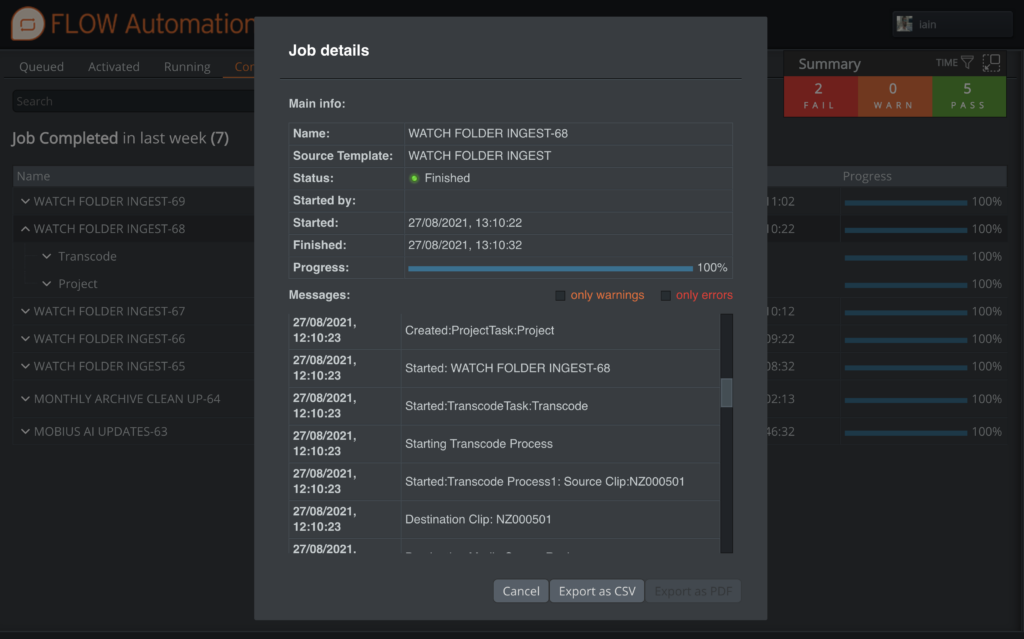
EditShare FLOW does a lot more than metadata management. It allows you to offload routine tasks to avoid using up edit workstations for things that can be better done elsewhere.
Use FLOW for ingest, whether from a delivered file or direct from the camera cards. You can store the raw footage, and at the same time prepare the content in the MXF Op-Atom wrapper that is a native format for Media Composer managed media.
FLOW supports all the latest versions of raw formats, and as well as rewrapping, you can transcode to the house codec, which might be DNxHD, or XDCam, or whatever you choose.
Easily track automated processes
2 – Prepare Bins Online
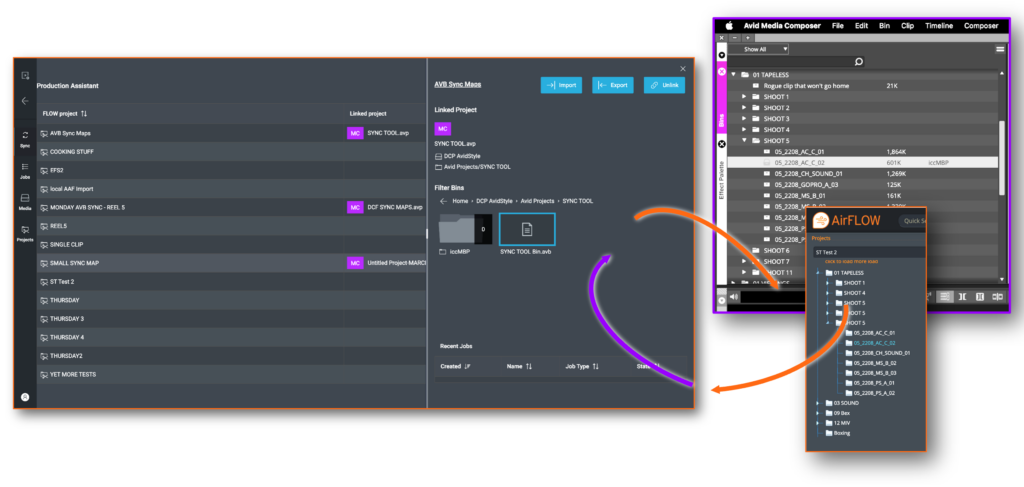
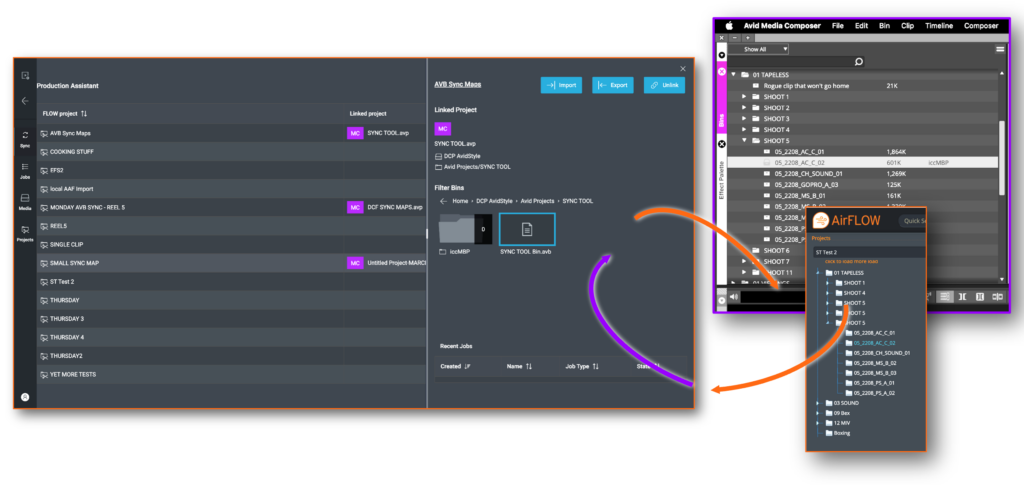
You can set up the bin structure before you get to the Avid workstation too. A core part of the Universal Projects software in FLOW is that it allows you to work from a central view of a project inside of FLOW and then synchronize that project to a range of editing systems, including Media Composer.
Working in a web browser, you can go through all the input material and organize it into logical structures such as folders for rushes, subclips and shot lists. This can be supported by automation when you need it, for example creating rules to create bins per day, to organize by metadata such as tape/scene information or even write a rule to ignore any clip that is less than three seconds long (or whatever duration you think is likely to be unusable).
Assistant editors, directors and producers can work collaboratively to review the dailies and only offer the editor the preferred takes. Once ready, all the work can be automatically synchronized into Media Composer bin files.
By doing all this in FLOW, it means you are transferring less material to the editing workstation, with all the bins set up and populated for the editor to start the creative work immediately.
Sync between FLOW and Media Composer respecting bin locking
3 – Work From Anywhere
The ingest processing, as well as storing the raw footage and transcoding to the house edit format, can also generate proxies, at a maximum bitrate determined by you. Proxies make it practical to view the content, in real-time, from anywhere with a web browser and a reasonable internet connection, on any device.
The producer and director might be on location but can still review dailies in exactly the same way that they used to, as soon as the content is ingested, rather than waiting for large files (or rush prints) to be delivered. The post facility could carry out automated sorting, the director could choose the best takes (on an iPad), and the edit assistant could set up and load the bin structure, all at the same time, from different locations.
Again, the key point here is that editors and edit suites are expensive entities and overheads for production teams. You want as much of their time as possible to be devoted to telling the story, and not wrangling data and waiting for timely transfers. This is a real boost to productivity.
4 – Bin Locking Support
Media Composer users will be familiar with the collaborative features available when using shared storage systems.
Bin locking is central to the Media Composer way of working, which allows users to share bins and projects, but provides a secure locking mechanism to ensure only one person is working on a file at a time. EditShare EFS supports this locking through AvidStyle spaces, allowing users to work with a familiar workflow whilst taking advantage of the other features of EFS and FLOW.
When using FLOW Universal Projects, bin locking is respected by FLOW itself when it updates bins, ensuring users don’t lose their work. Working in combination with the Avid Attic location, history of bin changes is retained as well, so if you ever need to go back to a previous version of a bin, it’s there for you.
5 – Review, Grade and Deliver Anywhere
Once you have completed the edit and rendered the output to the house master format, the next stage involves sending the file back to EditShare FLOW, where it is ingested and given its new identity and metadata.
At that point, a fresh proxy is generated. Everyone who is entitled to review the finished cut can then log in to view it and make comments, from anywhere and on anything that supports a web browser.
The project file is then ready to be transferred across to the colorist. If you grade on DaVinci Resolve, it will appear with all the project information, thanks to EditShare’s Universal Projects. If you are a Baselight post house, then you can mount the EditShare storage network as a source and directly access the file.
Once the project has been graded and signed off, you can leave the creation of all the deliverables to the automated processes in FLOW to handle. Again, it saves using an expensive and in-demand edit suite to do vital but uncreative and repetitive transcoding and rendering tasks.
At EditShare, the goal is to help you create amazing everywhere. I hope these tips help you get the best out of your post production resources by using the powerful intelligence in the combination of EFS and FLOW.
For more information on how you can optimize your Media Composer workflows, click here to get started.
I’m spending 2022 making up for lost time.
After a few years sitting in front of a screen on seemingly endless Zoom calls, I’ve spent most of this year in airplanes, on the road, and in front of partners and clients. And after a few particularly busy weeks of travel, I finally took a moment to look back on our first in-person IBC show in three years.
Like any good trade show, this year’s IBC was exciting, eye-opening, exhausting, and a little indulgent all at the same time. We won’t talk about the lines at Schiphol trying to leave Amsterdam! After some reflection, I wanted to share a short summary of what I took away from IBC, in one word, one theme, and one feeling.
One Word: Optimism
The only thing that people on planet earth do more than consuming video is working and sleeping and people are watching more video than ever before, and that trend is creating big opportunities for our creative clients. However, if you look across the economic climate, there’s a lot of heaviness out there too. The specter of a potential recession, a rising interest rate environment, and armed conflicts around the world are creating a lot of concern, and the need for many in our industry to do more with less. Despite that turmoil, I saw example after example at IBC of technology solving problems that enable creators to bring compelling content to subscribers faster and more efficiently. I see a real opportunity for our industry to come together and partner across our environment to solve the hard problems that need solving. Business models are changing from perpetual to recurring models. The industry is moving towards the cloud. As an industry, we need more innovation, more automation, and more simplification. Maybe this is an unpopular opinion, but I’m also hoping to see a little less of vendors beating down on price and more examples of innovation that helps creators do what they’re really great at: Making more cool movies, TV, and content.
Maybe this is a stretch of the concept of optimism, but I can’t tell you how good it felt to connect with people I’ve only had a chance to meet with virtually, and how much I’m looking forward to doing more of it in 2023. More than once I found myself closing a conversation on the floor with a handshake and a “good to see you again”, only to realize (or, on a few occasions, to be politely reminded) that I had only ever met the person over Zoom. Some of these folks have been customers of EditShare for multiple years now, and we are having our first in person introductions. So many of us still have so much catching up to do.
Our week in Amsterdam reminded me how much I’m looking forward to more of those connections later this year. For those of you joining us at NAB New York, or our channel partner training programs in Watertown, Basingstoke, and Thailand, I look forward to seeing you in November!
One Theme: A more flexible approach to Cloud
Cloud has been a hot topic for our channel partners and customers for some time now. But this year’s conversation around Cloud is noticeably different when compared to a few years ago. The conversation has shifted from “should we move to the cloud” or “I’m never going to the cloud” or “I just don’t get the cloud” to “I’m in the cloud” or “I need to know you can take me to the cloud when I’m ready” or “I don’t believe in the cloud, but… convince me because I might be wrong”.
At our last in-person IBC show in 2019, I remember a lot of “in or out” cloud conversations. Our industry was conceptualizing the cloud at that time as a full commitment, “either-or” proposition. You either kept everything local, or you moved it all into the cloud. There was no middle ground. That’s not the case anymore. Even the language people use to talk about the cloud is changing. The stuff we labeled “cloud” before is now much more likely to be referred to as “hybrid workflows.”
That’s a small shift, but almost everyone on our team noticed it. As we debriefed the show and discussed the changing perspectives on the cloud, the word that kept coming up was “flexibility.” Creative teams have different appetites, different needs, and are starting from different places as they consider how to equip their people. Some of our best conversations at IBC centered on how creators can make the “right first move to the cloud”, and helping our customers diagnose where they are and what they’re ready for in their cloud journey. My biggest takeaway? There’s no one right answer. Teams can and should take a flexible approach. But flexible approaches can also be daunting – there are so many options to consider. Having a framework to lean on sure seems to help. We have some good thinking to share here. Our CTO, Stephen Tallamy, will also be sharing some of his evolving point of view on a more flexible journey to the cloud in an upcoming IBC recap, and I encourage you to keep an eye out for that in a few weeks.
One Feeling: Pride
I walked out of IBC feeling proud. Proud of what our product can do, proud of what we’ve accomplished this year, but most of all, proud of the people on our team.
I won’t lie. I like to win. After being awarded a technical Emmy this spring, EditShare took home a Best of Show award for our Universal Projects approach at IBC. The team was elated. Being recognized for innovating in a room full of innovators is the kind of recognition you hope for in this industry. It’s validation for all the work we’ve done to translate what we hear from our customers into how our products work and what we choose to build next. It felt great.
But like I said, our win isn’t what I’m most proud of. What makes me most proud is simply how our team showed up. Every company out there talks about culture. But anybody who visited the EditShare booth got to experience ours and feel just how special our team is. They got to see firsthand how EditShare’s core values make this not only a great place to work, but also how they inform our product decisions and corporate strategy, and how they help us simplify storytelling for hundreds of clients around the world. We dig deep. We are all around athletes. We have deep customer empathy. We are humble. We win together. We’re EditShare. We are excited and optimistic about today and the future.
We’re looking forward to seeing many of you as we continue the [tradeshow tour] in Q4 and into 2023. In the meantime, don’t hesitate to drop us a line if there’s anything we can do – or if you’d like to hear more of what’s standing out for us so far this year.
Hope to see you soon.
While it is definitely a hot topic at the moment, at EditShare we have been helping users create and operate successful cloud solutions for many years.
Those early adopters, and the many who have followed, tend to be organizations who are reasonably cloud-savvy. They are comfortable using EditShare FLEX Cloud Edit software, alongside tools like the Adobe® Creative Cloud suite and Teradici for remote desktop control.
To make the best use of the cloud for post-production, you have to be able to manage the processes and optimize post-production storage. The much-lauded advantage of the cloud is that you only pay for the computing power you use, so you have to be able to rapidly spin up instances as you need them, and equally quickly release them when you are finished.
Some organizations will have the detailed cloud knowledge to be able to implement their own management layer. For teams without this knowledge, we now offer FLEX Cloud Edit+. Essentially, Edit+ takes over the detail of the cloud management so you don’t have to get into its depths.
FLEX Cloud Edit has been around for a number of years, and gives post facilities the ability to edit in the cloud using their preferred software, including Adobe, Apple, Avid, Autodesk, DaVinci and more. What FLEX Cloud Edit+ adds is workstation management capabilities, and integrated file transfer acceleration.
As we are talking to customers, one of the biggest areas of concern about cloud migration is how to get the material up and down from cloud video storage. When you are dealing with the very large files of professional video, it is natural to see transfers as a potential major bottleneck.
To solve this, we have partnered with Data Expedition, a specialist in accelerated communication. Its product CloudDat can push data transfers up to 5 gigabits a second on a single instance, and instances can be stacked when exceptionally high performance is required. The EditShare integration allows for direct upload to FLEX storage for online use or to Amazon S3 for archive or to use with EditShare’s Seamless Proxy Editing feature.
This file acceleration is bundled into a turnkey system and it works out of the box. It also fits into the cloud philosophy in that you pay for it only while you use it: the license is by connected time.
The second major challenge is management of the cloud workstation environment to reduce costs and overheads for management. FLEX Cloud Edit+ integrates the HP Teradici Cloud Access Manager (CAM) to handle the management layer.
As an administrator of the system, the Cloud Access Manager allows you to allocate users to workstations, giving the flexibility to choose from allocating one user to one workstation, through to allowing all users access to a pool of workstations (or any combination between). From the end user perspective, they simply use the standard PC over IP client to connect to the CAM. Once authenticated, the user will be shown the list of workstations they have access to, which workstations are in use and the ability to remotely start a workstation if it is powered off. Not only does this simplify the user experience, it provides significant cost savings – you are only charged for the workstation whilst it is powered on.
FLEX Cloud Edit+ has built-in Active Directory management to support single log-in credentials for all users and functions, which can be used stand-alone or connected to existing Active Directories.
In summary, EditShare has worked with two other industry leaders, HP Teradici and Data Expedition, to build an integrated solution to cloud editing for users who do not want to get into the details of AWS administration. It is a seamless, turnkey experience: a fast on-ramp to the cloud for those businesses who would rather focus on their core creative skills.
Co-sell partnership strengthens bond with cloud market leader
Boston, MA – August 24, 2022 – EditShare®, the technology leader that enables storytellers to create and manage collaborative media workflows, announced it has joined the Amazon Web Services (AWS) Independent Software Vendor (ISV) Accelerate Program, a co-sell program for AWS Partners that provides software solutions that run on or integrate with AWS. The program helps AWS Partners drive new business by directly connecting participating ISVs with the AWS Sales organization.
Members of the AWS ISV Accelerate program are held to the industry’s highest standards and must undergo a comprehensive architectural and security evaluation to gain acceptance into the program. Proof of customer excellence was also reviewed to validate the successes EditShare customers have achieved across industry verticals. EditShare has an excellent track record in integrating cloud video storage into practical solutions which are used by media organizations from national broadcasters to boutique post houses. In turn, this makes it a proven partner for the AWS Partner Network (APN) Customer Engagement Program.
“More and more media industry leaders are making the transition towards cloud and hybrid production workflows, because they support new ways of engaging with creative talents as well as providing the resilience and security of business continuity,” commented Said Bacho, chief revenue officer at EditShare. “The AWS ISV Accelerate Program gives us another route to provide our FLEX cloud storage and asset management applications to AWS customers.”
“Participation in the AWS ISV Accelerate program is more than just signing a form,” Bacho added. “A company is invited to join when it has demonstrated both the technical strength of the solutions and their relevance in the ecosystem, through multiple sales and significant revenues. This is an important accolade for the EditShare platform, and we are proud to be a part of this program.” EditShare’s cloud and hybrid technologies for storage and workflow can be seen at IBC2022 on stand 7.A35.
EditShare is a technology leader that enables collaborative media workflows on-premise, in the cloud, or in a hybrid configuration. With customer and partner success at the heart of EditShare’s core values, our open software solutions and robust APIs improve workflow collaboration and third-party integrations across the entire production chain, ensuring a world-class experience that is second to none. The high-performance software lineup includes media optimized shared storage management, archiving and backup, and media management, all supported with open APIs for extensible integration.
EditShare’s cloud-enabled remote editing and project management technology was recently recognized by the National Academy of Television Arts and Sciences (NATAS) with a prestigious 2021 Emmy® Award for Technology and Engineering.
Storage and asset management for broadcast and post facilities
Boston, MA – July 26, 2022 – EditShare®, the technology leader that enables storytellers to create and manage collaborative media workflows, is exhibiting alongside its local partner CIS Group at SET Expo 2022 (22 – 25 August, Expo Center Norte São Paulo, stand 81). The company will present a demonstration of integrated post production workflows supporting multiple edit software systems.
EditShare’s robust and reliable tools used by content creators around the world include its EFS networked shared storage and FLOW workflow and media asset management system, that easily integrate with leading editorial tools such as Adobe® Premiere® Pro and DaVinci Resolve. Through a partnership with AWS, EditShare also offers a seamless route to cloud and hybrid architectures for scalable, remote operation and storage protection applications.
On the EditShare demonstration area at SET Expo will be an EFS300 storage node running the FLOW workflow software. FLOW’s practical tools allow users, locally and remote, not only to access their content on the shared storage, but to edit using any of the popular edit platforms. FLOW even synchronizes between the platforms, allowing users to move between edit users. The workflow also provides browse resolution proxies, allowing remote editing even over modest internet connections.
“FLOW is a proven, simple and flexible set of workflow tools,” said Cristiano Barbieri, EditShare regional sales director LATAM. “Users can catalog, browse, collaborate, edit, archive and manage all assets from a single layer user interface. It is the perfect partner for the high performance EFS storage appliances.”
Visit EditShare on the CIS Group stand 81 at SET Expo 2022. For more information on EditShare solutions, please click here to get in touch.
About EditShare
EditShare is a technology leader that enables collaborative media workflows on-premise, in the cloud, or in a hybrid configuration. With customer and partner success at the heart of EditShare’s core values, our open software solutions and robust APIs improve workflow collaboration and third-party integrations across the entire production chain, ensuring a world-class experience that is second to none. The high-performance software lineup includes media optimized shared storage management, archiving and backup, and media management, all supported with open APIs for extensible integration.
EditShare’s cloud-enabled remote editing and project management technology was recently recognized by the National Academy of Television Arts and Sciences (NATAS) with a prestigious 2021 Emmy® Award for Technology and Engineering.
There is no right or wrong way to post produce a project: there is no right or wrong software package for each part of the process. How you choose to complete the work is down to a number of factors, not least individual preferences.
Except that for most organizations, they are locked into a specific toolset because that is the only way they can move projects around and work collaboratively. Everyone using the same suite of software applications may limit the operators, but it means projects can be (reasonably) seamlessly exchanged.
At EditShare we wanted to take a fresh approach to this. Our users told us that it would be great to have more flexibility. This is why we created Universal Projects, which allows you to move between platforms as easily as possible.
The idea is that you can start a project in any tool – including EditShare FLOW to set up bins and even rough cuts – and work in any other.
In the real world it may be unlikely that a single project will be worked on by multiple editors each using different NLEs, so you might ask why we have devoted our development efforts to this. But there are real-world use cases.
Imagine, for instance, working on an episodic series at an Avid post house. During the edit, the production company or broadcaster needs to start on the marketing campaign, and the in-house trailer editor prefers Premiere Pro. Having to go back to the raw footage and start the search for clips from scratch is clearly not an economic option. Being able to look into the programme edit, browse bins for each episode, and with key moments tagged by the producer, saves days of effort and leads to a much better result. When the pressure is always on to deliver things faster, this is a big benefit.
The idea of being able to share projects between platforms is sound. What does it mean in practice? Inevitably, there are differences between platforms.
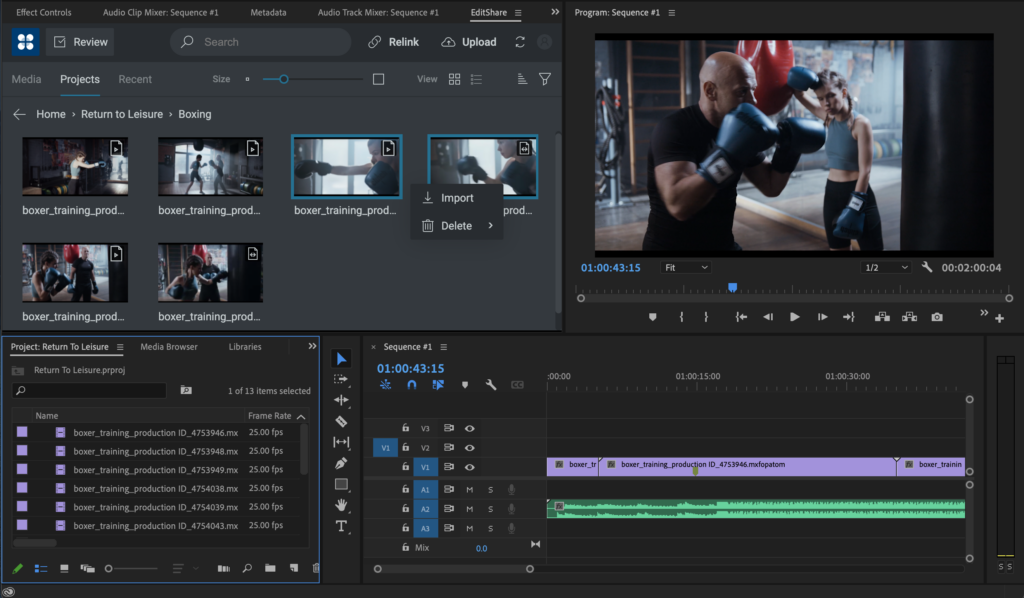
FLOW is the EditShare media management platform. In 2021 we introduced FLOW Panels – plug-ins – for Adobe® Premiere® Pro and for DaVinci Resolve, which were very well received. The Panels provide a means of accessing FLOW media management from within the familiar editor user interface.
FLOW panel connected directly into the Adobe® Premiere® Pro UI
More importantly, it is a simple means to swap bin structures, content, and all the metadata around the edit. Where it can, this is all maintained completely automatically. So you can create a project structure in advance in FLOW and have it pop up ready when you log in to your editor. If you add bins or sub-divide timelines or make any other structural changes, these are immediately reflected back into FLOW, and are available to any other user who logs in.
Avid Media Composer takes a slightly different approach and lacks the simple hooks for tight, cross-platform integration. But it would not be a very valuable cross-platform integration if it did not include Avid. So we have now brought Media Composer under the Universal Projects umbrella.
We think we are pioneering the universal projects concept. We are certainly the first to be able to integrate Avid technology and workflows into cross-platform collaborations.
Our implementation respects Media Composer’s way of working, like locking bins when a user has logged into a project. To allow it to be always available to other collaborative users, we implemented a routine that automatically generates a copy of the structure which is then reconciled again when the original user logs out or publishes.
This works in conjunction with the Avid Attic, so projects are backed up both here and in FLOW, ensuring each user can always access the history of a project as well as the latest version.
In effect, EditShare FLOW appears as another user in the Media Composer environment. It becomes a very powerful edit assistant, either manually through other portals into FLOW or automatically.
Sync between FLOW and Media Composer respecting bin locking
The original Universal Projects links are already available; the complete system including Media Composer integration is currently in advanced beta trials with a number of organizations from boutique post houses to major national broadcasters.
Whatever the application, it gives you an overview of every project and a means of planning and optimizing workflows. As a side benefit, it also helps engineers plan for future expansion, showing where the bottlenecks are in projects, and facilitating data-lead decisions about where to optimize workflows.
Ultimately, it is part of the new metadata revolution, whereby a strong, common, resilient set of information is used to drive complex workflows and automated processes from the camera to the screen.
Want to find out more? See it in action at IBC, book a meeting or a demo here, or request a follow-up
Originally driven by the need to move to remote workflows during the pandemic, Mallinson Sadler Productions worked with Tyrell Cloud to keep their editing teams working during Covid and beyond
Automated workflows, quality control and archiving at the center of its Amsterdam show
Boston, MA – July 26, 2022 – EditShare®, the technology leader that enables storytellers to create and manage collaborative media workflows, will use IBC2022 (Amsterdam RAI, 9-12 September, stand 7.A35) to showcase how its latest technologies boost quality and efficiency for production and post production. Demonstrations will show how remote working and the cloud can interwork to give creative artists seamless and secure access to the tools they rely on.
Central to this is the ability to use EditShare post-production storage spaces and FLOW workflow tools to synchronize projects across the popular NLE platforms, including Media Composer, Adobe® Premiere® Pro and DaVinci Resolve. The latest release of core FLOW media asset management system allows complex projects to be moved as needed between EditShare media management and whichever edit environment the creative team needs to use.
Having its first showing in Amsterdam will be the latest suite of EditShareFLEX software solutions for out-of-the-box cloud and hybrid workflows. FLEX reflects the powerful business trends in post today, including the migration to a “work anywhere” environment, with ready access to content wherever the creative staff need to be. In adopting video cloud storage and processing, it also meets the move towards an OpEx financial model, with the cloud hosting and storage fees flexing to reflect the level of business.
“The post industry is changing, in part reflecting the changes enforced by the pandemic, and in part because creative talent is looking to shift the work/life balance,” comments Said Bacho, Chief Revenue Officer at EditShare. “What we now present is an eco-system where editors and other post artists can choose their preferred tools, and work where they like, when they like, without it in any way compromising their creativity or limiting the quality, even as we move to 4k and higher resolutions, and to HDR.”
EditShare’s EFS Multi-Site will also be on the booth for the first time this IBC. Multi-Site allows users with multiple locations to leverage built-in file acceleration to synchronize project storage between EFS clusters in different facilities. This ensures that users have ready access to content, wherever they choose to work. FLEX Cloud Sync extends the capabilities of Multi-Site to cloud storage, providing added flexibility in access as well as security in archiving.
For news and sports fast turnaround editing, FLOW supports direct ingest of NDI contribution feeds for immediate editing. Working in conjunction with the Helmut orchestration platform from MoovIT, IBC will see demonstrations of practical high-pressure editing operations linking EditShare storage with Adobe software.
Content security and availability is vital to professional users, and EditShare has added new hardware and software in this area. The new EFS 60NL nearline storage provides 60 drive bays and nearly 1PB of storage in just 4U of rack space. This offers secure storage for large amounts of content which is needed but not immediately worked on, ready to be transferred to the online servers with virtually no delay. The 60NL is also the first hardware platform to utilize the new EFS capability for erasure coding-based storage goals, eliminating the need for hardware based RAID.
Rolling updates to EditShare’s FLOW software platform ensure that the latest raw formats from popular camera systems like RED and Blackmagic Design are accepted, with LUTs imposed in real time, both on full resolution material and on proxies, boosting remote working using intelligent proxy management.
“IBC has always been very important to EditShare, a real opportunity to exchange ideas with our users and partners from around the world,” Bacho added. “The whole team is excited to be returning to Amsterdam, seeing our users and partners face-to-face, and discussing the creative and operational challenges they encounter and how EditShare can provide proven solutions today and into the future.”
See EditShare on stand 7.A35 at IBC2022. For more information on EditShare solutions, please click here to get in touch.
About EditShare
EditShare is a technology leader that enables collaborative media workflows on-premise, in the cloud, or in a hybrid configuration. With customer and partner success at the heart of EditShare’s core values, our open software solutions and robust APIs improve workflow collaboration and third-party integrations across the entire production chain, ensuring a world-class experience that is second to none. The high-performance software lineup includes media optimized shared storage management, archiving and backup, and media management, all supported with open APIs for extensible integration.
EditShare’s cloud-enabled remote editing and project management technology was recently recognized by the National Academy of Television Arts and Sciences (NATAS) with a prestigious 2021 Emmy® Award for Technology and Engineering.
In the media industry right now, a lot of people are publishing opinions on the cloud. But they tend to focus on the features of the cloud, not the benefits.
We are all very aware of the features offered by outsourcing storage and processing. It is scalable, so you can turn things on and off, giving you the agility to try new things. But what are the things you might want to turn on and off? What, in short, are the benefits.
Take the case of a post house. You have a building, a fixed amount of space for which you pay rent. In that you build some facilities – edit suites, grading rooms, audio mixing and so on – and equip it with the necessary hardware and network connectivity. That is the limit of what you can offer, short of taking on more space, paying more rent, and buying more hardware.
If you are in a market, like London or New York, which expects city-centre facilities, it may not even be possible to expand. It will certainly be very expensive.
Today, if a regular and important client comes in with a large and interesting project, they may well say they want to edit from their location. Or the set. Or from the editor’s home. Blocking out an edit suite for the project, knowing that the room will be empty and the editor working over Teradici – looks like a poor use of your expensive real estate and resources. The client will certainly want to negotiate a discounted rate, but all you are saving is the runner’s time making cappuccinos. Rent, business rates, power and all the other overheads will still be there.
You could, of course, say that they can be in the building or they can be on the other side of the world: the rate for the edit suite is always the same. The client would then most likely shop around and either find someone else to do it for them, or potentially put something together on Amazon Web Services (AWS) themselves. Either way, you’ve lost this project, and perhaps the client, forever.
Or maybe you are a broadcaster, and your commercial team win the rights to a high profile sporting event. Suddenly you are asked to add a huge amount of editorial capacity, for a short time. Taking the conventional approach of building the extra edit suites – buying hardware and converting office space to creative rooms, even renting OB trucks – is not commercially viable if it is all going to be redundant the day after the event finishes.
Perhaps you want to experiment with augmented reality in one of your studios, because someone wants to try it on a pilot production which may turn out to be a one-off or may become a series. To support it, you need to add a lot of processing and storage for design and rendering, in order to create the virtual elements and give the show the wow factor.
These are the sort of opportunities for which the cloud can deliver real benefits. This is why we talk about scalability in the cloud, about being agile enough to add facilities and functionality quickly when you need it, without heavy capital investment which may never be amortised.
But the cloud is a great leveller. If we agree that you can do all these things in the cloud, then any disruptor could come in and win these sort of contracts from a blank sheet of paper.
The reason that the cloud opens up these opportunities for established businesses is that you already have proven strengths. The cloud just gives you the added capacity. To take advantage of it, you must move your existing business to be cloud-ready.
Importantly, you are not abandoning anything you already have today. Your capital investments, your business reputation, your physical location and working environments: they all stay exactly as they are, carrying on winning you business.
Now is the time to start building some experience in the cloud, no matter how small, so that you have the wheels greased, you have the systems in place so you are ready to go when the call comes. People across your business need to become comfortable with the cloud, allowing you to confidently guide clients who want to take advantage of your remote capabilities, or your pop-up extended functionality.
The reason that we call our cloud video storage and asset management platform FLEX is that it is built, from the ground up, to be completely flexible for both on the ground and in the cloud. That includes the ability to scale up and down, in compute as well as storage, without any changes to the user interface or working environment.
Making a small investment to start your experiments with FLEX in the cloud will help you realise just how simple it is to operate, how to add capacity as you need it, where it shines, and what changes you made need to adapt your workflows.
Armed with that knowledge and understanding, you now have a big advantage in the marketplace, because you’re ready to ramp up capabilities on demand. Your cloud experience becomes a demonstrable asset when pitching. You can punch well above your weight, simply because you can turn on the capacity you need at any time.
That is the real benefit of the cloud: it allows you to step up to any business opportunity and deliver creative quality, whatever the requirement and wherever the location.