Coping with curveballs: Best practices for review and approval
Just when you think everything is going well with your team’s project and the finish line is in sight, here comes the curveball. Someone was left out of the loop, or a senior executive gets surprised by a deliverable. The team scrambles to make last-minute changes and push back deadlines. Creative professionals know this can be discouraging. How can we improve our review and approval processes to ensure all stakeholders are included?
We all know that sometimes the approval process isn’t smooth. We’ll examine strategies for handling “curveball” feedback. So, let’s take a look at some specific, concrete steps that we can take along the way to give us the best chance at a smooth review and approval process.
Craft a solid brief
When you work with an agency, we may or may not deal directly with the client. But it is still our responsibility to ensure that the brief answers all of the key questions about the deliverable. Who is the audience? Where will this be seen? What are the goals of the campaign? What is the voice and personality of the brand? Getting as much information about the client’s goals as possible is critical to a successful end product. Here’s a great guide to crafting a brief.
Identify key stakeholders
It’s not uncommon for the task of creating a commercial to be handled by a Marketing VP or another higher-up. But sometimes, not everyone who needs to be involved is actually involved. Nobody wants to make the mistake of leaving out a CEO (who likes to be involved with everything) until the last minute. People who safeguard the brand visually and narratively must be all involved.
Another category of individual to consider is the “domain expert.” Companies often have individuals who really get the “heart” of the product and understand the customer’s desires. They might be in sales or even in product development. Getting those “domain experts” on your side can be vital to getting the final deliverable right.
A common decision-making framework is known as the DACI model. Each letter presents a key participant in the production and review process:
Driver: This individual doesn’t have sign-off authority, but they are responsible for moving the project forward.
Approver: You might have more than one approver. Usually, there is a chain of authority that needs to sign off. But overall, it is best to try to avoid having too many cooks in the kitchen.
Contributors: These individual contributors bring their talents to the table and help get the various aspects of the project done.
Informed: By keeping key people across the organization in the loop, you’ll avoid hearing “why wasn’t I consulted.”
MediaSilo delivers an environment for the members of a DACI team to collaborate. For instance, versioning helps to identify which export of a video a particular note applied to. And then, you can see how it was addressed in a subsequent revision.
Collaborate on the concept
When the stroke of genius hits you, and you draft that fantastic concept, view it as a rough draft. Sometimes, it’s hard not to be precious about a concept that works together on every level. So make sure your script and storyboard make the rounds to everyone who could kill it later. Help people to feel like they are a part of the process and that they are heard. This step will set you up for a successful review and approval process once the cameras have stopped rolling.
Work through legal and clearance issues
Keep in mind that your client may need to have their legal counsel provide input before and after you film your spot. Music and location clearances need to be in place to protect the company. And they will want to make sure that nothing in the piece could create unnecessary legal risk. It is key that the concept not rely on an element that might get struck down by a company’s internal legal team.
Gather broad internal feedback
When reviewing elements and deliverables, I like the saying, “Show your work early and often.” It can be scary to send out incomplete work, but platforms like MediaSilo provide a great way to get feedback at critical stages without slowing down the creative process. This way, the agency and client can feel like they have a handle on the process, and you can ensure buy-in along the way. Even then, it can still be tough to know who needs to see what at which stage. But getting early work in front of people can head off headaches. It also builds trust because it demonstrates a level of vulnerability. And your creative team will instantly know when you need to make course corrections.
This step is also where the presentation features of MediaSilo can make a big difference. When the work is presented online or in person, all distractions must be eliminated. It’s a key moment to control the messaging and ensure the work gets presented in the best light possible.
Handling creative differences
Inevitably, creative differences arise. These are the “curveballs” we’re talking about. It’s the director’s job to work through the client’s feedback and figure out ways to make them happy while still realizing the creative vision. This moment is where it can be really helpful to gain feedback from various sources so that there is a balance to offset the feedback from one influential individual. One executive may have a strong objection to a particular element, but if other voices like it, those voices can help soften the blow. As daunting as it may seem, gaining feedback from as many voices as necessary is ultimately helpful to get the deliverable across the finish line.
Avoiding defensiveness is key when hearing feedback. The temptation to defend the work is always present, but it is more effective to take notes, and give a little time to try to get to the core of the objection. When you are in the moment and receiving pushback, your stress level rises, and it is hard to think clearly and respond well. Sleeping on feedback is honestly one of the best methods for processing it. Take some time to process it, gain input from other voices, and allow for creative solutions to present themselves after a night of sleep.
Curveball feedback can yield even better work than originally planned. Sometimes, that feedback reveals a weakness in the spot, even if the person giving the feedback could have been more precise in articulating the exact problem. When people try to explain what they feel in their gut, there is often a significant disconnect, but there is still something real there. An experienced storyteller can digest that feedback and uncover the real reason a piece isn’t working. That insight can yield new creative solutions that fix those underlying problems.
Focus groups can help
Once your commercial is “finished,” a helpful step can be to get feedback from people outside of the process. Sometimes, we are so “head down” in the work that we miss obvious things. So, feedback from internal focus groups or even beta testers of software products can point out things that we would miss. It’s important to hold this feedback loosely, but it can also be illuminating.
When feedback from focus groups is obtained, it is important to consider their similarity to your main audience. For instance, sometimes, the hardest core fans of a particular product do not represent the majority of the customers of that product.
Final sign off
When it is time for the finished piece to make rounds, ensure everyone gets included again. The two critical junctures for broad approval are the storyboards and the final sign-off before shipping. Hopefully, the rounds of internal feedback have helped finesse the deliverable to perfection. However, it is still worth asking, “Has everyone who needs to see it had eyes on the final version?”
Conclusion
Keeping everybody in the loop can be challenging with the best of plans. That’s why it’s critical to have tools like MediaSilo that reduce the friction and help keep everyone in sync. See those curveballs coming, and the team will hit them out of the park. And that’s the kind of teamwork that leads to repeat clients, happy teams, and creatively fulfilling work for all involved
MediaSilo allows for easy management of your media files, seamless collaboration for critical feedback, and out-of-the-box synchronization with your timeline for efficient changes. See how MediaSilo is powering modern post-production workflows with a 14-day free trial.
Reuben Evans is a director, an award-winning screenwriter, and a member of the Producers Guild of America. As the former executive producer at Faithlife TV, he produced and directed numerous documentaries and commercials. Reuben’s tools of choice are RED Cameras, Final Cut Pro, and DaVinci Resolve.
Movie trailers. We see them by the dozens every time we watch a film in a theater. A trailer can provide great entertainment but also serve as an important marketing tool for filmmakers.
We spoke with three editors, all of whom have extensive experience working with movie trailers, to get their perspective on movie trailers today.
We’ll be hearing from:
Ryan Connolly of Film Riot. If you’ve ever looked for a filmmaking or editing tutorial, there’s a good chance you’ve discovered one of Ryan’s videos. In addition to their YouTube channel, Film Riot also has a terrific blog covering helpful topics ranging from pre-production all the way through post-production.
Chris MacDonald of Film Editing Pro. They have a 46-lesson course called The Art of Trailer Editing, which walks students through every aspect of putting together a trailer, including offering sample footage to work with to create your own trailer.
What aspects of a trailer make one great?
Ryan: The music and the pacing are major factors. I think the music is probably one of the biggest factors in that. The music doesn’t have to actually be a needle drop song; [instead] it could be the use of sound design. The use of sound from the film creates the music for the trailer itself and creates the pacing of how the trailer unfolds.
Pacing is paramount as well. I think the mystery is subconsciously asking a question of some kind, planting a seed in the audience’s mind that has this idea that they need to be answered. [Giving them] some sort of mystery that will pull them to the theaters. Because the ultimate job of a trailer is to get butts in seats or get clicks if it’s something on the Internet.
Patrick: At Muse, we have a thing that we call ‘the who gives a shit? meter’ and that’s about looking at any kind of content across mediums and asking yourself how much it’s really pulling you in, making you ask questions and caring in any way.
The number one aspect of a trailer, for us, would be that you have to get your audience’s ‘who gives a shit meter’ going as far off the charts as you can.
Visuals, SFX, soundtrack, and pacing all play into that—but that is more about characters and conflict, and all of it coming together to make your audience care and want to know more. It sounds simpler than it really is—, but when you get that, you have to motivate them enough to plop down $15, drive to a theater, and give 2 hours of their time. You really need to get that “WGAS” meter going.
Chris: A great trailer is one that tells the film’s story quickly and understandably by using the best ingredients the film has to offer.
With comedy, that means you’re telling the story by weaving together the funniest moments in a way that conveys the plot, typically supported by graphic cards and occasionally narration to tie it all together. Action uses the biggest, most exciting moments. Suspense moves you from scare to scare while explaining the plot.
Trailers of all genres will typically save the biggest, funniest, scariest moment for the end, right before the main title lands. The entire arrangement of these moments is made enjoyable to watch and seamless via the heavy use of music and sound to drive the cut forward at a pace that’s faster than the story would typically be told.
When an editor can include all these great moments in a rhythmic and natural-feeling way, you’ve typically got a great trailer on your hands. It also helps if the movie is good.
What recent trailers stand out to you as great?
Ryan: There are a lot of really awesome, more current trailers. Hereditary is a huge one.
That trailer was really brilliant, and its use of sound and the music that they chose was very brilliant.
I think all of Jordan Peele’s trailers are excellent: Us, Get Out, Nope. All of them really ramp up that mystery to get you to want to know what that is. But also, his selection of music is some of the best out there currently.
Spider-Man: Across the Spider-Verse was a really great one, really great use of song and really great pacing. It got the tone of the trailer across.
Mad Max: Fury Road, I thought, had such an amazing kinetic energy to it that really told you what you were going to get into with the film without giving away too much. It all translated into the trailer. That worked really well.
Patrick: I have a personal policy of shutting off a trailer the moment I know I want to watch a film. They often tend to give away too much and so I usually only watch 15 to 20 seconds, and it tells me enough about whether or not I want to watch the film.
The trailer for Top Gun: Maverick is one of those examples where it’s not traditionally a film I would see; however, within the first 30 seconds, I was hooked, shut it off, and then went to the theater that week to check it out.
Ryan: I thought Inception was an absolutely brilliant trailer. Obviously, that shifted things quite a bit when it came to trailers. A lot of people mimicked how Inception sort of went about its marketing.
And then there’s The Girl With The Dragon Tattoo, [whose] use of music drove the whole piece. You get that quick cutting, hammer driving the nail into your skull, which translated perfectly into what the film actually was without giving away a ton.
Going a little further back, speaking of tonally and the use of sound, I think Little Children is a really excellent trailer. It uses sound as music, and it’s maybe tonally one of the most incredible trailers. Its use of sound is really perfect to drive that growing sense of dread and asks so many questions.
The Shining is a brilliant trailer where it’s just one shot of the elevator, and the blood opens up and it’s just text. It asks a litany of questions that are screaming to be answered.
Patrick: I find it fun to go back to classic trailers, such as the one for Rocky, and you can see the principles of story structure and something like The Hero’s Journey at play inside of that three-minute trailer.
They’re very old school in style and don’t play like a modern trailer at all – they kinda look like film scenes mashed together – but as a way of learning about structure, they’re wild to watch.
Chris: I don’t know if it’s been long enough for this to be a classic yet, but the entire campaign of teasers and trailers for Mad Max: Fury Road was a beautiful and well-executed series of cuts that accomplished everything [I’ve mentioned about trailers].
What are your thoughts on how much should be revealed? Are the best trailers just emotional rides with no insight into the story? Or do great trailers give you a little taste?
Ryan: Some of the trailers that I’ve mentioned don’t really give you that much of a taste of the story but more of the tone of the film. Some give a whole lot of story. I’m not a big fan of giving too much away because you’re then detracting from the actual experience.
The marketing team is just trying to get butts in seats and make back the budget of the film, of course. But I think a perfect trailer has little hints at what the film will be about. But more than anything else, I think the most important thing for me with the trailer as far as what to convey to an audience it’s not necessarily about story plot points but conveying what sort of experience [the audience is] going to be in for.
Conveying that is paramount. Above all else is, “What is the thing that’s going to get them to click?” I think it is an exciting trailer that grabs you but also asks questions and plants little mysteries in your mind that you will feel then feel compelled to solve.
Patrick: I believe that the commercial answer is that you do what you have to do to get somebody to watch the film. But we personally don’t subscribe to the clickbait model where you’re less concerned about whether or not the person who checked out your content actually feels like they got value and had a good experience.
We very much try to set up a strong story with a good deal of intrigue while leaving a lot more for the final film so that we are delivering on that experience.
Chris: There are multiple types of trailers. Each has the same goal of presenting the film in a way that will entice a person to see the film, TV show, doc, etc. All seek to generate an emotional response from a viewer en route to that goal, whether the response is laughter, excitement, fear, nostalgia, or just a feeling of “I want to live in the world of that film for 90-120 minutes”.
Shorter promotional pieces like teasers live up to their name and tease just a bit of the plot while focusing mostly on generating emotion. Often, this is a strategic marketing decision as much as it is a logistical one.
Many times, when a teaser is being created and often even released, much of the movie has yet to be filmed. Occasionally, teasers are largely graphical and use little to no actual footage from the film. The majority of trailers, however, focus on telling a shortened version of the story, highlighting the best parts, whether they’re jokes, scares, or action set-pieces.
A common complaint is that “the trailer spoiled the film.” That’s a subjective statement and one I think is rarely true. If a trailer makes a movie/show look appealing to a viewer and doesn’t reveal a critical plot point, like the main character dying, it’s done its job. Watching a film is about the journey and experience. If a 2-minute and 30-second trailer can ruin that entire experience for a viewer, the movie/show probably didn’t have much to offer and wasn’t worth watching in the first place. That viewer should probably just thank the trailer editor for saving them $15 and 2 hours of their time!
You are also a filmmaker and content creator. What storytelling and editorial tricks/techniques can movie trailers teach us to use in our day-to-day work, whether short/feature films, YouTube videos, or branded/commercial content?
Ryan: The main thing is capturing the audience’s attention. Trailers do such a great job at that. They come in fast, gripping you, and then try to keep you there for the entire runtime of the trailer because it’s trying to sell something to you.
But it’s an emotional journey, you know? That’s what’s going to do it the most. Whether I’m writing the script for a feature or I’m making a short film, that’s always an aspect of the thing that I’m thinking of, keeping every possible moment compelling to some degree. Not saying that the moments are screaming at you, and they’re all loud action moments, but even when it’s a quiet moment between two people talking, what are the under-beds of theme and conflict there? Maybe that’s keeping the scene intensely compelling. And I think trailers do that just unbelievably well.
Patrick: From a storytelling perspective, we very much focus on character and conflict, as in how can we show you a character that you love or that you love to hate, but more so that you want to know more about.
And then how can we constantly bring in conflict, which, from a psychological perspective, creates a question in the viewer’s mind? If you can create a character that the audience feels connected to and a bunch of questions they want the answer to, it’s very much how we can motivate somebody to want to watch our film.
I believe the common mistake is that we vastly underestimate how much conflict is required both in a strong trailer and in a strong feature film.
Chris: I find myself drawing on trailer editing techniques constantly while creating content for our training school Film Editing Pro. Obviously, promotional pieces benefit from trailer-style editing, but even YouTube intros, lesson transitions, and the overall pacing of training videos and tutorials draw on the skills of the trailer world. This is a bit of a “meta” example, but this tutorial on How to Cut a Movie Trailer makes heavy use of trailer-style editing to keep the viewer engaged throughout the lesson.
So what makes a trailer great?
The answer is complicated. Every editor we spoke to gave a different answer, but the main thing that connects all of the answers is that a trailer needs to make you feel something and get you excited.
Ryan and Chris both pointed out Mad Max: Fury Road as a trailer to look at for understanding how to tell a story with tone, sound, and music.
The main takeaway is that if your storytelling hooks an audience, they will likely want to see your movie.
MediaSilo allows for easy management of your media files, seamless collaboration for critical feedback, and out-of-the-box synchronization with your timeline for efficient changes. See how MediaSilo is powering modern post-production workflows with a 14-day free trial.
Brian is a director, producer, and editor based in Los Angeles. He runs a boutique production company called Forge and Discover, which works with brands of all sizes in helping to tell their stories. He’s also one of the trainers at filmeditingpro.com, where he teaches various editing techniques and conducts demonstrations.
For every All Elite Wrestling (AEW) event, nearly a million enthusiastic fans from 6 different continents tune in and wait for their favorite wrestler to appear. The AEW graphics team creates 100s of assets each week that need to be distributed within the arena and to their partners worldwide before the show starts. There is zero time for errors, especially from their software. This is the high-stakes world of All Elite Wrestling, and they rely on MediaSilo to keep their workflow running smoothly and their extremely passionate fans satisfied.
Since 2019, AEW has built a loyal fanbase of over 41 million viewers worldwide by providing the most spectacular wrestling matches and entertainment anywhere. Their fans don’t just expect to stay informed on the latest news – they demand it.
With partners and fans relying on them for information, efficiency is critical, and software malfunction is not an option. Dealing with system-wide shutdowns caused by file sharing across borders could lead to delays and undeliverable assets. With incredibly tight deadlines, stalled delivery times would be unacceptable and quickly lead to frustration amongst the team and partners. With their fans’ near-insatiable appetite for content, the risk of losing engagement isn’t an option. They need a platform that can handle their international workload.
Adding another layer of complexity is the sheer number of assets the AEW team needs. Creating digital and social assets for multiple shows in multiple countries every week means keeping track of hundreds of unique file types and sizes, as well as the latest revisions. Collision assets are a different size than Dynamite assets; some international partners require unique dimensions and in-arena LED assets to consider as well. And the lack of detailed tagging made the process confusing and time-consuming. AEW sends hundreds of assets a week to twenty different partners, and they had no way of knowing if the files they sent were ever opened or viewed, leading to duplicated efforts of resending graphics that had gone overlooked or links lost in emails.
After researching multiple video collaboration platforms, a colleague showed them her MediaSilo workspace. They liked how straightforward our platform appeared and reached out for a free 14-day trial. From the price point, functionality, download capabilities and, most importantly, our reliability and customer support, they were sold.
“Since we switched to MediaSilo, we haven’t had a single issue of any person saying that this link is not working or I can’t download this file.”
We collaborated to simplify their workflow and gave them a single solution to manage and distribute their finished assets – one that always offers global coverage and consistency to everyone. Manually keeping track of delivered assets and links was also a thing of the past. Folders are created where the graphics team drops assets tagged by talent. Each file is tagged so that it’s easy for anyone to recognize the wrestler, where the match takes place and where it needs to be delivered. Unique links are sent to partners where MediaSilo’s Insights feature provides searchable analytics that track when, where and for how long any asset is viewed. Meaning AEW knows when it’s been opened and downloaded, reducing duplicative efforts.
Most importantly, they never have to worry about broken links or getting locked out of their system. “Since we switched to MediaSilo, we haven’t had a single issue of any person saying that this link is not working or I can’t download this file,” says one AEW employee. “We’ve even used MediaSilo on the fly to get assets from our production facility to the truck outside and into the arena, saving valuable time on event days.”
AEW has worked hard to test the limits of MediaSilo but has found nothing but success with this partnership. “We use this tool every week,” one AEW employee says, “and it’s been very reliable.”
They needed a powerful media management and distribution tool to stand up to their fast-paced international workflow. MediaSilo helps reduce excessive time and stress, allowing them to focus on what really matters – delivering quality content that keeps their fans engaged.
MediaSiloallows for easy management of your media files, seamless collaboration for critical feedback, and out-of-the-box synchronization with your timeline for efficient changes. See how MediaSilo is powering modern post-production workflows with a 14-day free trial.
My first few weeks as CEO, EditShare’s vision, and the evolving role of AI
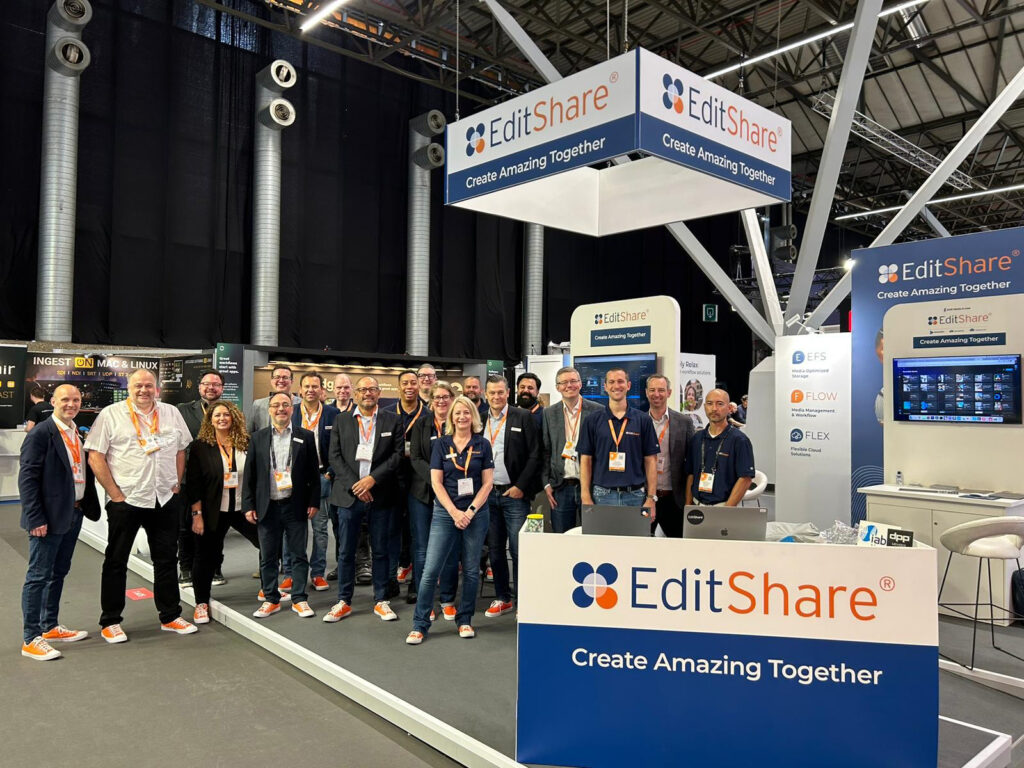
Towards the end of the show, a few folks asked me to sum up how it felt to see our team in action so soon after joining the company. The word I chose was “inspired.” I’ve come to appreciate the rich legacy of empowering storytellers that EditShare upholds, and seeing first-hand our team, products, and plan-of-attack coming together at such an important event, it’s hard not to feel wildly optimistic about what the future holds.
Where AI Is Headed
IBC 2023 also brought with it more and more conversation around the most compelling trend in our space today: the emergence of AI. In particular, we noticed an explosion of smaller AI-enabled companies aiming to streamline critical workflows within the content creation processes, from video editing to transcription and beyond. However, there’s a common challenge – harmonizing those workflows within one intuitive interface. I’m proud to say this is an area where EditShare is positioned to shine with the introduction of our new solution, EditShare One, which we unveiled at IBC 2023.
EditShare One, Transcription View
It’s been fun to hear the early feedback from customers and partners who have had a chance to see what EditShare One can do. We heard from more than a few people how useful the AI-integrated Transcription View will be to their producers – and the seamless integration we’ve built through FLOW into Premier Pro and Resolve also stood out at the show.
At EditShare, we’ve already made waves in post-production with innovations like Universal Projects, which lets teams work with whichever editing software they prefer. We’re pushing that idea of openness even further with EditShare One. My commitment to our customers is to keep building products that meet them where they are, and helping them balance the tension that comes with creating exceptional content within tight, demanding timelines. EditShare One is a natural next step in delivering on that promise, and we can’t wait to get it into the hands of more of our customers.
A Powerful Combination
As I look at our combined portfolio of products, I’m especially thrilled about the integration of the MediaSilo product into the EditShare ecosystem. We built MediaSilo to bridge the gap between creatives and non-creatives. It provides a platform where content can be effortlessly shared, organized, reviewed, and approved, unsticking collaboration between teams, with the security features such as watermarking and DRM to provide confidence that when media is shared, it is only being shared to the right eyes and ears.
This merger not only bolsters our commitment to providing comprehensive solutions but also opens up new horizons for creative professionals and organizations seeking to streamline their media workflows. It’s an exciting chapter in EditShare’s journey, and one I’m so excited to help shape in my first few months as CEO.
Thanks to everyone who stopped by to see us at IBC, and looking forward to meeting many more of you before we close out 2023.
Ramu Potarazu
After a 146-day strike that halted television and film production and threw the entertainment industry into crisis, the Writers Guild of America (WGA) reached a tentative agreement on Sunday night. If guild members vote to accept the deal in the coming days, some 11,000 writers can finally return to work.
Though the WGA cannot discuss details of the deal “until the last ‘i’ is dotted,” most speculate that the agreement includes almost everything they wanted from studios, including increases in royalty payments for streaming content and assurances that artificial intelligence will not infringe on writers’ credits and compensation.
In a published memo to its members, the WGA negotiation committee said with great pride “that this deal is exceptional — with meaningful gains and protections for writers in every sector of the membership.”
What does this mean for the SAG-AFTRA strike?
While the end of the writers’ strike comes as a relief to many, it doesn’t mean everyone returns to work as usual. With almost 160,000 Screen Actors Guild-American Federation of Television and Radio Artists (SAG-AFTRA) members still on strike, the only shows restarting production soon will likely be late-night and daytime talk shows.
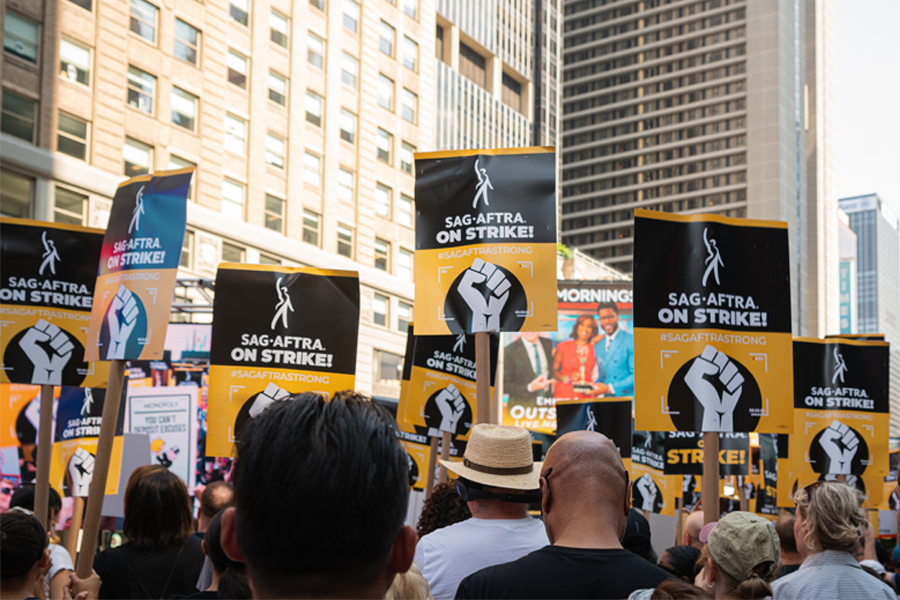
SAG-AFTRA members walked out in July over similar disputes relating to low pay, streaming residuals and AI, to name a few, and the group has no talks scheduled with studios yet.
In a statement released on their site after news of the tentative WGA deal, SAG-AFTRA applauded their counterparts for “incredible strength, resiliency and solidarity.” They also emphasized that the organization’s strike would continue, urging the “studio and streamer CEOs and the AMPTP to return to the table and make the fair deal that our members deserve and demand.”
The WGA continues to support their acting counterparts, calling on their members to join SAG-AFTRA on picket lines this week. Many hope that the negotiations accomplished by the WGA will lay the groundwork for SAG-AFTRA to reach a resolution with studios quickly since it addresses many of the same concerns.
Studios are undoubtedly feeling the effects of the strikes, with stock prices for Disney, Warner Bros. Discovery and Paramount Global having dropped and analysts estimating that studios will forgo as much as $1.6 billion in global ticket sales for movies pushed to next year. And while everyone in the entertainment industry collectively breathes a sigh of relief at this week’s progress, economists estimate that the dual strikes have cost the California economy roughly $5 billion.
What now?
This deal does not mean that the strike is over or that the entertainment industry can return to work immediately. Picketing has stopped, but contracts must be finalized. The WGA negotiating committee needs to vote; then their 11,000 members must accept the terms of the new agreement before the WGA strike is officially over.
In addition to the striking actors, more than 100,000 behind-the-scenes workers — including directors, camera operators, publicists, makeup artists, prop makers, set dressers, lighting technicians, hairstylists and cinematographers — will continue to stand idle, many with mounting financial hardship. Some A-list members of the Writers Guild pressed for a return to negotiations, citing the pressure on idled workers.
TV dramas and comedies will likely take the longest to come back because of the actors’ strike and the complicated logistics necessary to restart large-scale productions. Production will need to contact crew members and writing teams to resume, which might take some time if people have moved away from their filming locations, Variety reported. Shows will also need time to kick-start marketing campaigns so that audiences know to tune in.
The industry pivots
The implications of the record-breaking strikes are unclear, with many companies downsizing and out-of-work picketers having left the business for good. But viewers will still get the content they crave. Networks had already pivoted their fall programming to include international shows, game shows, documentaries, more sports and even a few new series and movies coming out this year. While it’s unknown how postponed projects will react to the news of the deal, with writers anxiously ready to get back to work, we wouldn’t be surprised if your favorites were back soon.
MediaSilo allows for easy management of your media files, seamless collaboration for critical feedback, and out-of-the-box synchronization with your timeline for efficient changes. See how MediaSilo is powering modern post-production workflows with a 14-day free trial.
Montréal-based production company moves to latest hardware for increased flexibility
Boston, MA, September 27, 2023 – EditShare®, the technology leader that enables storytellers to create and manage collaborative media workflows, and Canadian Channel Partner, DXM, have installed a large network of EFS storage devices at Pixcom, a leading Canadian production company. Pixcom, based in Montréal, has a permanent team of over 50, employs over 5,000 freelance artists, technicians and production teams and has relied on EditShare storage for more than a decade.
The new installation at Pixcom will provide a centralized workflow hub. With all media in one spot, engineers can ensure that producers and editors always have the right material at the right time. The company’s in-house post facilities use Avid and DaVinci Resolve editing, which is tightly integrated into the storage network meaning editors always have the right material on their workstations when they need it.
“We are very comfortable and familiar with the EditShare eco-system,” said Charles Laflamme, Technical Supervisor at Pixcom. “It was time to refresh the hardware, and EditShare and their local partners DXM Technologie showed us the benefits in connectivity and security with the latest EFS devices. It will make our workflows even simpler and more productive, while ensuring that we have complete control over all the material for our productions.”
Charles Laflamme, Technical Supervisor at Pixcom
This installation is built around six EF450 scalable shared storage appliances, each with 392TB of disk storage, plus two MDC metadata controllers, giving Pixcom both high availability plus all the benefits of the FLOW production asset management software. The network also includes four EFS 40NL nearline storage nodes totalling 1.5PB of storage, plus two backup 672TB EFS 40NL nodes.
The nearline storage provides working storage for media which is in current production but not needing the same levels of throughput as the online storage. Workflow tools built into the EditShare suite ensure material is moved between online and nearline storage as required. The new network also includes EditShare Ark LTO tape drives for permanent archiving, again automated through FLOW.
“Charles and his colleagues are very familiar with all the benefits of high-performance shared storage from EditShare, which means we could talk about the latest techniques in boosting workflows and delivering productivity benefits, like the tight integration between storage and edit software, and the ability to prepare material in FLOW, in advance of the edit.” said Adam Giraudias of DXM Technologie.
“EditShare’s commitment to enabling collaborative media workflows aligns perfectly with Pixcom’s mission to deliver exceptional content efficiently,” commented Said Bacho, Chief Revenue Officer at EditShare. “With this significant installation of EFS storage, in collaboration with our valued Canadian Channel Partner, DXM, Pixcom’s creative teams now have a centralized workflow hub with immediate access to the right material. We are proud to support their journey of simplifying and enhancing production workflows while maintaining complete control over their valuable assets.”
The new storage network was installed over the summer of 2023.
EditShare is a technology leader that enables collaborative media workflows on-premise, in the cloud, or in a hybrid configuration. With customer and partner success at the heart of EditShare’s core values, our open software solutions and robust APIs improve workflow collaboration and third-party integrations across the entire production chain, ensuring a world-class experience that is second to none. The high-performance software lineup includes media optimized shared storage management, archiving and backup, and media management, all supported with open APIs for extensible integration.
EditShare’s cloud-enabled remote editing and project management technology was recently recognized by the National Academy of Television Arts and Sciences (NATAS) with a prestigious 2021 Emmy® Award for Technology and Engineering.
About DXM
DXM Technology offers fast and effective services that can solve the problems and challenges faced in all fields of video content production, whether you are a broadcaster, producer, post-production house, blogger or other.
The digital age has completely altered the television and film worlds. With easier and more affordable access to technologies we can now build specific workflow infrastructures that will eliminate major headaches, which in turn allows producers to generate more effective content within established budgets and deadlines.
So, you want to get your film or TV show on Netflix? Unfortunately, there’s no easy A-B-C blueprint to follow here, and the truth of the matter is it’s a tough task. However, don’t let this dissuade you from trying. It’s not impossible. At the end of the day, Netflix is one of the biggest streaming platforms in the world, and they’re always on the lookout for new content!
While the roadmap for each individual project making it onto Netflix is always going to be slightly different, there are certainly a few pointers and tips that you can follow to give yourself a far better chance of success. If you have a project in mind and a goal set, read on to find out how you can get that famous “tu-dum” playing at the start of your production.
Have a clear, concise vision in your pitch
First things first (and this goes for any production, not just the one you want to end up on Netflix) – you need to have a very clear vision. In the pitch for your film, you should be able to succinctly summarize what the film is about, who it’s made for, and where it should exist in a content library. Furthermore, why make this film right now? And why you? If these basic things aren’t nailed, you’re going to find pitching it to Netflix an even tougher job.
Additionally, as an extra little tip, you may even want to include a roadmap that builds your world and opens up the possibility of extending it in the future, assuming that makes sense for the project. Streaming companies like Netflix love to capitalize on the success of a first installment with follow-ups. It’ll be interesting to know how your world can be built and what the potential longevity is. Of course, if you’re pitching a limited series or a one-off documentary, this won’t be as relevant.
Is this your best work?
This pretty much goes without saying, but to even have the tiniest of chances of making it onto a streaming site as large as Netflix, you need to be brutally honest with yourself and your team. Is this the very best work you can produce? Nowadays, there’s so much great work, and the competition is tough—if this is anything less than the very best, you can forget about it. Even if it is, that may still not be enough.
Secondly, you need to ask if this stands out from the crowd. What makes your show or film so unique, and why should Netflix commission it? If you can’t answer these questions convincingly, you’ll need to circle back to the drawing board.
Find an aggregator
This is perhaps the most important tip we can give you when it comes to getting your film on Netflix. As you can imagine, there are many independent producers and filmmakers out there who would all love to have their film or show streaming on Netflix. If Netflix was to take pitches from everyone separately and independently, it would take so much time and effort that it simply wouldn’t be worth it.
Instead, Netflix only works with trusted third-party aggregators. On their website, you’ll find the following guidance when it comes to pitching ideas:
“If you have an idea, game, script, screenplay, or production already in development that you’d like to pitch to Netflix, you must work through a licensed agent, producer, attorney, manager, or industry executive, as appropriate, who already has a relationship with Netflix. We are unable to share references for these resources.
If you do not have any of these resources available, Netflix will be unable to accept your unsolicited submissions.”
In other words, an aggregator is absolutely essential. They meet with Netflix regularly to pitch ideas, and they know what the streaming platform is looking for. These aggregators are always on the lookout for the next big thing, so they will be the ones to hear your pitch and review your film. If they like it, they’ll pitch it to Netflix on your behalf and help you package it properly, taking care of all the details before final delivery to Netflix.
And how much does this cost? Well, it depends. Different aggregators use different pricing models, so there isn’t a universal, consistent figure for you to work with here. As a general rule of thumb, you can expect that most aggregators will charge at least $1,000 to get your film on Netflix, and there may well be further pitch fees, annual charges, or percentage cuts of any profit generated. Here’s an idea of what two aggregators cost:
Quiver Digital charges $1500 + $150 pitch fee + $75 annual charges (payable after 2 years)
Distribber charges $995 +$150 annual charges (payable after 1 year)
For help in finding an aggregator, you can explore a full list of “NPFP” partners here. These are elite companies that have met strict requirements to become a “Netflix Preferred Fulfillment Partner.”
Find an agent
Finding an aggregator isn’t the answer to everything, unfortunately. If you’re serious about getting your film on Netflix, hiring an agent can open a lot of doors for you. While aggregators are there to get your film onto Netflix with packaging and final delivery, you may be wondering how you get to meet an aggregator in the first place.
An agent who’s earned their access and credibility in the business can pull strings and arrange such meetings with potential buyers. They will offer their expertise on how to improve your pitch and help it stand out from the crowd, assist with marketing, and guide the development process to a successful conclusion. They also have their ear to the ground and meet with Netflix buyers regularly, so they know what the network is looking for.
Attach a big name
Love it or hate it, in this business, sometimes it really is all about “who you know.” One of the ways to give your film or show a fighting chance is to attach a “big name” to the project. If you can find a producer, an executive, or an actor who already has a great relationship and track record of working with Netflix, it’s undoubtedly going to help you out.
If this “big name” backs your project and comes on board, it signals to Netflix that you’re worth a shot. This person has the ability to pull in an audience and produce great work, and they’re willing to vouch for you and believe in your project!
Do your homework
With all of the above in mind, you need to do your homework. Catching the eye of a big name in the industry or finding the right aggregator and agent is not simple. If you want the best chance of finding the right fit and getting people on board with your film or TV show, you need to research who it is you should be targeting.
If you have a new German comedy aimed at Gen-Z, it might not make sense to be talking to an aggregator who specializes in groundbreaking historic documentaries. And vice versa. Instead of wasting your time aimlessly, invest in the time it takes to dig deep and find the people who are most likely to be interested in what you have to say.
Network, network, network
How might you bump into these kinds of people? It isn’t going to happen sitting in front of your PC screen, sending out cold emails. You need to network in person and network hard. The good news is there are plenty of opportunities to do so.
Thankfully emerging from the other side of the pandemic, in-person events are back on. From pitching and film festivals to industry talks, networking events and casual social gatherings, there are many ways to rub shoulders and get your face seen and known throughout the year. In the case of pitching festivals, not only will you have the benefit of networking and potentially meeting the right person, but you’ll learn a lot about the industry and what it takes to build a great pitch. Both pitching and film festivals also present the possibility of meeting directly with Netflix personnel – they’ll be in attendance.
Social media helps
When it comes to networking and getting your face known (for the right reasons, of course), social media can certainly help out. You should keep an active presence online by sharing your latest work, getting involved with discussions in the industry and connecting with people in the business. If you happen to have a substantial following or are able to build one (we’re talking tens of thousands of followers/subscribers at minimum), then that can certainly pique the interest of Netflix. They like to know that you can bring an audience with you.
Working the social media angle can also help if you’re able to generate substantial social chatter and interest in your project. There’s a good case in hand happening right now, with Russell Cook (aka “Hardest Geezer”) currently attempting to be the first person to run the entire length of Africa. He’s been courting Netflix and generating a lot of chatter on Twitter and YouTube, so watch this space…
Getting your film or TV show streaming on Netflix isn’t easy. It’s a long, arduous process, and there will be many setbacks. In fact, our final piece of advice here would be to get comfortable with rejection. The word “no” doesn’t necessarily mean no forever; it just means not today.
Pretty much everyone in the industry starts off with a “no.” How you deal with this rejection is key. Try to build on it by taking feedback on board and understanding that you have to knock on thousands of doors before even one opens. Rejection and failure are part of the game. With perseverance, patience and the application of the advice you’ve read above, you can maneuver yourself and your project to be in the best possible position to get that famous “tu-dum” playing at the start of your show.
MediaSilo allows for easy management of your media files, seamless collaboration for critical feedback, and out-of-the-box synchronization with your timeline for efficient changes. See how MediaSilo is powering modern post-production workflows with a 14-day free trial.
EditShare®, a technology leader that enables storytellers to create and manage collaborative media workflows, today announced it has entered into a definitive agreement to merge with Shift Media, a leading cloud-native video solution provider that helps creators manage, present, and collaborate on their high value projects. The combined business will operate as EditShare, with Shift Media’s well-known products – MediaSilo, Wiredrive, and Screeners.com – folding under the EditShare corporate brand.
Over the past several years, video creation has continued to accelerate in myriad industries globally, including entertainment, advertising, corporate communications, higher education, house of worship, and many more. Corresponding with this increase in content production, an explosion in video technology has occurred, leaving video professionals with an ever-growing, complicated stack of tools and vendors to integrate to get their jobs done effectively. The combination of EditShare and Shift Media will deliver a comprehensive, open solution that enables creative teams and content creators to seamlessly store, edit, collaborate, and share their content, whether they choose to work on-premise, in the cloud, or with a hybrid solution.
EditShare’s high-performance workflow focused product suite includes EFS media optimized shared storage and FLOW intelligent media management. In 2022, the company launched EditShare FLEX built on AWS, ensuring professional production and post companies can build remote and collaborative workflows that suit their creative and commercial needs.
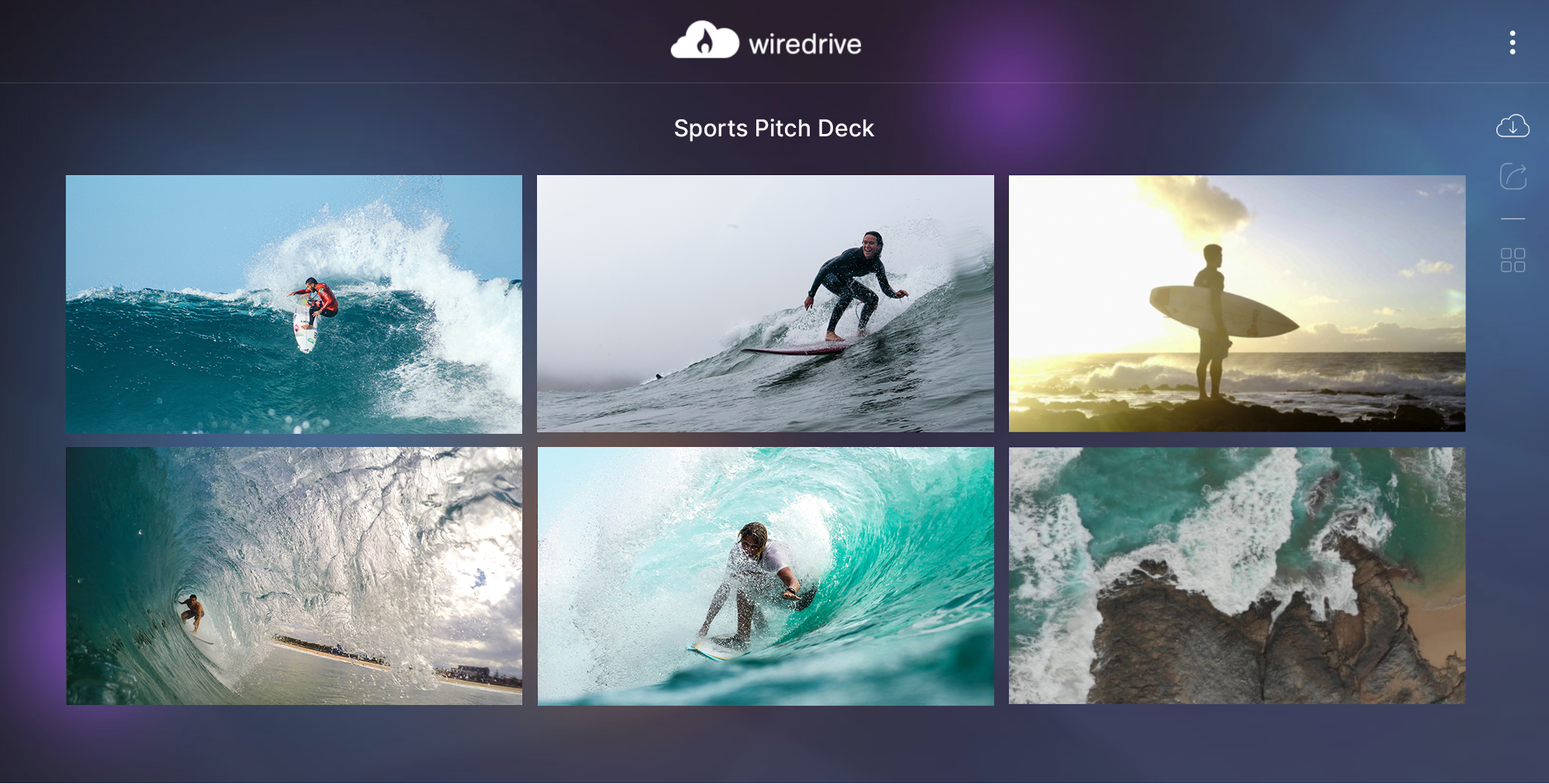
Shift Media’s cloud-native, software-as-a-service solutions include MediaSilo, Wiredrive and Screeners.com. MediaSilo provides a video collaboration HQ, helping the biggest names in media get projects approved faster. Wiredrive helps commercial production companies and agencies quickly and easily create custom pitch materials and showreels. Screeners.com provides the industry standard virtual screening experience for press review and sales opportunities of high value pre-release content.
Ramu Potarazu, Shift Media’s CEO, will lead the combined company under the EditShare banner following the close of the transaction; current EditShare CEO Conrad Clemson will leave the business to pursue other opportunities. “The tireless work of Conrad and the EditShare team has put us in a position of strength for the future,” Potarazu said. “Shift Media was built on the principle that video workflow technology should be completely intuitive and customer friendly. EditShare and Shift Media are highly complementary businesses with market leading products and services and shared commitment to putting the power of video production in the hands of creators. As a combined company, we will create a one-stop shop with a more comprehensive range of products and global network of channel partners, enabling us to better meet our customer needs around the world.”
“Our two companies have very strong businesses and powerful product offerings,” said Stephen Tallamy, CTO of EditShare. “Together, we will be better positioned to deliver a powerful, comprehensive, and intuitive content management and collaboration offering to the broad middle market, which is where most of the industry sits.”
ParkerGale Capital and Marlin Equity Partners, previous backers of EditShare and Shift, respectively, will maintain their positions as primary investors and board members of the combined company. “I’m excited that Marlin Equity Partners and ParkerGale will continue to support the business,” said Potarazu. “Together, we are aligned on delivering cutting edge solutions in response to the stratospheric growth in video production and continued move towards flexible, collaborative on-premise, hybrid, and cloud workflows.”
For more information on all EditShare solutions, please visit the website at www.editshare.com. Information on MediaSilo, Wiredrive, and Screeners.com can be found at www.shiftmedia.io.
MediaSilo allows for easy management of your media files, seamless collaboration for critical feedback, and out-of-the-box synchronization with your timeline for efficient changes. See how MediaSilo is powering modern post-production workflows with a 14-day free trial.
With nearly 200 worldwide events and tournaments every year, each demanding massive amounts of data, our client in global action sports has no time for spotty platform performance or delays. Filming extreme sporting events results in dozens of terabytes of video content. These assets include once-in-a-lifetime record-breaking moments used in live streams, social and web content, and highlight packages on both owned channels and with media partners. This content keeps their 7.3 million social media fans up-to-date on the athletes they love and, in turn, increases engagement, brand loyalty and profits. When you’re distributing footage of a world-class athlete making history with a flawlessly performed stunt, a gap in content is not an option. They needed a reliable, secure solution that fit into their existing pipeline, integrated with their production applications and kept track of multiple revisions.
Wiredrive features comprehensive and intuitive analytics reporting.
Frustrated over the lack of a standard content management system and platform, the Head of Post Production for the property contacted Shift Media for a solution. They had hundreds of users needing a standardized workflow. Confusion and lack of consistency between key video production stakeholders caused by disparate file management systems were tremendous problems. The fact that they held events worldwide only added a layer of difficulty to their existing workflow, with unreliable internet connections and services making the distribution of assets back and forth to the United States incredibly challenging and time-consuming.
Secure media sharing for marketing teams, agencies and production companies.
They required performance at the highest level, and Wiredrive delivered. The solution allowed for the management of all work-in-progress and finished assets from one common collaboration hub. Handling file transfers globally with consistent coverage at all live events accelerated delivery timelines, making assets available to the entire global-wide team, who could download them instantly for upload to their website or social media channels. With a single platform, our customer replaced several solutions in asset management and content presentation while increasing their digital presence and driving the sport forward.
Wiredrive enabled them to simplify their media delivery workflow and eliminate the threat of missing deadlines, giving them peace of mind to focus on growing their global community and creating best-in-class stories for their audience.
Learn how Wiredrive can enable your creative process with a free 7-day trial.
We can all relate to this experience: You are looking for a particular photo, document, or video that you’ve saved somewhere on your computer.
You open one folder … then another … then another.
Was the file in the “website” folder? No, go back to the last one. Maybe you put it in the “July” folder because that’s when you shot the footage? Not there either.
If you are using a digital asset management system to store and organize all of your assets, then you already have a basic organization system in place. Despite this, your design team may still not be operating at its full potential, wasting valuable time hunting for files and juggling version control.
That’s where combining the use of projects and folders with tagging comes in, enhancing the overall organization and management of your digital assets.
How Tagging Enhances Digital Asset Organization
Here’s another example: What happens when you need to find your team’s electronic press kits stored in various projects? Or all photos of one specific product taken on different days for use in different campaigns?
If your projects and folders are stored in a cloud platform, such as Google Drive, your team can be left searching every folder for each account, struggling to make a general file management system work for your specialized digital asset needs.
That’s where a customized tagging system for digital asset management and design team collaboration can prevent a time-intensive hunt for your content. Instead, your team can use specific keywords to organize, tag, and quickly search for all of your assets.
Getting Started with Tagging
With the right tools and platform, it’s easy to implement tagging into your digital asset organization. Here’s how:
1. Make a plan.
Before you jump in and start adding tags to all of your files, it’s important to map out a strategy. If you are dealing with a large number of files, or sharing a system that will be accessible to colleagues and collaborators, making a comprehensive plan is vital.
Start by thinking about the types of files you have in your account and how your projects are currently set up. This will help you determine what kind of categories your tags might fall under and where the gaps are in your current project and folder structure.
Depending on your specific workflow, here are some helpful ways to think about organizing your files.
Other examples of tags can include:
The status of an asset, such as “pre-production,” “production,” and “post-production”
The location where the photo or video was taken
The names of the actors or models appearing in the shot
A ranking system to note a director’s or editor’s favorite selections
The notation of “final” on a document that has gone through all revisions
The primary colors or shades appearing in an image
Whatever the tagging system, it has to work for you and your team so it remains consistent and continues to be used.
Retail or Brand Asset Management
There can also be tags specific to your industry. For example, if your company sells products directly to consumers online or in storefronts, a tag structure can include:
High-level tags: website, print, storefront, e-commerce, social media, model, packshot
More specific tags: product name, SKU number, seasonal campaign, model name, specific social platforms, primary colors
Media and Entertainment Production
Production companies working on film, television, or online video projects could use:
High-level tags: film or show name, scene number, date of production, director’s name, stage of production
More specific tags: location, take number, names of actors, director’s ranking
Advertising and Marketing Campaigns
Creative, production, or marketing teams that work on advertising campaigns with a variety of clients, brands, and products could use this structure:
High-level tags: logo, product name, specific campaign, brand or client name, date of production
More specific tags: primary colors, subjects, themes, specific social platforms, launch or release dates
2. Tag your assets.
Once you have a plan, document it, share it, and then start tagging!
Begin by uploading your content (videos, photos, audio, documents, and more) into your workspace and setting up a basic organization system. With MediaSilo, this process is easy; just create a new project with folders and individual assets inside each to suit your specific needs.
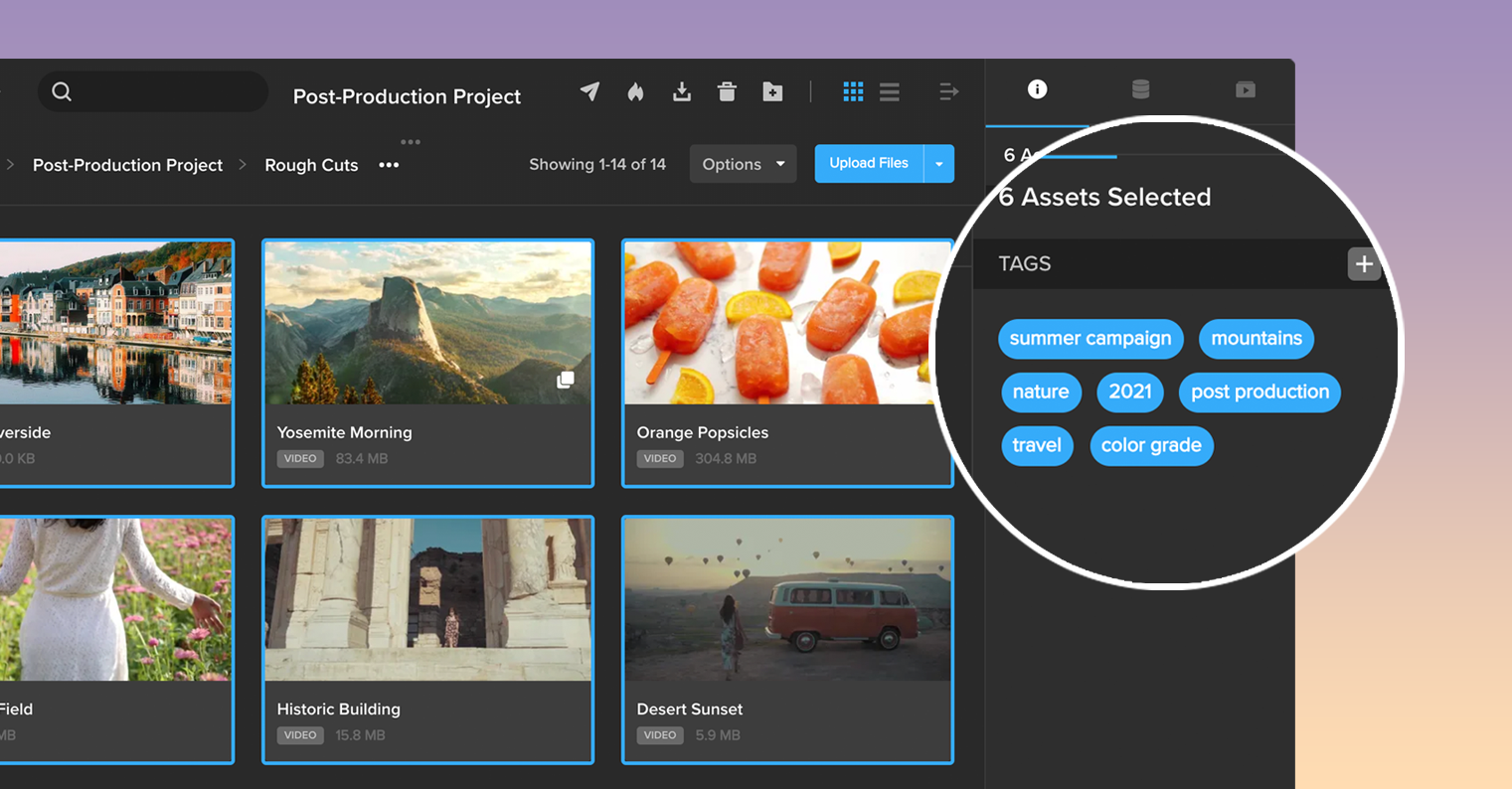
Once your content is uploaded, you can start adding tags immediately. Within MediaSilo, select any asset or multiple assets and open the right-side drawer. MediaSilo even allows your team to either tag assets individually or highlight and bulk-tag multiple items to quickly and efficiently label what you need after uploading.
3. Search for assets by tag.
Once all of your assets are tagged, use the global search in MediaSilo to drill down to exactly what you need without navigating through layers of folder tree structures.
Filters such as asset type (video, image, document), date uploaded, and who it was uploaded by add specificity to your search in conjunction with your added tags.
With MediaSilo, you can even create your own custom search by selecting a combination of search terms to find the specific assets you need in just a few clicks. You can also choose to save the search to use it again and again.
4. Share searchable asset libraries using MediaSilo’s Spotlight.
Looking to make your assets accessible outside of MediaSilo? Tagging can help with this process too.
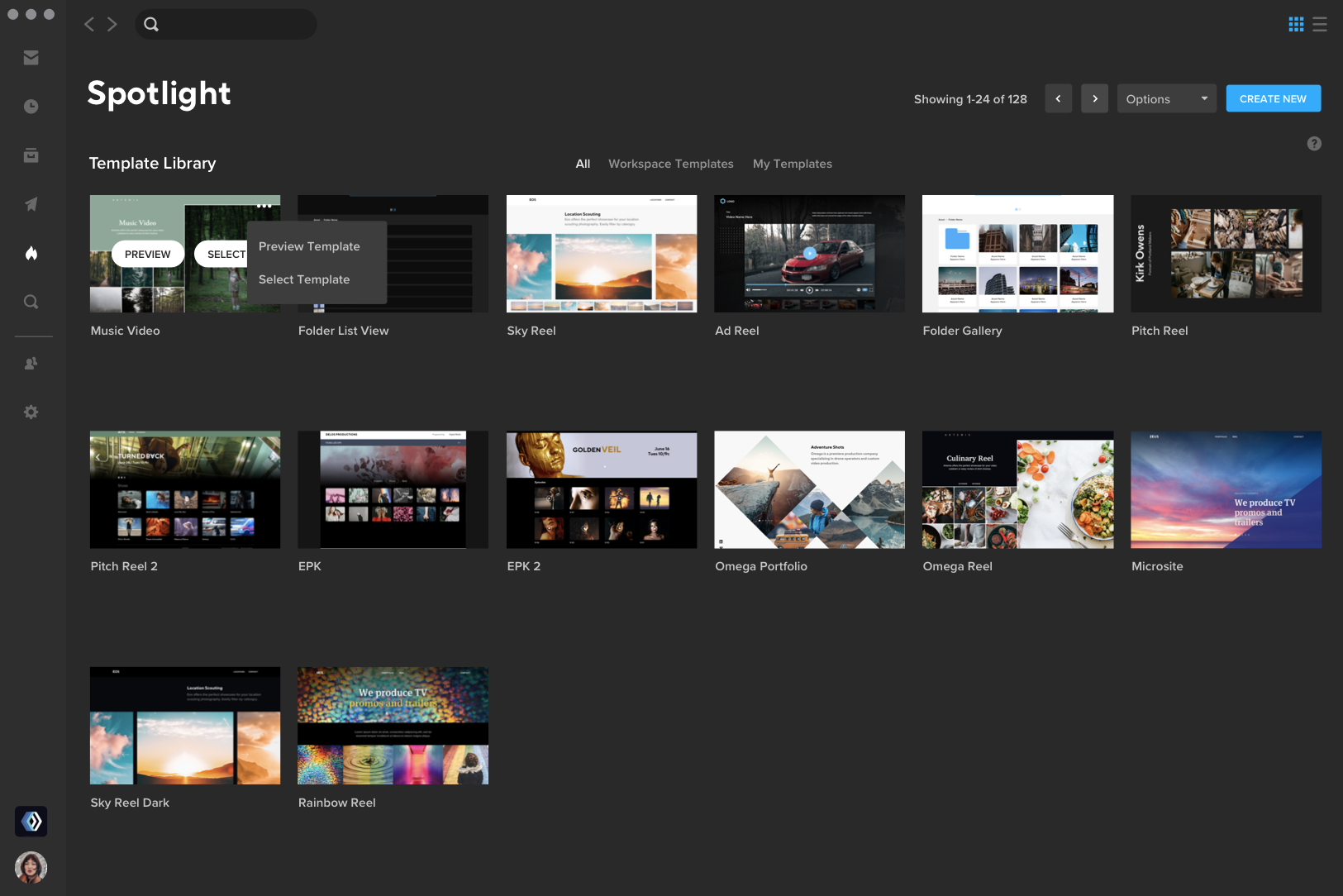
With Spotlight, MediaSilo’s turnkey presentation builder, you can easily share projects, folders, or a curated playlist of assets in a branded, searchable asset library.
Either use a preset template with a built-in search bar or add the search element onto your own template design.
You can even customize your Spotlight with multiple pages and tabs, each with as many folders, projects, and playlists needed. From there, you can share it externally, and collaborators can use the built-in search bar to search by title, description, or tag to find what they’re looking for.
Taking Your Digital Asset Organization to the Next Level
Managing your media and assets doesn’t have to be a full-time job. A little bit of strategy and work on the front end can save you hours—and lots of headaches—down the line.
And, with MediaSilo, it’s easy to get started. With just a few simple tags in the search bar, you can always find exactly what you need, whether you have 100 or 100,000 files