White Paper: Deciding When/If/How to Migrate Video Production and Workflows to the Cloud
By Tom Rosenstein, VP of Business Development, EditShare
**This Webinar Has Passed. Please Fill Out The Form To Access The Recording.
Details
March 17 Session 1: 9:00 AM ET (duration 1 hour)
Faced with the realities of remote learning, students of Massachusetts College of Art & Design (MassArt) adopt real world, remote production techniques to complete coursework and graduation projects. Their success proves the efficacy of remote production workflows and paves a path to the cloud for tomorrow’s filmmakers. Join EditShare founder, Andy Liebman and MassArt’s associate director of video, Joe Briganti as they showcase graduating filmmaker Ian Dumas’s thesis work and the EditShare solution that made it possible.
Access The Recording
Webinar Speakers
Dan Schaffer, Director of Partner Strategy and Enablement, EditShare
Andy Liebman, Founder EditShare
Joe Briganti, Associate Director of Video, MassArt
Ian Dumas, Undergraduate Senior – Film/Video, MassArt
**This Webinar Has Passed. Please Fill Out The Form To Access The Recording.
Details
March 17 Session 2: 3:00 PM ET (duration 1 hour)
Faced with the realities of remote learning, students of Massachusetts College of Art & Design (MassArt) adopt real world, remote production techniques to complete coursework and graduation projects. Their success proves the efficacy of remote production workflows and paves a path to the cloud for tomorrow’s filmmakers. Join EditShare founder, Andy Liebman and MassArt’s associate director of video, Joe Briganti as they showcase graduating filmmaker Ian Dumas’s thesis work and the EditShare solution that made it possible.
Access The Recording
Webinar Speakers
Dan Schaffer, Director of Partner Strategy and Enablement, EditShare
Andy Liebman, EditShare Founder
Joe Briganti, Associate Director of Video, MassArt
Ian Dumas, Undergraduate Senior – Film/Video, MassArt
Wednesday, February 17 Session 1: 9:00 AM ET (duration 1 hour)
Join us as we explore using logging and automation to maximize the value and efficiency of your media production workflows. We’ll set the stage, view the architecture in a workflow diagram, and see first hand what it’s like to use day to day. As always, we’ll finish with a Q&A where our Solutions Architects will answer your questions and discuss matching these capabilities to your unique needs.
Save Your Seat
Webinar Speakers
Dan Schaffer, Director, Partner Strategy and Enablement
**This Webinar Has Passed. Please Fill Out The Form To Access The Recording.
Details
Wednesday, February 17 Session 2: 3:00 PM ET (duration 1 hour)
Join us as we explore using logging and automation to maximize the value and efficiency of your media production workflows. We’ll set the stage, view the architecture in a workflow diagram, and see first hand what it’s like to use day to day. As always, we’ll finish with a Q&A where our Solutions Architects will answer your questions and discuss matching these capabilities to your unique needs.
Access The Recording
Webinar Speakers
Dan Schaffer, Director, Partner Strategy and Enablement
David Bourke, Pre Sales Engineer
You don’t need me to tell you that 2020 was a year we’d rather have skipped. We didn’t have that option, so we’ve had to deal with it – just like our colleagues and friends across the industry. By staying true to our values and with the phenomenal talents of our team, we’ve been able to keep innovating and help our customers continue to create engaging and compelling stories.
#WinTogether
In addition to the pandemic, 2020 was a year characterized by tumultuous events and widespread unrest. But when I looked more closely, I found humility. It wasn’t always there, but when we all put others in our community first, it was amazing to see.
One of the things that I’ve seen is our team, our clients, and our partners really unite with a common goal: to emerge from these experiences with determination and an eye to the future. When I look back at 2020, I see collaboration with our partners and customers, showing and feeling empathy, and asking the question ”what can we do to win together” was the strongest and best thing we could have done. We listened, and, where we needed to, we evolved.
We made a strategic decision to accelerate and intensify our shift to the cloud
Fast Followers Cross the Chasm
Cloud innovation was not new to EditShare. In 2015, we introduced our first cloud solutions and in 2019 we embarked on a more aggressive investment in cloud. At that time, not everyone was ready. One customer even told me “you’ll take my content out of my house and into the cloud when hell freezes over”. But, 2020 validated our decision as the cloud quickly became a necessity for everyone. The market needed us to complete the journey and reinforce our cloud efforts as a strategic focus of the company. The pandemic was the catalyst for doubters to “cross the chasm” and become mass adopters. As existing cloud users were able to continue with their business of remote working and collaboration, the fast followers saw that it was time to make the jump.
Our overall feeling was to go back to our core values and tenets – flexibility, scalability and openness – and build a much broader solution. We designed seamless proxy editing and all the services around it. The cloud has enormous potential and we are just at the beginning. What we can do now is phenomenally useful, but the best is still to come.
No One Has a Monopoly on Innovation
As organizations are being forced by the circumstances to cooperate in the cloud, most are doing it because they want to, and that’s because it’s the best way.
The cloud is a fundamental shift in the computing paradigm. It has empowered buyers. It’s as far as you can get from the jaded approach of “Here’s my solution. Pay me some money and I’ll install it. Pay me some more money and I’ll upgrade it. Pay me still more money and I’ll make sure it keeps working”. The cloud changes this to a far more cooperative model, where multiple vendors open their products to integration, making it easier, not harder, to work with third parties. In this environment, it makes sense for there to be open standards; open APIs where integrations can happen as need and innovation dictate.
Nobody has a monopoly on innovation. Other vendors have products and services that can enhance our workflows. It means that customers can use the “best of breed” products in their workflows and still be confident that they’ll be supported and supportable into the future.
The cloud gets better because it’s always getting broader and wider. It encourages collaboration. It means that we can add our or another vendor’s services easily and without breaking anything. It means that we can issue upgrades every quarter and know that it’s not going to cause problems. Clients are always up to date. It’s a virtuous circle, where it’s in everybody’s interest to work together.
All Bets on Cloud
I’m seeing an upswing in the industry, even at this early stage. Spring is just around the corner. We don’t have the pandemic put to bed yet but – at last – there are some promising signs. By the middle of the year, we’ll be able to put what we’re learning right now into practice. For our customers this means savings and efficiency.
As the value of our clients’ content grows, so does the need for flexibility to cope with doing business in an era of dramatic and unexpected change. We’re on the side of anyone who is facing up to these challenges.
It would have been wrong to bet against Moore’s law. It was wrong to bet against the web. And now you should absolutely not bet against the cloud.
Ultimately, we give our clients flexibility, continuity and confidence. If you want to engage with our software, you can run it on any suitable hardware or you can take it with you into the cloud.
We’re going to take with us what we learned in 2020. Empathy with our customers – not a new thing, but number one going forward. And guiding customers towards the cloud. We’re there, ready for them: it is no longer a question of “if”, but “when”.
FLOW and EFS provide campus-wide cloud-based media management and open storage for renowned educational institution
Boston, MA – December 3, 2020 – EditShare®, a technology leader that specializes in collaboration, security, and intelligent storage solutions, today announced that the UK’s National Film and Television School (NFTS) is standardizing its post-production, content delivery, and storage operations on EditShare’s EFS open shared storage solution and FLOW media management platform. By replacing its aging shared-storage platform with a mix of on-premise and cloud-based technologies, the prestigious NFTS, one of the world’s leading film, television and games schools, will increase productivity and more efficiently manage and share the content being created by staff and students.
Founded in 1971, and based at Beaconsfield Studios in Beaconsfield, Buckinghamshire, England, the School offers more than 30 post-graduate level courses across the film, television and gaming disciplines, including camera operations, directing, cinematography, sound, script supervision, and production accounting. The school realized it needed to update its current system, while implementing open, logical, and automated methods of file and project management.
NFTS has always taken pride in its earlier reputation as a “slightly anarchical” community of filmmakers, but just as that culture over time settled into a more organized and formalized environment, its technology and production infrastructures needed to follow suit, according to Doug Shannon, head of IT for NFTS.
“When I began here, there was no network,” said Shannon, who brought a professional background in post-production when he joined the School 20 years ago. “Everyone simply passed hard drives around by hand. We needed greater consistency and a more open production environment. Initially we moved to simple, departmental servers. Then, five years ago, we first moved to dedicated shared editing storage, but that system had come to the end of its usable life, with the support contract becoming unsustainably costly. It was time to move on.”
In addition to continually enhancing productivity and efficiency, NFTS is focused on giving its students a diverse educational experience with hands-on access to the latest generation of production tools used by professionals today.
“We aim to emulate real life as much as possible,” Shannon said. “Our students come here already knowing what they want to do, so they work with teams of specialists, much like any professional environment. It’s less about technology and more about helping people work to achieve their best within each role.”
NFTS was looking for an open media management and storage foundation to easily allow the use of multiple creative editorial and finishing tools. The School will use EFS and FLOW to support a range of connected solutions for editing, grading, animation and more.
“Companies have realized they have to be open,” Shannon said. “The proprietary world is gone. For us, openness was both an assumption and a requirement.”
He added that the EFS and FLOW systems help production teams adapt quickly to the different camera systems NFTS uses from Arri, Sony, RED and Blackmagic. “For example, FLOW supports formats in a clever way and doesn’t have to break up RED files into blocks.”
Security and remote collaboration were also key factors, especially with the school and the rest of the world still in some phase of COVID-related lockdown. “We needed something to help us work beyond our physical boundaries and give us the ability to look at rushes when working remotely,” Shannon said, adding the virtualized version of FLOW and AirFLOW are the perfect match for the school’s fast-turnaround production and review cycles. EFS underpins the on-premise and remote production workflow with best practice security file tracking to answer who did what and when.
With the EFS system in place, total shared editing storage at NFTS has increased from 490TB to 2.2PB, more than enough to meet the School’s current and even future requirements.
“Our enrollment is quite small at 500 students per year and we don’t see those numbers growing exponentially, so it’s an easy equation,” he said. “Most of our workspaces are around 10TB and an average film is 5 to 10 TB, with around 120 films in production and post-production at any one time. Also, using the Ark storage software is the easiest way to back-up an entire project. EditShare gives us a complete media production workflow. Everything you need for a film is there.”
“EditShare has worked alongside universities since its inception and understands the unique and highly diverse needs of faculty and students and have purpose built, yet open, solutions that sustain the academic setting while mimicking a real-world situation,” states Robin Adams, vice president EMEA sales, EditShare. “This insight and crafted solution, paired with EditShare’s cloud innovation, will help teachers and students hurdle the unprecedented challenges this year has brought and continue to connect, teach, learn, and create amazing together.”
For more information on EditShare solutions, please visit the website at www.editshare.com
About the National Film and Television School (NFTS)
Variety’s Top UK Film School 2020 and recipient of the 2018 Outstanding Contribution to British Cinema BAFTA, the NFTS is one of the world’s leading film, games and television schools. NFTS alumni have gone on to win 13Oscars and 145 BAFTAs with graduates including: double Oscar winning cinematographer Roger Deakins (1917) creator of global Netflix hit Sex Education Laurie Nunn and BAFTA winning director, Lynne Ramsay (You Were Never Really Here). The NFTS is a registered charity (313429). For more information see nfts.co.uk
About EditShare
EditShare is a technology leader in networked shared storage and smart workflow solutions for the production, post-production, new media, sports, and education markets. Whether you need on-prem, cloud, or hybrid solutions, our products improve efficiency and workflow collaboration every step of the way. They include media optimized high-performance shared storage, archiving and backup software, a suite of media management tools and a robust set of open APIs that enable integration throughout the workflow. Customer and partner success are at the heart of EditShare’s core values ensuring a world-class experience that is second to none.
Press Contact Cat Soroush Zazil Media Group (e) catherine@zazilmediagroup.com (p) +1 (631) 880-9534
DaVinci Resolve’s journey
Just eleven years ago, when DaVinci Resolve was hardware-based and usually found in the plush and rarified grading suites of only the top level post production houses, there were around a hundred installations. It was expensive. But if you could afford it, or sometimes even if you couldn’t, it brought an extraordinary level of capability to its users.
Today, in a world that would have seemed unimaginable back then, DaVinci Resolve has more than 2M users, and has grown into one of the most fully featured applications in post production.
The last decade has changed technology and entertainment far beyond what anyone would have predicted, and on top of that, everyone is currently dealing with the consequences of a global pandemic. We’ve all had to innovate, so much so that new ways of working that might have taken years before have now been planned and implemented in just a few weeks.
In the new COVID world, remote working and collaboration are no longer “nice to have” but completely essential. At the same time, the amount of video content across the planet is showing explosive growth. When you put these factors together, they point inexorably to a need for a solution like FLOW, which is built on scalable distributed technology stack and optimized for media at every level.
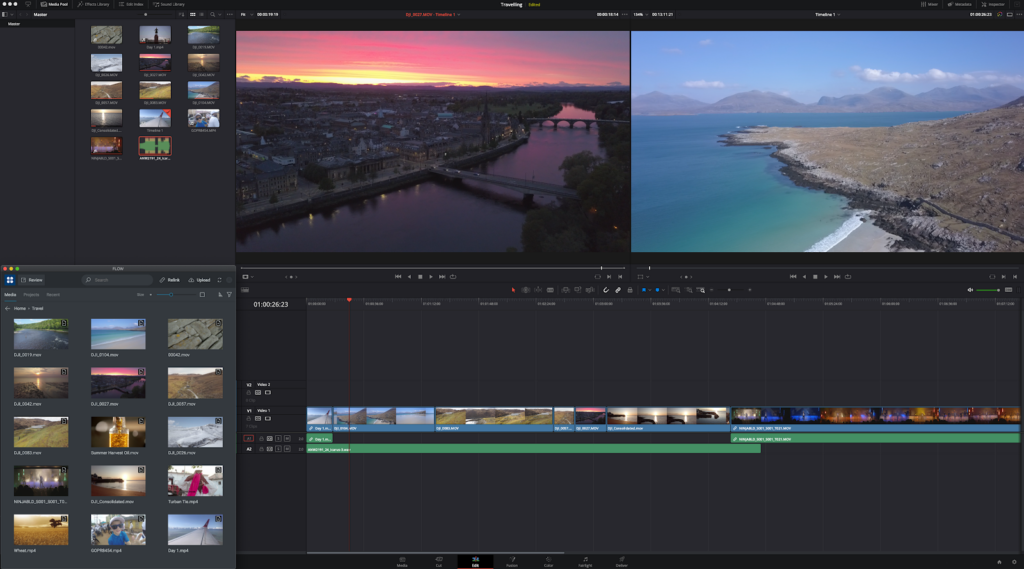
DaVinci Resolve is a super-powerful application in itself but it was never designed to sit at the center of a global, interconnected digital media ecosystem. FLOW’s new integration with DaVinci Resolve Studio brings users into a new world of searchable media, remote working, and format flexibility.
Seamless workflow integration with FLOW
The FLOW workflow integration with Resolve 17 enables users to find digital assets fast
Blackmagic Design has cleverly engineered modern versions of DaVinci Resolve Studio to be open to integration with other software, not just through conventional plugins, but through workflows that are completely dynamic and highly functional.
As a result of close collaboration between EditShare and Blackmagic Design, FLOW is now available to DaVinci Resolve Studio users as a workflow integration. It brings all the enterprise power of FLOW’s search and media management right into the heart of the DaVinci Resolve Studio.
For DaVinci Resolve Studio users, it’s business as usual, working inside a familiar environment with nothing to learn except new and good stuff. Resolve creatives will find immediate and dynamic connection to their media on a shared and collaborative storage system. Crucially, DaVinci Resolve Studio users can stay in their comfortable and productive zone within the Resolve user interface. The moment they want to find media – or export it into the FLOW system – they can use the integration to manage that task.
Imagine the difference between having to find media locally based on a complicated and convoluted file structure and, instead, searching within Resolve Studio via the integration with FLOW for media that’s anywhere within the FLOW media management ecosystem.
Demo of FLOW integration with DaVinci Resolve Studio
Remote possibilities, ultra high resolution potential
FLOW doesn’t mind whether you’re working with full resolution media, mezzanine codecs, or proxy-level content. But for remote work, it’s likely that you’ll want to work with media files that are bandwidth-friendly. Also, for ultra high resolution codecs you may find it easier to work in a lightweight proxy to put less strain on your system”.
FLOW doesn’t lock remote workers into any particular format. In fact, if you have already downloaded media, FLOW allows you to toggle between multiple formats – Mezzanine and Proxy for example.
It also allows you to work inside DaVinci Resolve Studio with ultra-efficient formats that were not previously supported, such as H.264/MP4. FLOW’s import manager lets you choose all available formats and resolutions.
And of course, range markers and large amounts of metadata are preserved when material is imported to or exported from DaVinci Resolve Studio via the FLOW integration.
Let FLOW do the heavy lifting
There are many tasks, like rendering, that you can offload from your local DaVinci Resolve Studio workstation to the FLOW ecosystem. It’s like having all the power of the cloud, with the look and feel of your familiar working environment.
Seamless Proxy workflows With FLOW Automation providing the data wrangling service, Resolve users can now choose two different codecs, such as a mezzanine format and the UHD finished version to connect to concurrently. Work on a low powered laptop, cut using the mezzanine format, simply hit toggle to replace with UHD content, all on premise or in the cloud. It eases the burden on DaVinci Resolve Studio users and improves the workflow
The reviews are in: Integrated Review and approval process, directly from the DaVinci Resolve Studio timeline, thanks to AirFLOW
The bidirectional nature of the communication between FLOW and DaVinci Resolve Studio means that it’s a near-perfect tool for having your work reviewed and approved remotely. You’ll be able to grade in Resolve, upload a version for review via AirFLOW, get instant feedback from producers, creatives or directors and then bring it efficiently back into resolve with all remote comments appearing as notes on the resolve timeline, enabling you to fix issues at that exact moment.
As technology gets better, it gets simpler
Underneath the apparent simplicity of the FLOW integration with Resolve Studio, there’s some advanced technology at work. Years of experience, development and feedback from customers have allowed FLOW to evolve into an advanced ecosystem of media management functionality that scales across size and location. Behind the scenes, there’s a plethora of configurable options. On the surface, there’s a sharp, focused, uncluttered, familiar user experience.
Blackmagic Design and EditShare work in different fields, each to a high level of excellence. The openness of Blackmagic Design to this integration project has resulted in a massive increase in functionality for DaVinci Resolve Studio users, and has allowed FLOW to bring the benefits of enterprise-strength media management to right within the DaVinci Resolve Studio user experience.