No matter which creative industry you are in, you likely often hear, “Send me your reel.”
Production companies, directors, creative agencies, post houses, and even marketing and brand teams are expected to have a demo reel to showcase their best work, much like an artist, model, or photographer has a portfolio.
But in different subsets of the creative industry, there can be different meanings or expectations for what the demo reel actually includes.
So what exactly is a reel, and what can you do if you don’t have one?
In this guide, we’ll walk you through the many names, types, and uses for reels as well as some best practices for how to make and share one with your clients and collaborators.
What is a reel and why do I need one?
Borrowing from the old way of storing film, a reel is an edited video highlighting the best examples of your work.
In creative industries such as film production, media, advertising, and post-production, a reel is a great way to demonstrate your vision or past work to a potential collaborator or client. For an experienced professional, a demo reel can be a great way to highlight the best of the best of your creative portfolio.
Taking inspiration from other creative industries, the concept of reels is beginning to make its way into B2B and B2C marketing and sales, with companies creating a reel of their products and services to give customers an overview of their brand identity and specific offerings. In these situations, this unique video could also be referred to as a highlight reel, promo reel, or brand video.
“No matter your specific use case or industry, think of a reel as a trailer for you and your work.”
No matter your specific use case or industry, think of a reel as a trailer for you and your work. Similar to movie trailers, you don’t need to tell your audience the whole story, but you do need to get them interested in seeing more.
What are some different use cases for reels?
While companies, brands, and creatives can have demo reels, the ultimate finished product can be quite different.
Production Company
Whether working in media and entertainment, advertising, or both, a strong demo reel is a must for any production company.
For a producer, brand, or agency looking to begin a new production, a company’s reel is the first place they will look to make their hiring choice. What these decision makers are looking for is a company that they feel will fit the right creative style and artistic tone for the project at hand.
A challenge for many production companies is how to show a wide range of styles and skills in a single reel. It is not uncommon for a company to produce multiple reels to show different skill sets—a commercial reel, a narrative reel, and a documentary reel, for example.
In any of these cases, be true to your strengths and what your company does better than anyone else.
Advertising Agency
For an advertising agency, the power of your reel comes from the power of your creativity.
What brands are really looking for when hiring an agency is a representation of emotions or ideas that are often hard to articulate quickly and clearly. They are also looking for individuality. Do your spots look the same as everything else they’ve seen so far? What sets you apart from the rest?
Similar to production companies, agencies also often have the issue of choosing which spots to include in their reel. But don’t be intimidated; editing a reel is just another opportunity to flex your creative muscles while showing off your distinct style.
Brand
You might not think of a brand having a “reel,” but with the broad reach of digital and online marketing campaigns, a video reel for your company can give you a competitive edge.
A brand reel allows a potential client or customer to immediately understand not only your company and your product(s) but also your values and vision. For those advertising directly to customers, brands can also choose different levels of focus, such as on a specific product or even a popular marketing campaign that your customers might recognize. For those with specific skills, such as animation or visual effects, reels can showcase the depth and breadth of your capabilities.
For a B2B brand reel, you might want to focus more on the story and identity of your company. In these cases, you want your demo reel to focus on answering questions such as:
What are the values you serve and the morals you represent?
Can you align yourself with one of your more recognizable users and tell the story of your success through their success?
However, a brand reel in these situations often requires more work, where new footage, voiceovers, or specific messaging is often needed in conjunction with clips from existing campaigns.
Commercial Director
For a commercial director, your reel is your calling card.
Whether you work directly with an agent, sales rep, or are a freelancer, you cannot book work with a new client, brand, or company without a reel that stands out. A director’s reel is an incredibly personal representation of your personality, vision, and work. It should show your skill, experience, creativity, and range all in one presentation.
As with other use cases, commercial directors can take different approaches with their demo reels. Some can choose to make a traditional “sizzle reel” made up of a variety of clips cut together with music, while others can create a compilation reel showing longer clips or entire end- to-end spots.
The approach you take depends on your audience and the type of commercial (i.e., automotive) that is your main focus.
Film Director
While there is a lot of overlap between commercial directors and film directors, a main distinction is the end goal of their reel. A commercial reel is all about sales, using creativity to sell a brand. For a film director, you have more flexibility to tell a story; capture a performance; and play with style, color, sound, and emotion.
Director of Photography
Of all of the examples we’ve discussed in this guide, a director of photography is the person who gets to have the most fun with their reel.
For a director of photography, their art is 100 percent visual, and there is no need to worry about the actor’s performance or the scene’s sound design. The main focus is capturing beautiful shots and jaw-dropping camera work. It is also a way to showcase an eye for composition, lighting, and layers of storytelling through exceptional camera work.
Actor
An actor’s demo reel is about creating a collection or montage of your best performances so directors can see your range and abilities.
That means you should work to keep things simple, using copies of the footage from your previous work and weaving them together to show your abilities, beginning with a high-impact scene to grab attention.
In this case, don’t worry about production quality or camera work. A great performance will shine through even if the shot doesn’t look very cinematic.
How do I share my reel?
Once you have created a reel that best represents you, your work, and your audience, your task is still not done. Your approach to sharing it can also reflect your specific tone and style.
It’s important to be thoughtful about how you choose to send your demo reel to show that you understand the best and most effective way for the viewer to engage with your content.
For example, you can host your reel on YouTube or Vimeo and send a link to anyone who requests it. While this is a simple and straightforward option, it does not allow you to tailor the viewer’s experience with your content or customize your presentation. At the same time, the content around your video can be distracting or deflect from the message you want to send about your brand and individual identity. Finally, if your reel contains sensitive or confidential content, these platforms offer limited security features.
On the other end of the spectrum, there are asset management and presentation platforms such as MediaSilo that give artists all the tools they need to organize, update, and beautifully display their reel on a secure and customized page.
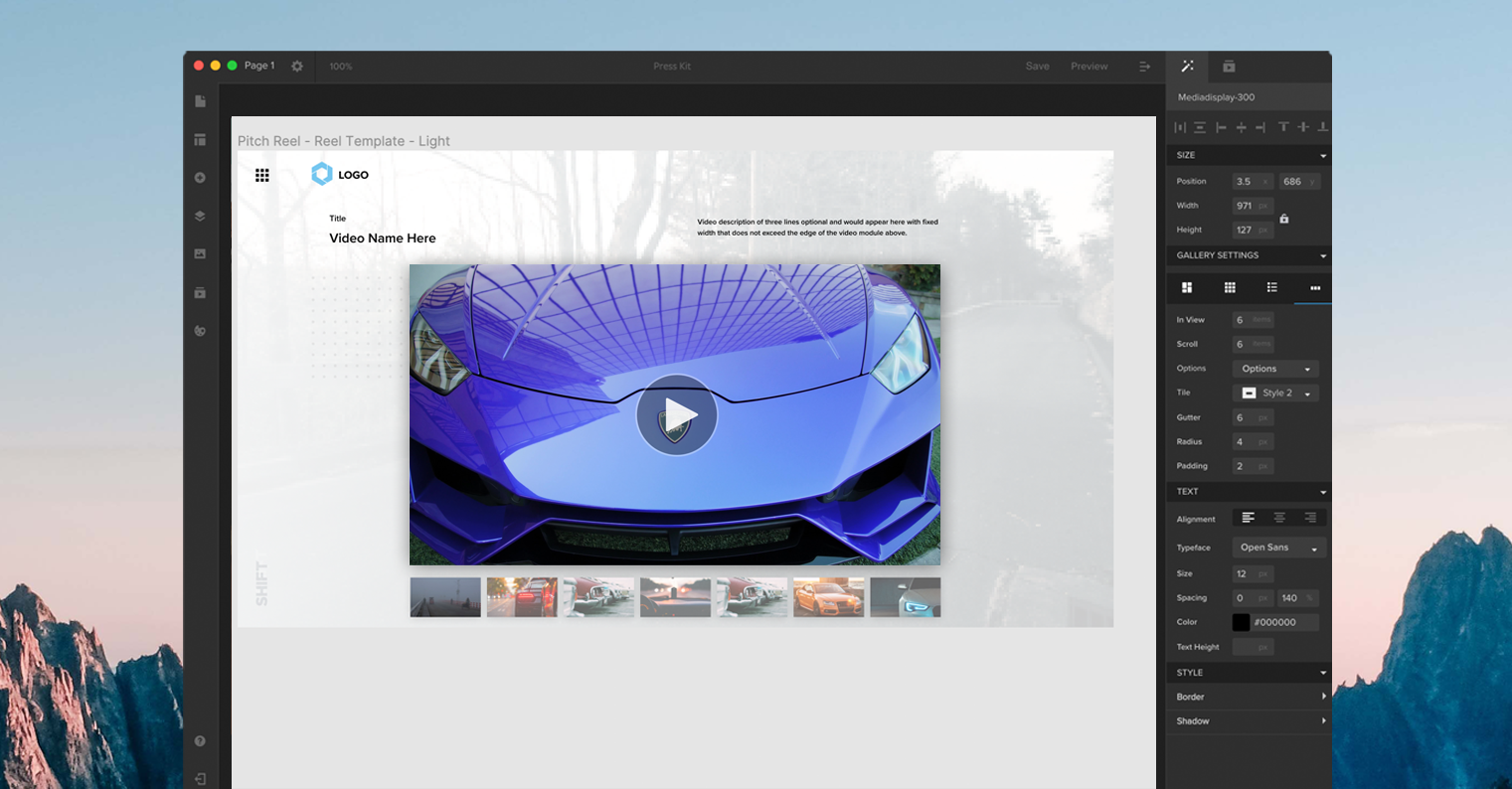
MediaSilo’s intuitive presentation tool, Spotlight, allows artists to easily build a custom landing page for their video and include additional links, information, and branding. There are also prebuilt reel templates so you can publish content in a few clicks. Or there’s the option to build something entirely from scratch that suits your specific needs.
You can also choose to share your demo reel with others while it is still in development and use MediaSilo to get time-coded feedback, comments, and on-screen annotation from your collaborators.
When your reel is completed, it can be launched on your Spotlight page and easily shared using a variety of secure and private or public viewing options. Once your reel is shared, MediaSilo’s comprehensive analytics dashboard lets you see exactly which videos are getting the most traction and who is engaging the most with your content.
When should you not to use a reel?
Although there are a lot of use cases for demo reels, they aren’t always the answer to your content-sharing needs.
For example, rather than sharing a reel, many creative professionals will choose to create and share an online portfolio that showcases their best work. Editors, in particular, may benefit from a portfolio over a reel because specific skills with timing, pacing, and tone are really best shown over a full scene, spot, or short film. Many directors, agencies, and brands also prefer a portfolio to show a wider scope of work.
In other cases, you can combine a reel with a portfolio, which can be a good compromise if you do not know the preferences of the audience, but you would still like to prioritize which specific pieces they see.
Whether you are sharing a reel, portfolio, or both you can easily make a branded presentation page for all of your work using Spotlight.
Bring it all together.
Reels represent a creative way of expressing ideas and are a powerful way to communicate an artistic vision.
There is no one-size-fits-all approach to making a reel that works for you, your business, and your audience, so take the time to try different options until you find the best way to showcase your work and talents.
If you work in video production or a similar creative field, your media reel is key to getting more clients. You have to make a great impression in a short amount of time. That means carefully curating your own work to make sure the best clips are on display, while also remembering that out of context, they might not have the same effect.
Using a media management app like Wiredrive will make this process much simpler. By having easy access to all your media files, as well as the ability to collaborate with other members of your team while making your selections, you can take the time needed to make the best possible choices.
To make sure your media reel shows off your skills, keep these tips in mind:
Have a Consistent Tone
In terms of tone, your past projects could be all over the map. Some are profound, some are funny, some are professional and informative. You might think that by tossing them all together in your reel, you’ll be able to show off how versatile you are.
What’s more likely, though, is that the rapid shifts in tone will prevent your work from having its intended effect. A funny clip might not be as entertaining if it comes right after an extremely serious one. Instead, try to aim for a consistent emotional feeling throughout your reel. Better yet, organize the reel so that the tone develops gradually into something new. A reel that begins as light and amusing, yet by the end has seemed to naturally grow into something very moving, will work better than one where the amusing and the moving are chaotically thrown together.
Show What Happens Behind the Scenes
Clients aren’t strictly interested in the finished product. While that is what’s most important, they want to see that your process reflects your expertise.
With that in mind, incorporate some behind the scenes elements into your media reel. This will demonstrate to clients that the great work they’re watching was not a fluke, but a natural result of your approach to a project.
Share the Good Stuff First
A demo reel has to have a certain flow to it, and often, the impulse is to build up to your best work. Think of an action movie trailer. Typically, it starts out fairly calm, with the more intense moments reserved for the end.
This works for a trailer, because moviegoers are a captive audience. Clients are not. They might not take the time to watch your entire reel if they’re not impressed with it from the start. As such, while it is important to keep the overall flow in mind, it’s more important to put your best work front and center.
Additionally, give clients the option to view your entire portfolio if the reel was interesting to them. With a media management tool like Wiredrive, you can easily share all your media assets with clients, giving them more reason to consider your team.
No matter what type of content you produce, analytics play a major role in your ability to be successful. This is just as true for a video as it is for a listicle. By understanding what does and does not engage an audience, you can fine-tune your work in the future. As more digital content incorporates multimedia elements, it’s now more important than ever that teams have access to a media management tool that provides this information. That’s why Wiredrive features comprehensive and intuitive analytics reporting. As a collaboration app, it already gives teams the ability to easily organize and provide feedback on their media files. Through analytics, it also offers the kind of insights that provide for greater success.
Monitoring Viewer Trends
Walk through the offices of any major digital publication, and you’ll likely spot screens throughout the hip open-space layout displaying the ever-shifting engagement data. Which articles are getting clicks. When people are reading them. How long they stay on the page.
These screens are there because being able to constantly see how content is performing is the simplest way to perfect it. Audience trends are fairly unpredictable. Teams need to be able to modify their approach quickly if need be. These data allow them to do so as soon as they notice a new trend.
It’s the same for those who work primarily in multimedia as it is for those who focus primarily on prose content.
In that respect, Wiredrive fulfills a key need. Through its analytics feature, it’s possible to see when a file was viewed, how many views it received over a certain period of time, and how long viewers watched it.
Unlike other analytics services, which often do not provide their own collaboration tool, Wiredrive allows users to share comments and feedback on files via the same system they used to monitor engagement. When media companies notice that content is not performing as expected, they typically convene meetings or send emails to address the issue. While this isn’t an entirely flawed approach, it also isn’t perfect. Ensuring that everyone on an email chain has reviewed the analytics data can be cumbersome. Meetings can occur days after a trend is spotted; in the meantime, little can be done to make the right changes.
Wiredrive’s analytics tools are built directly into its other features. As such, when teams see that a piece of content is failing, they can immediately begin collaborating to address the issue. If they notice it is succeeding, they can communicate their ideas on what made it work.
The result is stronger engagement. Analytics are only helpful when used to make the needed changes to a strategy or approach. On its own, this information is merely numbers on a screen. With Wiredrive’s media management features, you can use that information to get started on a new approach right away.
Collaborating with a team can mean a fount of new ideas, creative solutions, and brilliant plans. It can also mean a perfect recipe for miscommunication and technological frustration, but team collaboration is inevitable – as is the need to share files online.
Working with other professionals in your field isn’t quite as nightmarish as a high school group project, but it’s still fraught with potential dangers. Sometimes files don’t send, or videos don’t play. One person wants to use Google Drive, but the other is all about Dropbox. People lose track of what’s been done already. There’s no consistent branding across all platforms. Chaos ensues.
The only guaranteed way to save yourself and your team from a world of broken links and malfunctioning fax machines is to find a trustworthy team collaboration app.
Programs like Wiredrive remove the roadblocks from team collaboration. Everyone has experienced the acute frustration of a failed video upload, but Wiredrive’s selective transcoding ensures crystal-clear playback every time. Wiredrive’s digital library means that all of your work-in-progress and final media assets are safely stored in one central, searchable hub. You won’t have to stress over creating a branded experience because Wiredrive allows you to feature your brand on every email, reel, and presentation you send.
Now that we’re all past disorganized group projects, it’s time to ditch the rudimentary methods of file sharing. Glitchy videos are fine for sharing Youtube clips, but not ideal for presenting the professional face of your company. To upload larger files without a hitch, you need a fast, commercial-grade collaboration app.
With Wiredrive, there’s no need to download software for instant playback on uploaded videos and all major formats are supported with no lagging.
Sometimes the challenge of collaborating goes beyond the chaos of uploading, though. Collaboration is all about communication. There’s the issue of keeping track of multiple moving parts, making sure that every media asset is reviewed and approved before it heads out into the world, and remembering who did what when. Luckily, programs like Wiredrive are prepared to keep your team up to date with time stamps and comment tracking. Reviewers get an email alert with one-click access to a preview, so they can respond as soon as a new piece of media is shared. Leaving feedback and comments is easy and organized.
With an app to take care of the filing, comment tracking, and data protection, the team is free to concentrate on the important stuff. No one wants to spend precious hours of work time watching a video buffer or waiting for a folder to upload. A team collaboration app streamlines work and keeps track of every step along the way, so no one’s left out of the loop. A good team collaboration app goes the extra mile to make sure that your final product is easy to share and consistent with your branding. Finding a reliable app that can handle your video uploads is essential to taking your team from frustrating to functional.
There’s no need to suffer through miscommunications and multiple fuzzy videos on multiple platforms. If you and your team want to skip the headache and start sharing files and feedback with ease, you need an app that’s designed with the sole purpose of making your collaborations hassle-free.
GBH is the leading multiplatform creator for public media in America. See how they securely moved their editing workflows to the cloud with EditShare and AWS.
Today’s post-production teams are often highly distributed, with team members scattered across towns, cities, and even time zones. Fortunately, collaboration technology has made huge advances over the past few years, making working with your far-flung colleagues as seamless as working with someone in the next room.Although collaboration technology1 has revolutionized how we work, it has also helped open up the floodgates for potential data breaches. In 2020, when millions of workers suddenly pivoted to remote environments, security experts marked a significant increase in cyberattacks2, including phishing, ransomware, and brute-force password attacks, often enabled by poor cyber hygiene, lax password protocols, and unsecured remote access points.
In fact, a report by the Identity Theft Resource Center3 states that data breaches increased by 68 percent in 2021. These 1,862 security events surpassed the number of breaches in 2020 (1,108) as well as 2017’s record of 1,506.
Effective data protection is crucial for video production projects.
The media and entertainment industries have always been popular targets for hackers and other malicious users. But with cyberattacks on the rise and remote work environments likely here to stay, it has never been more important to make sure your collaboration software is secure enough to meet the challenge.
It has never been more important to make sure your collaboration software is secure enough to meet the challenge.
Some of the more common threats video post-production teams encounter include:
Intellectual property theft
Unauthorized access to files
Accidental or malicious file corruption
Ransomware
Depending on the type and the extent of the media breach, the consequences can be devastating to you and your clients.
For example:
File encryption/deletion can delay post-production work and require expensive remediation to restore lost or damaged footage.
Exposure of personal data can result in compliance penalties, fines, and legal fees.
Leaked film footage can reduce potential revenue and impact the success of the asset.
All of these scenarios can cause irreversible reputational damage to your brand, resulting in loss of customers—both current and future.
Look for these security features in collaboration software.
With security being a key requirement for your collaboration software, it’s important to find a solution that is tailored to the specific security and productivity needs of post-production teams.
MediaSilo studio-grade technology makes asset security a priority with three key capabilities:
1. Watermarking
Video watermarking is an effective way to deter unauthorized release of assets, track who is viewing and sharing content, and indelibly brand your shared content. MediaSilo’s SafeStream watermarking technology provides enterprise-grade security for your assets at multiple levels:
Visual watermarks: User-specific information is burned directly onto the video to create a robust layer of theft deterrence.
Forensic watermarks: Invisible tags trace a video to the user who requested playback, making it possible to trace leaks to the source.
Ad-hoc watermarking: Send review links with custom watermarks for one-off use cases.
Workspace or project-level watermarking: Create watermarking standards for specific projects or entire workspaces.
2. Role-Based Security
The post-production process requires the input of many different people—from video editors and sound technicians to graphic designers and visual effects artists. And while all of the players will need access to the project files, not every user needs the same level of access.
While all of the players will need access to the project files, not every user needs the same level of access.
Role-based provisioning lets the project administrator define who can access what and when by assigning permissions for standard or customized roles to provide flexibility and control over what a user can do in a given project.
For example, the project owner can delete a project, modify watermark settings, invite users to a project, or modify a user’s role within a project while an internal collaborator can only view, edit, and share assets within the team.
In addition to limiting permissions by roles, lifecycle policies can be used to set expiration dates for project assets and review links to control who has access to what and when.
3. Access Management
With so many employees now working outside of the traditional firewall, organizations are having to change tack and make the people the perimeter.
There are several ways to add additional layers of security to ensure only authorized users have access to your collaboration platform:
Multifactor authentication (MFA)
MFA requires credentials to be verified by more than a password alone. For example, when logging in, a user may be asked to enter something they know (a password) as well as an additional code sent to their phone or email.
Single sign-on (SSO)
SSO lets a user log in to multiple applications with one set of credentials. This increases security because it reduces the number of potential entry points (i.e., attack surfaces) for malicious users.
Passwordless login
This security approach creates a one-time link that confirms browser and machine identity each time before granting access tokens for login, and removes the possibility of a password being hacked or stolen.
Turn to MediaSilo to protect your assets.
Preventing data and media breaches is a top priority for every post-production team. MediaSilo’s secure collaboration technology can help ensure assets are only accessible by the right users and that videos are watermarked for protection against unauthorized sharing and leaks.
Once the camera stops rolling, it requires monumental effort from a team of professionals to take that video through post-production to the final product. During post-production, the video files will be reviewed, changed, shared, and saved by editors, artists, graphic designers, sound editors, members of the marketing and distributing teams, and many, many others.
In addition to the internal post-production team members, there’s also a multitude of external users that will need access to at least some of your files some of the time.
For example, on any given project, you may need to share the asset with freelance sound editors, VFX contractors, technology vendors, your clients, and other outside stakeholders that need to sign off on their portion of the project before it can officially be labeled as “done.”
With this many cooks in the proverbial kitchen, it is essential for the project administrator to control who can access which assets, what they can do with those assets, and when they can do it. This is where role-based provisioning comes in.
Why Role-Based Provisioning Is Important in Post-Production
Role-based provisioning keeps your workflow flowing and your content protected from theft, corruption, cyberattacks, unauthorized access, and even accidental file damage.
Although all of the different users have a legitimate need to access files and assets, not every user requires the same level of access. And it’s very likely that a given user won’t need the same access and user permissions for the entire post-production process.
To prevent overprovisioning and permissions misuse, users should only be granted the minimum amount of access needed to do their jobs.
Role-based provisioning lets administrators—and in some cases project owners—grant permissions on an as-needed basis. By customizing access for each user based on their specific role on a specific project during a specific time frame, it’s easier to control who is accessing files and footage at any point in the post-production process.
To prevent overprovisioning and permissions misuse, users should only be granted the minimum amount of access needed to do their jobs, and those user permissions should be revoked when the assignment is complete or after a predetermined amount of time. This helps prevent security and quality control issues due to vulnerabilities from unmonitored accounts and unauthorized access to critical systems and files.
How MediaSilo Makes Role-Based Provisioning Intuitive and Customizable
MediaSilo recognizes the importance of limiting and controlling access to video assets and files. We have prioritized access management and security by making role-based provisioning easy to implement and customizable to meet the needs of each project.
In MediaSilo, roles are created by the administrator using custom user permissions templates. These roles govern the level of access a user has to a project.
For example, MediaSilo administrators can assign role-based permissions that determine how a user can interact with a particular asset. For example, they may only be able to:
Upload into assigned project rooms
View
Share internally
Manage and share but not delete or download
Users can be assigned different roles on different projects, which may grant the user more or less access to assets on each project. But if a user is not assigned a role on a project, they won’t have access to that project’s files and resources.
Account Level Permissions
There are three user types that determine account-level permissions:
Administrator
This user has unlimited permissions. They are automatically added as a project owner on every project in the workspace, and only an admin may add and remove users in the workspace.
Manager
A manager is granted standard user permissions, but they also have the ability to create new projects. Creating a project automatically makes the manager the project owner (in addition to the administrator).
User
A user cannot create new projects, and they are limited to the default or custom roles assigned by a project owner.
Project Level
At the project level, roles are used to define who can perform certain actions and who has access to which assets:
Project Owner
This role, which cannot be modified or deleted, can be either the user who creates a project or an administrator. The project owner has every project-level permission, and only project owners can delete a project, modify watermark settings, invite users to a project, or modify a user’s role within a project.
Default Roles
These are premade roles that are available in every workspace. Default roles are based on industry or project needs, and they may be modified or deleted by an administrator as appropriate.
MediaSilo’s default roles include:
Uploader: view and create new assets
Asset manager: create, view, edit, delete, and share assets internally
Internal collaborator: view, edit, and share assets internally
Public collaborator: create, view, edit, download, and share assets
Custom Roles
Custom roles can be created in the Role Editor found on the Administration page. These roles are workspace-specific with custom permission selections assigned by the administrator. Custom roles are a good solution for team members who may need a unique set of permissions, for example:
VFX artist
Marketer
Content Editor
Role-Based Provisioning in the Era of Remote Work
With post-production teams increasingly working from disparate locations and the rising risk of cyberthreats and other bad actors, using role-based provisioning to control who can access video assets and sensitive files is a common-sense security measure.
Download MediaSilo’s Guide to Post-Production Workflows to learn more about how post-production is evolving in the era of remote work and how you can increase efficiency, productivity, and security no matter where your team is located.
Even before the drastic changes many businesses have undergone the past few years, creative professionals were known for their ability to share their talents with one another to take a project from rough cut to final masterpiece.What has changed for those in post-production, however, are the collaboration tools that are now available to help them do their work more efficiently, securely, and effectively—from audio to visual effects—all within one purpose-built platform.
So whether you are in the market for a new post-production collaboration tool or if you are just beginning your research, here’s what today’s industry-leading platforms can offer your team.
How Modern Post-Production Tools Deliver for Remote Teams
Post-production teams have unique requirements when it comes to their collaboration platforms; not only do they need a logical and intuitive way to manage their assets, but they also need the right blend of security, communication, and functionality to streamline their workflows.
Fortunately, today’s modern post-production tools blend the latest innovations and industry best practices to help your team take its content to the next level.
Here are six of the key benefits:
1. Centralize projects and ease management, which saves time.
Retire manual workarounds, cloud drives, email, and texts as the primary way to manage, collaborate on, and complete projects. Instead, manage your entire portfolio from idea to customer delivery in one platform. This helps save your team time and ensures everyone is working from the same foundation.
2. Boost communication.
Go beyond chat messages and email, and use features such as in-asset tagging and frame-specific comments to pinpoint edits and feedback for follow-up action, helping to reduce turnaround times and prevent key details from being overlooked. Modern post-production tools also keep an audit log of all edits and feedback for each project so teams can track the evolution of a creative asset.
3. Provide version and user access control.
Assets can take a long and varied journey until they reach their final, locked version. A post-production tool makes it easy for editors to keep track of all of the versions and related elements until the cut is locked and keep careful watch over which users have access to your content and projects.
4. Make personalization and administrative management easy.
A modern post-production tool provides an easy and secure way to centralize file storage. It also has the ability to introduce user- and asset-based access controls and customizable tagging and organization. This can even apply to collaborators outside of your organization or customers, providing them private links with time- or user-based access controls.
6. Deliver must-have production features and tools.
The last thing you want to do is introduce more tools and technologies for your team to juggle during their workflow. Today’s post-production tools not only integrate into your team’s existing creative ecosystem but can also enable them to natively add visual and audio effects, make color and text edits, and share works in progress.
MediaSilo is Designed for Post-Production Collaboration
While it seems like all of these benefits could easily turn into a long wish list, MediaSilo is specifically designed to provide these features—and so much more—to your team.
From real-time feedback and file sharing to customizable, secure, and web-based user access, no matter the size of your portfolio or your industry, MediaSilo is designed to help your team do their best work, regardless of where they are.
If you are ready to learn more about how MediaSilo can enhance your post-production workflow, we recommend you check out our Guide to Post-Production Workflows to take a deep dive into the power of the MediaSilo platform.
By the time your video content reaches post-production, it has worked its way from idea to reality. Along the way, many people applied their skills and talent to take that concept from storyboard to camera.
Now that the video is ready for the post-production team, it’s important not to assume the hard work is over. In reality, post-production is a time-consuming, multistep process that, depending on how well it’s done, can make or break your project.
There is too much at stake when moving content through post-production not to ensure the team is working efficiently, collaboratively, and securely. In other words, you need to create a great post-production user experience to maximize the ROI in time and budget spent on the project.
How to Improve the Post-Production User Experience
The term “user experience” gets thrown around a lot today, but that doesn’t diminish its importance.
No matter what industry you are creating a product for, good user experience—both for in-house and end users—is essential for building trust in your organization so you can attract and retain customers. When it comes to post-production, user experience will determine the level of talent you attract, whether they will choose to stay on the team long term, and even the quality of the end product the team produces.
In recent years, the post-production landscape has evolved. These changes have had a huge impact on workflow, adding a lot of complexity to the process that, in many cases, has had a negative effect on innovation and user experience.
For example, many post-production teams now work remotely across different locations and time zones. This new way of working affects everything from collaboration and file sharing to cybersecurity and data analytics.
To help combat today’s increasingly complex post-production environments and provide a high-quality user experience, many organizations are adopting feature-rich, easy-to-use collaboration software to help them navigate the new normal.
Giving the right people the right access to the right resources
Making file sharing friction-free
Automating updates, so team members don’t have to guess which version is the most current
Securing files against theft and accidental or malicious corruption
Generating actionable insights through metrics and analytics
How MediaSilo’s Technology Enhances Your Post-Production User Experience
MediaSilo’s cloud platform for video teams provides an exceptional user experience by seamlessly connecting each member of the team with the tools, technology, and data they need to perform their best at every step of the post-production process.
To ensure every team member and stakeholder has the best possible user experience, MediaSilo focuses on seven core capabilities that maximize collaboration, organization, security, and more.
1. Access Management
Access to the right resources by the right people at the right time is essential for creating a secure but user-friendly workflow.
MediaSilo’s platform decentralizes management so each project manager can customize user access with workspace permissions and role-based user management at the project level.
2. Collaboration and Sharing
Collaboration is key in the fast-paced post-production environment, but it can be hard to keep the team aligned.
MediaSilo helps teams stay on track and on schedule with fast file upload; one-click sharing; internal, external, and private review capabilities; and asset-based commenting.
3. Organization
Unintuitive asset organization is a leading source of user dissatisfaction. If your team can’t find the right files, documents, and assets fast, productivity and user experience suffer.
MediaSilo’s platform provides multiple ways to keep your projects organized, including intuitive search, webhooks, and tagging. These features give users easy access to the resources they need to work efficiently.
4. Versioning and Updates
With multiple users updating and changing files, it’s easy to lose track of which version is the most current. Working on the wrong version will lead to schedule delays, expensive rework, or worse.
MediaSilo helps your video post-production team streamline versioning by allowing users to manage multiple versions of assets, view comments across all versions of a file, and compare versions of assets in a side-by-side view.
MediaSilo also automates publishing and updates, so you never have to wonder whether the working version is the most current version.
5. Integrations
Simplicity plays a huge role in user experience. The film post-production process is complex enough without adding extra steps, roadblocks, and incompatible tools.
MediaSilo’s video management and collaboration solution eliminates compatibility conflicts by letting users connect seamlessly from their existing creative and project management tools to import, export, and sync feeds. MediaSilo integrations also provide a secure environment to edit your content and collaborate with your team without switching between systems.
6. Security
Unreleased film and video projects are a popular target for criminals. To prevent unauthorized access, content theft, or file encryption, the post-production team must ensure their clients’ projects are well protected from cyberthreats.
MediaSilo’s enterprise-grade security is trusted by some of the biggest names in the business and entertainment industries. The platform provides multilayer security against both internal and external threats, including:
SOC 2 Type 2 Certification
SafeStream real-time security
Multifactor authentication and SSO
Lifecycle policies
Visible, forensic, and ad-hoc watermarking
7. Analytics
MediaSilo’s powerful analytics enhance the user experience with in-depth insight into your post-production project’s progress and performance.
Capabilities include activity tracking that lets you track individuals across review links and presentations; see comments, approvals, and views; and play-through to measure drop-off points and user engagement.
Today’s already complex post-production environments are further complicated by the shift to remote workplaces, increased cybersecurity threats, and fast-changing technology.
By taking a proactive approach to creating an excellent user experience for your post-production team, you can improve workflow efficiency, increase team productivity, and deliver high-quality assets to your clients.
Before the pandemic, remote work was a luxury enjoyed by employees in higher-level management or IT-type roles. Today, remote or hybrid workplaces are the norm in many organizations, with millions of workers conducting business while dispersed across geographies.
For example, tech giants Microsoft and Facebook offer flexible hybrid options, while Twitter maintains a fully remote business model and offers office space in key markets for workers who want it.
It’s clear that we will be living with COVID-19 indefinitely. However, for many businesses, embracing a remote work environment is about more than navigating a public health crisis.
The Pros and Cons of Remote Work
As businesses chose—or were mandated—to shift to a remote work model, the benefits of this new way of working quickly became apparent.
With no office space to maintain, businesses realize significant cost savings, including a reduction in operational costs and—for the truly committed—the elimination of real estate expenses.
And for employees, working remotely increases productivity and flexibility, improves job satisfaction, and positively impacts employee retention.
Companies that offer remote work opportunities also have access to a broader talent pool. With no geographical constraints, remote organizations can source skilled employees from anywhere in the world.
Although there are many reasons to appreciate a remote workplace, the model isn’t without its challenges.
For example, some employees miss the personal connection of working face to face with their colleagues. Others find communication breakdowns are more likely in remote environments. Another common complaint when working from home is that it is harder to “switch off” at the end of the day, leading to burnout.
Those in leadership positions cite security as a leading concern when supporting a remote workforce and find employee oversight more challenging in this type of environment. Executives have also found that setting up and supporting a non-centralized workforce can increase equipment and infrastructure expenses significantly.
Challenges of Managing the Post-Production Process Across a Distributed Team
According to some digital production experts, many post-production teams plan to permanently adopt remote or hybrid work environments.
Like so many workers, these teams switched to a remote model out of necessity but found that the flexibility of working remotely has made them more productive and efficient.
That said, achieving this efficient workflow isn’t seamless. There are several factors post-production teams must address to keep video content flowing in a remote work environment.
Structure
Without a centralized workspace, it is imperative to ensure that users at every stage of the post-production process have the equipment they need.
Due to the nature of this type of work, the team will need access to high-quality audio and video technology, the appropriate software and hardware, and a reliable and secure network connection.
Accountability
Post-production is a multi-step process, with each step dependent on the others to succeed.
In a remote work environment, accountability and visibility are key. To ensure the process stays on track, the team needs highly efficient project management, automated versioning capabilities, and reliable progress tracking.
Security
Securing remote post-production activities is challenging but essential. These teams work with valuable intellectual property frequently targeted by cybercriminals and would be extremely expensive to replace if lost or damaged.
To ensure the post-production process is secure, remote teams need to implement cybersecurity and data loss prevention initiatives that include:
Role-based permissions
Access management protocols
Comprehensive data protection strategies
Secure storage
Multiple backups
Connectedness
Post-production teams must work closely with colleagues and stakeholders throughout the entire process.
Remote workers may find it difficult to communicate when they aren’t sharing a space with their team. Because collaboration is such an essential part of the post-production process, it’s important to invest in collaboration tools and file-sharing solutions that enable and encourage open communication.
Five Ways Collaboration Software Enhances the Productivity of Your Remote Post-Production Team
For many post-production teams, remote or hybrid work environments are here to stay. With the right tools and infrastructure, this evolution has the potential to supercharge efficiency and create a streamlined process that saves both time and money.
Collaboration software is an essential ingredient in a remote post-production team’s success. By providing these five core capabilities, the right collaboration software allows teams to work together seamlessly regardless of where members are located.
1. Management
Housing all of your video production assets on one platform makes it easier to manage the post-production process using features such as:
File tagging and metadata
Versioning
Role-based user management
Webhooks
2. Collaboration
Maintaining open communication channels between the post-production team and stakeholders keeps everyone apprised of project progress. It also ensures everyone knows when they need to provide input by using:
Internal and external review options
Tag-driven sharing
Distribution list management
Automated notifications
3. Presentation
In addition to facilitating creative cooperation, good collaboration software allows users to turn content into remarkable visual experiences that can be shared using presentation capabilities like:
Templates
Access controls
Automated publishing and updates
4. Security
By the time your video gets to post-production, there are many costly resources involved in the project. A security-focused collaboration tool will protect your investment with industry-best features, such as:
Visible, forensic, and multi-level watermarking
Multi-factor authentication
Single sign-on (SSO)
Role-based project permissions
5. Analysis
No matter how much data you collect, it is only valuable if you can turn it into actionable insights. Good data can be a key driver of decision-making, so be sure your collaboration software is equipped with robust analytics. Ideally, your solution will allow you to:
Track user activity across review links and presentations
Track asset activity to gauge popularity and interest
Export data in multiple formats
Pinpoint dropoff points to measure user engagement
According to a recent survey conducted by MediaSilo, 94 percent of our customers are doing their post-production work in fully remote or hybrid environments. MediaSilo’s feature-rich, all-in-one collaboration platform helps post-production teams work together seamlessly, from delivering dailies to finishing the final cut. Download MediaSilo’s Guide to Post-Production Workflows to see how MediaSilo is taking the lead in remote post-production collaboration software.