
Our guest Zach Basner outlines how video content can streamline your sales team, and how to get started.
The following interview is an excerpt from our video series, Marketing – In Conversation. To watch the full interview and see more video content, click here. Or you can listen to the Shift In Conversation podcast here.
Zach Basner – Director of Inbound Training and Video Strategy, IMPACT
Grace Amodeo – Marketing Manager – Shift Media
Grace:
I’d love if you could start off by telling us about IMPACT on a high level, and more specifically what you do at the company.
Zach:
IMPACT is a digital sales and marketing company. We specialize in training and consulting, so we train our clients to be fully self-sufficient when it comes to their digital sales and marketing success. We work with our clients for sometimes up to a couple of years to get them to the point where they’re fully confident, fully insourced, and fully in-house. And my role within the company is to oversee all of our training offerings, and also the way that we teach and talk about video strategy.
(more…)
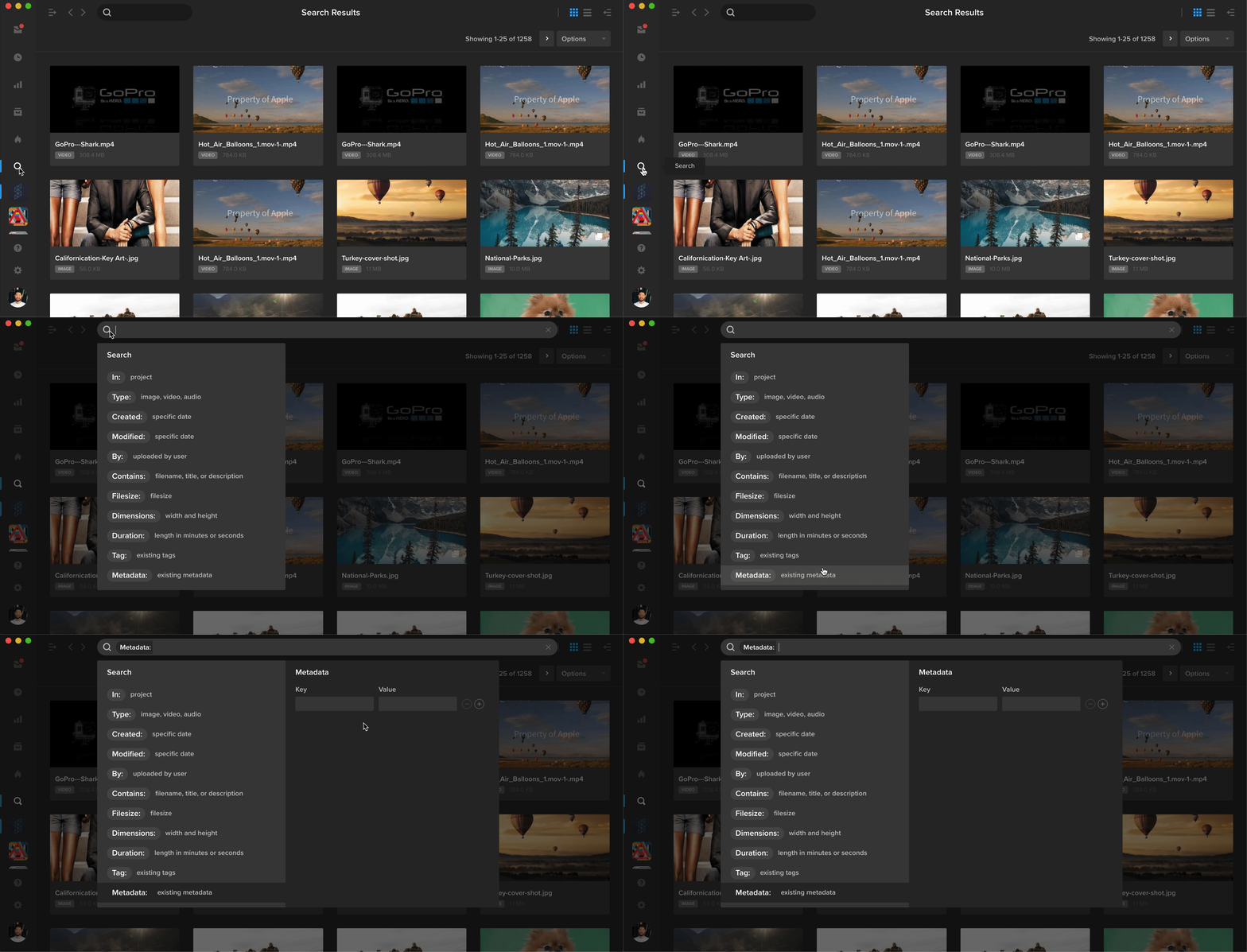
Global Search now supports Metadata as a search filter option, so you can track files based on keys and values.
(more…)
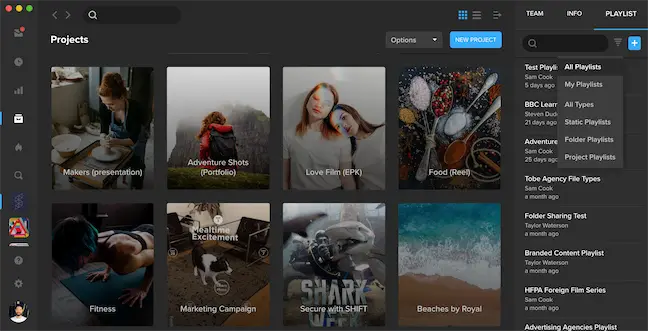
In the right-side navigation drawer, you can now sort your playlists by type: static, folder, and project playlists.
(more…)

Photo credit: Andy Strong, @astrongphoto
Piper Payne’s got a lot to be stoked on, a phrase she uses often. The new EP Visions from Madame Gandhi, former drummer for M.I.A., that Payne mastered just dropped. She also started a new project for Cartoon Network’s Steven Universe in February, and there’s lots of lacquer cutting ahead. Payne, a mastering engineer with studios in Oakland and Nashville, got her start apprenticing under mastering greats Bob Katz and Michael Romanowski.
(more…)
Congrats — you’ve got a killer film, album, product, or event coming out soon. How are you going to let the world know about it?
Back in the day, you would’ve spent lots of time and money printing, packaging, and sending physical press kits with promotional photos, synopses, and media like video tapes or CDs. Look how Star Wars did in 1977.
Luckily, it’s much easier to create robust, multimedia electronic press kits and distribute them quickly and widely in the digital age. Whatever you’re pimping — an indie film or studio album, video games and apps or splashy festival — an electronic press kit (EPK) should be part of your promotions strategy. EPKs are especially handy because they contain in one place all the elements journalists and media outlets need to cover your product, event, or creative work.
EPKs are just one part of a PR push, though. Kirsten Saladow, who spearheaded communications and public relations for Matter Communications, Portland Institute for Contemporary Art, and ChefStable, explains: “In theory, the press kit should solely be for press, and there should be plenty of other marketing materials (website, social media, email newsletters, print pieces, etc.) that artists can send out to their mailing lists of the audience that they’ve built up over the years, so press kits can just be sent to journalists from a PR person.”
If you don’t have the budget for a PR firm to help market your project, don’t worry; we list resources below for building and deploying your own electronic press kit.
What to include in a successful EPK
“This varies so much by what you’re using a press kit for,” Saladow writes in an email, “but typically, it’s important to have a press release that gives the details around whatever the press kit is for, downloadable photos (with photo credit!), video if applicable (also with credit!), bios of artists and/or key executives (if relevant).”
Neal Block, head of distribution and marketing at Magnolia Pictures, describes the EPKs they create in addition to dedicated websites and social media accounts for each film: “For every film we release, we have press notes, a set of still photos approved by the filmmaking team, and clips pulled from the film. We also like to include Q&As with filmmakers to give additional context.”
Filmmaker Matt McCormick, whose documentary The Deepest Hole premiered at Sundance in January, says EPKs are a must-have: “They are vital if a filmmaker wants their film to receive any press.”
An while EPKs will vary by industry and what you’re promoting, they should include the following to be most effective:
- Press release: This should describe the project you’re promoting and use language that journalists can pull from. As McCormick writes in an email, “It’s amazing how many writers and media outlets simply copy or paraphrase a press kit when writing a story about a film.” If the press kit is for a film, include a synopsis. Some even have both short and long versions so writers can cut and paste as much as they need.
- Bios: Include bios on the principals involved in the project — the band releasing album, the sponsor behind an event, the company that’s recently been acquired, and so on.
- High-resolution images: These can be film stills, a headshot, or poster art. Make sure you include credits so the photographer who took the shots is recognized.
- Media clips: Embed the trailer and video clips for films, audio for albums, and performance clips or interviews for arts, theater, and other events.
- Website and social media links: Include social media accounts, website, and any relevant hashtags.
- Press, awards, or blurbs: Already won an award or received good press? Good for you! List it in your press kit and link to it if it’s available online. If not and you can scan the print version, then you can add the high-res file to your website. Alternatively, if you were given a high-quality PDF of the print version, then you can cut just the relevant pages and use that instead.
- Important dates: Let people know where and when they can see your work, whether it’s at a venue, screening, or launch party.
- Contact info: List your PR firm or whoever is handling media relations
- FAQ sheet: Bonus points if you can include a FAQ sheet for quick reference. “The FAQ sheet should include things like date, time, location, price (which should be covered in the press release), as well as things like how many people attended this event last year, if kids can attend, if venues are appropriate for all abilities, etc., which might not be covered in the press release but would be questions that media would want to ask,” says Saladow. “The less you make people have to hunt and dig for an answer, the easier it is on everybody.”
PDF, online, or both?
With the prevalence of social media and easy-to-build website templates like Wix and Squarespace for promoting your project, are PDF press kits still necessary? Indeed they are. Many journalists still expect them and prefer having all the info about whatever it is you’re promoting in one easy file.
“Many websites will have a press section where press kits are available electronically or can be downloaded as a PDF. Typically, the PDFs wouldn’t be outdated, because a press kit is either for something specific (like an event or a new product), which shouldn’t need to be updated frequently,” writes Saladow. “If you’re creating a more general press kit for an arts org as a whole (for example), it’s smart to have that live on a website that you can update frequently. Even if a downloadable PDF is attached to it, you can update both simultaneously, so everything stays up to date.”
Who should receive your EPK and when
Who you send your EPK depends on what you’re promoting. As the name “press kit” implies, you should send it to members of the press relevant to your project, event, or product. You’ll want to send it to as many media outlets, blogs, and journalists who would potentially want to cover it. At a minimum, compile your mailing list at least three months before you want press coverage. Most outlets have editorial calendars that list when and what will be included in each issue, so research the sites of magazines and other publications you’re targeting to see if there are key dates to keep in mind.
“As a general rule, most print magazines are 3-6 months out, so if you are sending your press kit to Vanity Fair in hopes of getting into their print magazine, you’d need to send it to them at least six months in advance,” Saladow says. “Daily and weekly newspapers and digital publications typically have shorter lead times, so you don’t have to plan that far ahead. However, I’d still aim for at least three months in advance.” If your album drops three months from now, for example, you’ll want to get that press kit out pronto.
“Showing that you’ve done your research will help get your press kit viewed”
A press kit can also be used when you apply to film or music festivals or, if you’re a musician, to booking agents. “I’d also advise sending a press kit with a specific pitch to a writer, which means actually reading what they write about and sending them a brief (3-4 sentences!) note about why you think they’d be interested in your organization and/or event. Give them an angle, tell them why they should care, tell them why you’re sending them this press kit,” Saladow says. “Showing that you’ve done your research will help get your press kit viewed and potentially written about, which is the goal.”
Making and distributing your own EPK
Filmmakers can check out FilmSourcing for free EPK templates available to members or StudioBinder, which offers templates that link to their call-sheet software. Musicians can explore Wix’s free website templates or Sonicbids free to cheap templates for interactive landing pages that list tour dates and stream your social media content. If you need inspiration, check out the websites of music labels, film distributors, PR firms, and events. For filmmakers, Tribeca Film Festival has a great archive of EPKs to peruse.
Not every project can set budget aside for a publicist, but you don’t have to be a publicist to send out your own press kit. Once you have it written, compiled, and designed, create a PDF that you can email or make downloadable from your website. When you’re ready to email your media list, either include the link to your site if you’re hosting the press kit there or attach a PDF of it.
A word about social media
Social media is an integral part of our lives today, and it’s tempting to rely on it alone as a way to get the word out. It’s certainly possible, especially if you’re your own publicist, but “if you’re using press kits as part of your media relations strategy, then they are just as important as social media promotion,” says Saladow. “Your average audience member or customer isn’t going to be interested in your press kit, which is one of the reasons why a strong social media presence is important.”
“A press kit is intended for press, so by creating one, you are putting together information that will make a journalist’s job easier which is important if you want reporters to write about your event or whatever it is that you’re promoting,” she continues. “Journalists should be the intended audience for press kits while social media is for anybody and everybody who’s interested in what you’re doing.”
As COVID-19 (Coronavirus) spreads across the globe, it is clear that its spread will not be limited to isolated outbreaks and is developing into something much more widespread. So it makes sense that governments, corporations, and individuals take reasonable precautionary measures appropriate to stop its propagation.
At EditShare, we have watched with concern as the human and economic toll has continued to rise. We have been asking what can and should we do to help. As technologists, scientists and engineers, our response should be directed not just to limiting the effects of the current outbreak, but to considering how we can protect ourselves, our livelihoods and our industries today, and in the future should this happen again. It’s now very clear that a novel virus can appear unexpectedly from anywhere, putting the world on alert, and, in the process, cause significant disruption.
Of course, a degree of inconvenience is not only tolerable but completely acceptable if it saves lives and avoids mass discomfort. But a safe, stable and liveable society depends on a functioning economy. There is no way around this. Managing the situation so that lives can return to normal only happens if essential parts of the economy keep going.
Luckily, the last few years have seen a very significant shift in our ability to work remotely, and that could be the key to minimizing future outbreaks. Digital communication is at the heart of this and video conferencing via Skype, Zoom, and FaceTime are part of many people’s lives – especially when they are spread across a city, country or the entire planet. We’ve not only learned to embrace and leverage these technologies through work but also to keep connected with friends and families around the world.
At EditShare, we have an entire collaborative video production workflow in the cloud, and in the future, all of our products will scale geographically across the globe and move from bare metal servers in the office to the most abstracted and virtual systems in the cloud.
But it’s not just the physical ability to transcend distance and work remotely that matters. It’s also that telling stories – whether through traditional or digital media – has more influence on the way a society changes than almost everything else. In times of crisis, there is an additional responsibility on storytelling enablers: the technologists that build the real and virtual means to create stories and get them delivered to their audience. To keep workers, friends and families connected and functioning in society at a time when they most need to be.
We don’t want to make this an opportunistic shout-out for our technology. Far from it. We want to be open and to work alongside all our friends, colleagues and competitors in the industry and beyond, to make sure that during this episode and whatever comes next, we help to keep things going, keep our businesses moving, keep our lives connected, share our stories and learn from this experience in ways that will make us a stronger and more connected society in the future.
To support remote collaboration across the creative community during this challenging moment in time, EditShare is making its FLOW media management solution available for free now through July 1, 2020. FLOW enables individuals as well as large creative workgroups to collaborate on story development with capabilities to perform extensive review approval from anywhere in the world. Complete this form and one of our FLOW experts will follow up.

At the same time that many of her peers prepared for college finals, Audrey Ember released a video explaining why she had decided to quit school for the second time. For a while, she admits, going back to college was Plan C, but the plan had been scrapped again. “Sorry mom,” she says to the camera with a grin. It’s a moment typical of Ember — honest, personal, reflective of that place between adulthood and owing your parents answers.
The twenty-year-old YouTube creator has been doing things her way for a while now. After pursuing a film degree for two years, Ember decided to focus full-time on her YouTube channel, where she creates content specializing in cinematography, video production, and the creative process. (more…)
Collaboration has always been a key theme at EditShare and since our launch back in 2004 we have worked hard to enable editors to share both media files as well as NLE projects. After all, making films and videos is usually a group effort, and the whole process is much more efficient when everyone on a production team can work from the same common canvas. That’s why over the years we have developed our own sharing solutions and we have also supported any native sharing capabilities that are baked into the various NLE applications.
So naturally we are very excited about Adobe’s new “Productions” feature that gives editors the best Premiere Pro “project sharing” experience ever.
I am pleased to report that over the past two months, EditShare has been testing a beta version of this new feature, and this very significant upgrade for Premiere Pro users does indeed work flawlessly with our EFS shared storage.
“Project Sharing” is a rather broad term, and for those of you who may not be familiar with the concept, I thought it might be helpful to explain it in some detail, so that you can appreciate the somewhat different approaches taken by NLE developers.
Project sharing is a collaboration system that divides up larger non-linear editing (NLE) projects into smaller mini projects, each of which represents a part of the whole. For instance, if a group of editors and assistants is editing a large documentary, they might create individual mini projects for “Rushes”, “Assemblies”, “The Show Open”, “Act 1”, “Act 2”, “Act 3”, “Conclusion”, “Fine Cut”, “Effects”, “Sound Mix”, etc.
As soon as a user opens up one of these mini projects with write access, Premiere Pro creates a “prlock” file next to the project file, effectively “locking” that project to ensure that other Premiere Pro editors on the same project are automatically flagged to open the mini project as read-only, so that they can’t overwrite or corrupt someone else’s work in any way.
When the user with write permission closes the project, the prlock file goes away and now the project becomes available for editing by another user. The system allows users to see each other’s work and collaborate safely. Avid has had a similar sharing feature for a long time, called “bin locking”, and it has been widely used for big projects that require large scale collaboration. In the Avid environment, bins are files on disk inside a project folder, so it’s possible to set permission on each bin file independently. In Premiere Pro, bins are virtual folders inside projects – so you have to do the locking at the level of an entire project file.
EditShare was the original pioneer of “project locking” for non-Avid NLEs back in 2009. Our objective was to enable editors to collaborate in a similar way to Avid but using Final Cut Pro 7 and Premier. At the time, the capabilities were not available in either Apple or Adobe. So we developed our own concept of dividing projects into multiple mini projects (it was mind shift in the way editors needed to think about their projects) and then we created two different systems for ensuring that only one user at a time could get write access to a project.
In our first system, we stored Final Cut Pro 7 and Premiere Pro project files in “User folders” to ensure that only that user had write access to anything inside, and we provided a way to move project files between user folders.
In our second system, we made an automated way to change permissions on a project file as soon as a user opened it, so only that user could write to the project. These were pretty effective solutions to the collaboration problem. But they weren’t native to the applications and couldn’t support some of the features that are desirable in project sharing.
Adobe introduced its own version of project sharing in 2017, but it had some drawbacks. For example, each user had to enable “project locking” in their own project settings. If one user forgot, projects could get locked for some users but not for others.
And one user couldn’t open another user’s sequence and copy a small part of their timeline into their own project, because Premiere wouldn’t let them set in and out points on a timeline from a read-only project. Users had to import the entire sequence into their own project, which also resulted in every clip of the sequence getting imported into their own project space. This wasn’t ideal.
Adobe listened to user feedback and came back with a massively improved method for project sharing, called Productions.
With the new feature, when the first user creates a “Production”, this makes a top-level folder inside which everyone now puts their related projects. Just beneath the Productions folder, you also get some master settings files – specifying things like the location for media and scratch folders. Every Premiere Pro project created inside the Production will now inherit these same settings – so you get total continuity across all parts of the project.
Perhaps most significant, you can now copy small sections of sequences from one project and paste them into other projects, without unwanted clips being copied to the destination project.
Premiere Pro projects created inside a Production also understand the relationship between projects, and what items came from where. So, if you match frame on a clip that was copied from another project, and then reveal the file for the match frame, Premiere will open up the original project where the clip was located – just like Avid does with bins. Adobe has even added a feature that notifies editors when a project opened as read-only has been updated by a read-write user, prompting the read-only user to refresh their view of the project to make the latest changes visible.
The new Productions feature is a major improvement for users of Premiere Pro and we are excited to see this built into Adobe’s editing product. Best of all for EditShare users, we have tested this new feature extensively with EditShare EFS storage and can assure our customers that Adobe’s new method of project sharing works flawlessly with our native Windows and macOS file system client.
EditShare EFS + Premiere Pro continues to be a winning combination!
For a sneak preview of how we support this new feature, visit us at NAB 2020 or contact us at sales@editshare.com.

Emily VanDerWerff is tripping out on voices. She recently learned, for example, that male and female voices aren’t all that different. In terms of pitch, voices considered feminine fluctuate between 100 and 525 Hertz, while voices considered masculine typically stay in the 65 to 260 Hz range. A voice in the overlapping zone — around 100 to 260 Hz — could go either way.
(more…)

For the first time in Academy Awards history, two women were nominated for Best Director at the 2021 ceremony, with Chole Zhao taking home the statue for “Nomadland.” Only seven women filmmakers have ever been nominated in this category, with Kathryn Bigelow being the only other female to earn the title in the ceremony’s nearly 100-year history.
Despite being underrepresented in these awards programs, the percentage of women working as film directors on independent movies has doubled since 2008, rising to 38 percent in 2020. And, women directed 16 percent of the top 100 most profitable films in 2020—the highest recorded—up from 12 percent in 2019.
While there is much ground to cover on the road to equality, the increasing momentum, along with the growing number of resources and champions supporting women filmmakers, is inspiring.
Shift has compiled a list of some of the top resources, women filmmaker associations and collectives, networking and mentoring opportunities, film festivals, and more to help change the ratios by increasing the number of women in film.
Professional and Membership Organizations
The Alliance of Women Directors (AWD) provides hands-on craft enrichment, mentorship, and education to women and gender nonbinary directors who directed at least one long- or short-form narrative film, television program, documentary, commercial, or new media program aired publicly by an established film festival or distribution company.
“Although the current statistics show that women make up a small percentage of working directors, we are hopeful about the future of the industry because we know firsthand the tenacity and dedication of our members. Change is inevitable,” Nikki Braendlin, vice president of AWD, wrote in an email. “We are also encouraged because of companies like NBC, CBS, Disney, Canon, and Fotokem who have partnered with AWD and understand and respect the intrinsic value of the voices of our members.”

Mary Lou Belli, honorary board member of the Alliance of Women Directors, teaches “How to Prep: Television Directing.” Credit: AWD
New York Women in Film & Television (NYWIFT) advocates for equality and supports women at every stage of their film and TV careers. It offers training and professional development programs, scholarships and grants, and a supportive community of peers. It also has a group called The Writers Lab that helps develop narrative feature screenplays written by women over the age of 40. NYWIFT is part of a network of 50 Women in Film chapters across North and South America, Europe, Africa, Asia, Australia, and New Zealand. Check each chapter to see which services and programs it offers.
The Couch Film Collective also offers grants, workshops, mentorship, and social events for women filmmakers. The organization works to get women and nonbinary people in front of and behind the camera at all levels of production. It’s an intersectional group that produces and supports equitable and inclusive projects that hire at least 51 percent of people who self-identify as women or non-binary, 35 percent people of color, and are LGBT inclusive.
Opportunities and Funding
Women in Film (WIF) offers funding, scholarships, a screening series, mentoring, workshops, and more.
“The industry is in a moment of genuine transition, finally beginning to understand that the media we create must reflect the world we live in and that its current structures and systems also need to transform to accommodate that,” Maikiko James, WIF’s director of programs, wrote in an email. “WIF is excited to be at the frontlines of this movement. We’re committed to these transformations at both the structural level and through elevating the incredible talent of the community we support.”
Women Make Movies supports women producers and directors through all phases of their careers, planting the seeds for a diverse and inclusive filmmaking landscape. In addition to being the world’s leading distributor of independent films by and about women, it offers a production assistance program for women working in independent media. Verizon also continues to support its Future Fund, setting aside $5 million to support female-led entertainment projects. Those who receive funding will also get access to Verizon 5G Labs across the United States and the Verizon Media RYOT 5G Studio in Los Angeles.

From L to R, Kimberly Cooper, Catherine Day, and Evette Vargas speak at the VR pioneers panel. Credit: Women In Film
Chicken and Egg Pictures supports women nonfiction filmmakers at various stages in their careers. Since 2005, it has awarded $8 million in grants and thousands of hours of creative mentorship to more than 300 filmmakers.
The Sundance Institute offers the excellent Inclusion Resource Map, a searchable database of opportunities and programs available to U.S.-based artists from underrepresented communities.
More locally, New York City-based women working in film or theater can turn to the Mayor’s Office of Media and Entertainment, which offers grants, speed funding, and a screenwriting competition. For members of Women in Film & Video Washington, D.C., Carolyn’s First Decade Fund has a professional development grant designed to help advance the careers of women in their first decade of working as media professionals and provide them with access to a larger film community and continuing skills development.
Female-Focused Film Publications
Women and Hollywood highlights women filmmakers and agitates for increased opportunities for them. CherryPicks compiles film reviews written by women from across the web, creating a score based on their reviews.
Women Under the Influence shares the stories of cinema directed by women through events and media. Check out their fantastic watchlists of female-directed films, such as “Sweet Dance Movies” and “Films of Resistance.”
Film Festivals
There are many festivals that cater to women filmmakers. Here’s a small sample:
- Rocky Mountain Women’s Film Festival, the longest-running women’s film festival in North America, showcases documentary, narrative, shorts, and animated films.
- St. John’s International Women’s Film Festival, established in 1989, is more than a festival. It offers film screenings and forums, workshops and master classes, youth filmmaking camps, mentorship programs, and advocacy work throughout the year.
- LUNAFEST, a 20-year-old festival by and for women, presented by LUNA Bars, raises funds for women’s causes while providing a global stage for female filmmakers.
A few female-focused, genre-specific festivals include:
- Reel Sisters of the Diaspora, an annual two-day film festival showcases movies directed, produced, and written by women of color.
- Ax Wound Film Festival, the official film festival of Women in Horror Month, features a diverse selection of horror films written and directed by women from around the world.
- Broad Humor Film Festival screens “smart, sexy, and unapologetically funny” short films, web series, and features written and directed by women.
Inclusion Research and Advocacy
The Center for the Study of Women in Television and Film at San Diego State University houses the longest-running and most comprehensive studies of women in film and television. Dedicated to producing extensive and timely research, its studies provide the foundation for a realistic and meaningful discussion of women’s on-screen representation and behind-the-scenes employment.
Need statistics and reports on diversity and inclusion in entertainment? Turn to the Annenberg Inclusion Initiative. It produces insightful research papers and reports and develops targeted, research-based solutions for tackling inequality.
The Queen Collective program, developed in partnership with Procter & Gamble, Tribeca Studios, and Queen Latifah, seeks to accelerate gender and racial equality behind the camera. Its first act was funding short films by two directors whose work premiered at the Tribeca Film Festival and streamed exclusively on Hulu. One of the directors, B. Monet, said at a press conference for her film, “It’s not that [women] are not amazing, and dope, and all these kinds of stuff. We need the opportunities. We need people to take chances on us.”
Looking Ahead
While the last couple of years have been tumultuous for the creative community on several fronts, the years ahead look strong for not only female directors and creators but also others looking to introduce more equality and diversity in the industry.
With diversity comes more relevant content, vibrant stories, and unique perspectives that capture the essence of our world today and the experiences of those around us.
Shift has been focused on delivering the tools, resources, and content that creative teams in all industries need to perform and share their best work, and we invite you to subscribe to our blog to follow these and other trends.
If you are interested in learning more about the Shift platform and how it helps creative teams stay connected, enhance collaboration, and create exceptional work, we encourage you to sign up for a free two-week trial.






