Your film has reached picture lock. The director is happy and the producer is relieved. Now, it is time to move the edit over to the online facility. Whether this is your first film receiving a proper finish, or if you are an assistant editor moving up the ranks and need a refresher, follow along with our online editorial preparation guide to ensure the conform process runs as smoothly as possible.
What is offline editorial?
A video editor often only edits. What we mean by that is: final transitions, effects, color correction, and titles are often handled by a dedicated department broadly referred to as “online.” That is not to say a video editor only handles straight cuts. Quite often, the editor will use color correction to set an overall guide for the production to follow. Or, the editor makes placeholder title cards to establish the timing of elements in the cut. By distributing work across a team, post-production departments can work more effectively.
The department responsible for the video editor bringing the edit to picture lock is referred to as “offline.”
What is picture lock?
Picture lock, or locked picture, is when the timing of each edit is decided. Once this is determined, other departments, including sound, music, color, and visual effects, can start their work.
What is online editing?
Online editing is the process of ensuring every piece of video, image, title, or transition is created at the best possible quality. This is to ensure that footage is ready to be versioned and distributed, looking its best on every screen. Online editors coordinate with distributors and associate producers to add elements such as commercial breaks for television broadcasts and seamless cuts for the streaming release.
They are additionally responsible for technical issues such as mismatched frame rates and dead pixels. They will use the best techniques for speed ramps that blend or morph frames together to look more natural than a frame duplication technique.
Sometimes, online editors will add effects such as glows and blurs, or perform chroma keying for green screen removal. They additionally tend to have many restoration plug-ins at their disposal, such as noise reduction to contend with grainy and underexposed footage or de-flicker to compensate for the interference left by fluorescent lights.
What is the conform?
Conform editing, sometimes just called “the conform,” is the process of relinking each piece of media to the highest possible quality source. This could mean unlinking dailies and connecting to the camera’s original files, or purchasing a stock image that does away with the watermark. Conform editing is either done by the assistant editor at the end of offline or is handled by an online editor during the preparation for final color correction.
What software is primarily used for online editing?
Software used for online editorial varies on the preference of the online editor and the infrastructure of the post-production facility. Any software that can input raw camera files and support professional codecs can be utilized for online editorial.
Adobe Premiere Pro paired with Adobe After Effects is commonly used for finishing. After Effects offers great communication over the Premiere in the form of motion graphics templates (or MOGRTs), which makes text and animation-heavy projects a breeze. The addition of dialog transcribing tools and closed captioning support streamlines the finishing process and uses fewer tools than in recent software generations. Similarly, Final Cut Pro paired with Motion is another strong combination for finishing artists.
Avid Media Composer with the Symphony option had been a popular choice as Symphony was one of the first dedicated online editing tools on the market. A major advantage of using Symphony is that if Media Composer was used during the offline, edit transitions, titles and effects will translate into the new timeline natively. For even more effects, Blackmagic Fusion and Filmlight Baselight offer Avid native plug-ins for online editors.
There are “big-iron” solutions for online editorial; highly specialized combinations of hardware and software that cost north of six figures to deploy in a facility. These suites tend to feature a combination of editing, color, compositing, and restoration features. The most popular of these platforms are Autodesk Flame, SGO Mistika, Digital Vision Nucoda, FilmLight Baselight, and Grass Valley Rio. The advantage of using one of these high-end tools is the feature set paired with excellent performance and real-time playback of complicated effects. However, their somewhat niche status makes learning any of these platforms a bit difficult for newcomers and leaves the job market for talent highly specialized.
And last, but certainly not least, is DaVinci Resolve. The long-popular color correction suite has added video editing and VFX compositing tools in recent years and features a fantastic noise reduction tool for contending with underexposed footage. For ease of use, cost, and overall features, Resolve is tough to beat.
Is online editorial simply software?
There are additional hardware requirements for online editing. Color-accurate monitoring with high bit-depth support is also required to properly view the results. Therefore, broadcast-quality video monitors or digital cinema projects are required during the online.
Online editorial requires the ability to playback and the most demanding camera formats with complicated effects in real time so that directors and producers can approve the work being reviewed. For this reason, online facilities require large arrays of network-attached storage (NAS), whereby dozens of drives work in tandem to facilitate the speed and size requirements of camera raw footage.
How does the online software receive the edit?
Often, the online edit system will differ from the offline system. For example, a show may edit in Avid Media Composer and online in DaVinci Resolve. The key component for this workflow is the Edit Decision List (or EDL). An EDL describes the metadata of every cut made in the picture-lock timeline so that the timeline can be recreated in another piece of software.
The key components of an EDL are:
Source Media Clip Name
Source Media Reel Name
Source Media Timecode In-point
Source Media Timecode Out-point
Edit type (cut, dissolve, etc.)
Timeline Track
Timeline In-point
Timeline Out-point
Edit Decision Lists are human-readable. If you were to print out an EDL and give the results (and source media) to another editor, they would be able to recreate the edit in another piece of software manually. Thankfully, the software does this process for us.
However, EDLs are far from perfect; there are many components in an edit that they do not describe, which are:
Positioning, such as zooms and pans, does not translate.
Effects such as blurs and glows are not maintained.
EDLs do not translate title information.
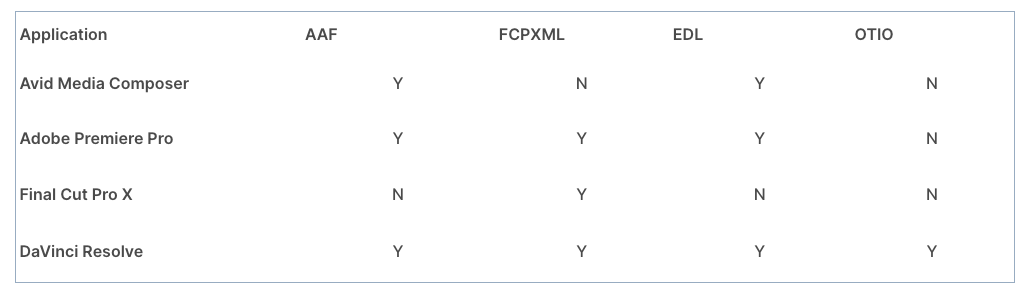
To compensate for these shortcomings, there are more sophisticated interchange formats. These formats offer some effects translation and are better overall formats than EDL. These are the following:
AAF – Advanced Authoring Format. AAF replaces the now legacy OMF framework.
FCPXML – Final Cut Pro Extensible Markup Language. Often referred to as simply “XML.”
OTIO – Open Timeline Input Output. A relative newcomer to video editing software, though used in the visual effects industry, OTIO is an open-source solution offering the benefits found in an AAF or FCPXML. Hopefully, this format will continue to gain traction and see more adoption in the industry.
There are varying levels of support for different interchange formats. The software receiving the interchange may not interpret the edit list correctly. For this reason, we recommend sending an AAF or FCPXML as the primary interchange file and then sending an EDL as a backup.
Timeline preparation for online
Duplicate the picture-lock timeline
Assess the work of the video editor and determine what the methodology is for layer management. Using as few layers as possible, consolidate the timeline onto thematically dedicated layers. For example:
Video 6 – Titles
Video 5 – VFX
Video 4 – Stock Video
Video 3 – Transitions / Bumpers
Video 2 – Primary Video
Video 1 – Primary Video
At this stage, assets such as titles need to be on their own layer (and only their own layer) to quickly be hidden during reviews. It can be additionally helpful if special camera types (such as a GoPro only used on occasion) are isolated onto their own layer, as this footage may require special processing to match other cameras.
Remove unused content
While fleshing out the story, an editor may have unused takes or alternate ideas on the timeline and simply disable them. At this point, delete the unused clips. Not only is this for visual clarity, but it is also important to keep EDLs as minimal as possible to avoid the loading on redundant assets during the conform.
Commit multicam edits
Multicam clips are essentially containers on the timeline, referencing other elements in the project. This is helpful for organization and gathering multiple angles. However, these kinds of clips do not reference metadata in the same way as a video clip and, therefore, do not translate to an EDL. The Multicam “containers” need to be broken down to show only the video angle used. To do this in the following applications:
Premiere Pro
Select all clips in the sequence
Right-click > Multi-Camera > Flatten
Avid Media Composer
Select the sequence in the bin
Right-click > Commit Multicam Edits
DaVinci Resolve
Select all clips in the timeline
Right-click > Flatten Multicam Clip
Add timecode burn-in
Timecode burn-in offers a visual indicator of how metadata relates to the edit. Use a smaller font size and pack away this information in the lower left of the frame so it is not in the way of any screen action. Some suggested fields for the burn-in:
Record Timecode – where clips need to be in the edit and can help troubleshoot any drift or relinking issues
Source Clipname – what video file was used in the timeline
Source Timecode – wherein the video file is used
Export a reference clip
The reference clip is a representation of the timeline for use on other platforms. It is used by the online department to check the integrity of the conform and to ensure effects such as pan and zooms are translated correctly. Sound and music teams will additionally need to use the reference picture.
When exporting a reference clip, be sure to utilize either Apple ProRes Proxy or Avid DNxHR LB codecs, as these formats are optimized for the post-production process. H.264 files are not ideal as they rely on temporal compression to save filespace, which can slow down a computer during playback and could introduce discrepancies at the per-frame level.
What happens if changes need to be made after picture lock?
Do not worry. This happens very often. At this stage, communication is important. Consider the following:
Inform all other departments that a changed reference is coming once a new picture lock is achieved.
Version up the timeline in the editing software.
Avoid “rippling” the timeline whenever possible in the new edit. Try replacing a shot with another that runs the same length to prevent sync issues.
Clearly track every change with a marker and a brief description. Send the timecodes of these changes to the new departments in an email.
Deliver a new AAF, FCPXML, or EDL to each department with only the new changes (remove non-problem scenes from this timeline upon export). Alternatively, a program like Change List X can compare two different FCP projects and generate a list of only what is different between them.
Output a new reference picture of the whole film with the new changes included.
Is online editorial still relevant?
For many years futurists and post-production supervisors thought that the online department would become obsolete and for good reason. Software is increasingly more affordable and computers are exponentially faster, while the prices of storage have plummeted. However, dedicated tools and clearly defined responsibilities during the finishing and distribution processes are more relevant than ever. So for now, keep your bins clean and your timelines tidy, and we wish you a smooth conform to keep the online department moving right along.
MediaSilo allows for easy management of your media files, seamless collaboration for critical feedback and out of the box synchronization with your timeline for efficient changes. See how MediaSilo is powering modern post production workflows with a 14-day free trial.
Keeping post-production on schedule requires continuous communication and coordination. As editorial, sound and visual effects teams are working in-person, remote and hybrid across different vendors, a single review portal keeps producers and artists working without delay. An intuitive workflow is only one component in the post-process; security is arguably even more important. User management and a comprehensive set of permission controls ensure that the right artists have eyes on the right assets.
While there are a number of free tools that can quickly post a video online, using them for coordinating work, versioning and tracking progress quickly becomes difficult. A purpose-built solution for visual effects and editorial teams is ideal to keep post-production moving along. Read on to discover how to quickly lock edits, approve reviews and securely collaborate remotely.
Approvals and feedback
As editorial teams lock cuts and VFX artists render shots, work in progress needs to be showcased for approval. MediaSilo equips editorial, production and post facilities with streamlined tools that get shots and cuts ready for review. Popular delivery codecs, including Apple ProRes, Avid DNX and H.264, are supported for native playback from MediaSilo, without the need to transcode additionally. Some image-sequence formats–such as DPX and EXR–need to be downloaded before they can be reviewed.
In MediaSilo, once a project is created, teams of users can be invited with just a few clicks; and helpful preset templates keep permissions and access controlled. For example, the editorial team can have download access, and the production may have streaming only. Uploading media can be done drag-and-drop straight from the desktop, and folder trees are maintained during the upload to a project.
As creative stakeholders add notes, projects can be easily managed to keep the flow going. Artists and clients need to be in constant communication. Rather than adding new uploads (and having to send out new links), videos can be versioned to show the progress of the latest cut. During review, creative stakeholders can make notes in the form of a comments field, and artists have the ability to mark these comments as incomplete or done. Per-frame annotations can additionally be added.
For media composers and Premiere pros
The amount of supported codecs, formats and wrappers within MediaSilo is extensive. From a standard H.264 to Apple ProRes to Avid DNxHD – there are so many deliverable formats that chances are, you won’t have to do any special outputs to get content online. There is even support for uncompressed graphics formats such as TIFF, CR2, PSD and even vector formats like SVG. Simply drag and drop the desired asset into the portal, and your client (and only your client) will have instant access.
Adobe Premiere Pro editors can enjoy the MediaSilo extension, which can directly generate review links from the NLE straight out to clients, and client notes will automatically sync with Premiere for even fewer mouse clicks. Avid Media Composer editors can import notes coming out of MediaSilo in the form of a .txt file that is optimized for Avid workflows.
Security
Post-production is the central hub for all things related to production. Since the editorial team has the footage at their fingertips, they often receive the first call when an asset is needed. Sometimes, the wardrobe department needs footage from a previous episode to recreate a costume or, a visual effects artist needs to reference the look of a specific location. Whatever the reason, key creatives need immediate access to source footage.
MediaSilo pairs user permissions to specific projects. For example, a production creative might only require stream-only access to a scene, whereas the art department needs download access. Configuring either is easy. Links can also be set to expire after a time window, and custom watermarks can be generated as needed.
Multi-factor authentication is available for situations where device access is a concern, such as remote teams or shared office spaces. With MFA enabled, teams can use an authenticator app like Google Authenticator or Authy to add another layer of security. It’s a simple, safe and straightforward solution to keep assets under lock and key should an account login be compromised.
By providing a single, secure portal for review, many potential vulnerabilities are closed. The post-supervisor isn’t managing email accounts and passwords manually because the platform backend handles those details. Logins and passwords do not ever need to be shared over email, and review links are less essential as the portal-style layout of MediaSilo gives each user a customized view of just the content they need access to.
Stopping leaks
The most unfortunate scenario would be if a production member’s computer were to be hacked and footage gets leaked. Though rare, it certainly does happen. Sometimes a reused password is the culprit; other times, it could be a more serious exploit within a network or facility. Whatever the case, SafeStream within MediaSilo projects offers forensic watermarking that can showcase which user’s account was responsible for the leak.
With usage tracking built-in, security and network admin discover when any unusual activity occurred. This allows the production to quickly migrate off the compromised devices and accounts. Identifying sources quickly helps solve problems and keep production moving.
Can’t I just use a free tool?
There seems to be an expectation that video can be easily and instantly shared for review, in part because user-generated content is absolutely everywhere. However, any assistant video editor will gladly share how cumbersome it is to post unlisted videos to a major sharing site or that cloud storage folders can become cluttered quickly with revisions. In the case of video post-production, a free-to-use video-sharing network is not the best tool to reach client approval. The fact is that these platforms were not designed for production usage.
Once notes start coming in, things can get confusing quickly. Did the producer mean the timecode in the video player toolbar? Or the burn-in timecode? Now that there are creative notes coming in by email, how do those notes get organized and tracked? Who crosses off shots from a spreadsheet as they are approved? All of this coordination adds confusion and can waste time during production.
Remote work is here to stay
In many ways, post-production has always been remote, even before WFH was trending. A film may utilize multiple vendors to divide visual effects and motion graphics or be filmed in one city and posted in another. This concept has only been expanded upon in recent years, with individual artists and coordinators working from home and reporting to a single studio. For the foreseeable future, team reviews are more likely to happen online and less so in the boardroom.
Remote workflows have been demonstrated to be as effective as in-person collaboration, but additional considerations need to be made; communication and coordination being principal among them.
Even if you are a freelancer, you can’t always assume that a review portal will be provided for you. Increasingly, productions are bypassing post-boutiques and hiring artists directly. If coordinating assets or reviews is not your current expertise, it may well soon be.
Getting post-production onto a platform like MediaSilo will get creative teams’ communications and—fingers crossed—get through the client notes. And the assistant editor will most certainly be a lot happier. With simple coordination, ease of use and speed, key creatives will spend more time locking shots and less time digging through emails and crossing off notes in spreadsheets.
MediaSilo allows for easy management of your media files, seamless collaboration for critical feedback, and out-of-the-box synchronization with your timeline for efficient changes. See how MediaSilo is powering modern post-production workflows with a 14-day free trial.
Many content creators find themselves facing the need for organized, secure, shared content storage for the first time. You might be a successful YouTuber, or perhaps a growing corporate communications business.
The common factor is that you have an increasing archive of material which you need to organize. Efficiency means you need to reuse some of that material. Location shooting is expensive; you will wear out your welcome if you keep calling up the CEO to ask about shooting some B roll every time you need it.
Keeping Track of your Assets
So you need to know what you have and how to find it. Keeping track through stick-on labels on USB drives or on camera cards, or at best an Excel spreadsheet, is not a scalable solution. Storing the material on USB disk drives on a shelf is increasingly impractical. And, of course, there is the question of content security: if the shot you are looking for is only on one disk drive and it goes faulty, what can you do?
What you need is a solution which will provide very secure, very resilient storage with asset management so you can search your archive.
You may think that EditShare storage systems are for big production companies, and certainly we do supply some of the biggest in the world. But the good news is that our platform is designed to be scalable, so you can start with something small, confident that it will grow as your business does.
Avoiding Data Loss
And however small you start, you will always have the highest levels of protection for your content. Automatically, within the storage device, RAID protection tuned to the needs of video content will ensure that your material is protected.
Working Out What You Need
The question, then, is how much storage do you need? There are a number of online calculators (https://www.omnicalculator.com/other/video-size, for instance) where you can put in your video format, frame rate and length of the recording and it will tell you how much data you have.
If, for instance, you are planning a five-minute video, and you expect a 10:1 shooting ratio. Your acquisition format is ProRes 422, 1080p/50. The raw footage is going to come out at a little under 100 GB. Add some extra for edits and renders.
Then multiply by the number of projects you have now, and how many you plan in the immediate future – the next year or two. That will give you the capacity to aim for.
The EFS 200 is designed for this sort of production capacity. You can start with as little as 24 TB of storage – room for a couple of hundred of our sample project including room for RAID protection – and you can scale it up to 360 TB simply by adding disk drives as you need them. It automatically manages distributing the data so nothing is lost and no time is wasted.
It is a network device, so whether you are using Mac, Windows or Linux you will see it as a connected device, directly accessible from your favorite edit software. There is no need to learn anything new. Better, because it is on the network, you can have multiple editors working on multiple projects simultaneously, without loss of performance.
Having this sort of content management gives you security, it boosts productivity, and it helps you manage your precious assets. You can start with the right size for your business as it currently stands, confident you can grow in the future without issues, even if your ambition is to be one of the most successful production companies in the world.
When you visit the cinema, there’s always been a certain joy to be had in seeing the trailers for upcoming films (ignoring those who purposefully turn up 10 minutes late). It’s a chance to catch a glimpse of the next big blockbuster and make a mental note of when you’ll be back.
However, in recent years, doesn’t it feel like a lot of movie trailers aren’t up to snuff? Perhaps those turning up 10 minutes late know something. Whether they’re too loud, too confusing, too long, or potentially just ruin the whole plot (this is happening far too much), some movie trailers seem to have lost their way. We’re here to show that with a bit of understanding and knowledge, it’s still possible to make a great trailer for the ages.
The importance of a great trailer?
Studios invest millions of dollars into the marketing and promotion of films in the hope that they’ll sell enough tickets and merchandise to turn a profit. So, before anything else, a trailer is a marketing tool. There’s perhaps no other marketing tool used to promote a film that is as influential as the trailer. If it leaves you wanting more and makes you think, “Yeah, I’ll buy a ticket for that,” it’s a great trailer. It’s just like any other piece of advertising, selling a product.
With that in mind, let’s get into the do’s and don’ts.
Show as little plot as possible
This is the number one problem with a lot of trailers in recent years. For two to three minutes, the trailer seems to act as a “mini-movie,” giving away all the important plot points and leaving you feeling as if you got the whole story already. It defeats the purpose of a trailer because rather than thinking “I can’t wait to see that and find out more,” you’re left wondering, “Why would I go and see that when I already know the whole plot?”
A trailer that felt very guilty about doing this was Spiderman Homecoming (2017). It just felt like an overall summary of the movie, revealing all of the plot points that should’ve been kept hidden to surprise the audience.
The decision to do this is a perplexing one. Can you imagine if the trailer for Star Wars: The Empire Strikes Back (1980) featured Darth Vader delivering the iconic line “No, I am your father”? If you’re making a trailer for a comedy film, don’t give away all of your best jokes. If it’s a sequel, don’t freely reveal huge plot points that the audience didn’t know at the end of the first film. If it’s a horror film, don’t reveal the monster! Why would anyone want to watch your film if you’ve left nothing to the imagination and created no mystery about the story?
Instead, you want to do just enough to tease an audience and leave them wanting more — that urge to fill in all of the blank spaces and explore the world that’s been created. You want to have your audience asking questions such as, “Who is that?”. . . “How does this work out?”. . . “What does that mean?”
The trailer for Dawn of the Planet of the Apes (2014) did an excellent job at this. It’s full of suspense and mystery, none of the plot is given away and we’re left with plenty of questions we want answered.
Show off your best visuals
While you don’t want to reveal the whole plot and ruin the film before release, it’s okay to show off the visuals if you can do so in a sensitive way that won’t give the game away. Ultimately, movies are a visual medium, and you can entice an audience into watching them by showing off some of your best work in the trailer.
This technique can work particularly well if your trailer is for an action film that features huge set pieces and cutting-edge special effects. It’s not a secret that the best way to experience these moments is on the big screen — that’s a major selling point for your film, so don’t be afraid to show it. Rather than revealing the whole action sequence and all the big moments, you can just offer a glimpse or a taste that leaves the audience wanting more — that’s always the goal here.
Check out the trailer for Pacific Rim (2013). It’s big, brash, and bold. This is a film about giant human-controlled robots fighting giant monsters and boy, do we know about it. We’re given plenty of little teasers of the great special effects and action on display, making us keen to see the whole film on the biggest screen possible.
Market your talent
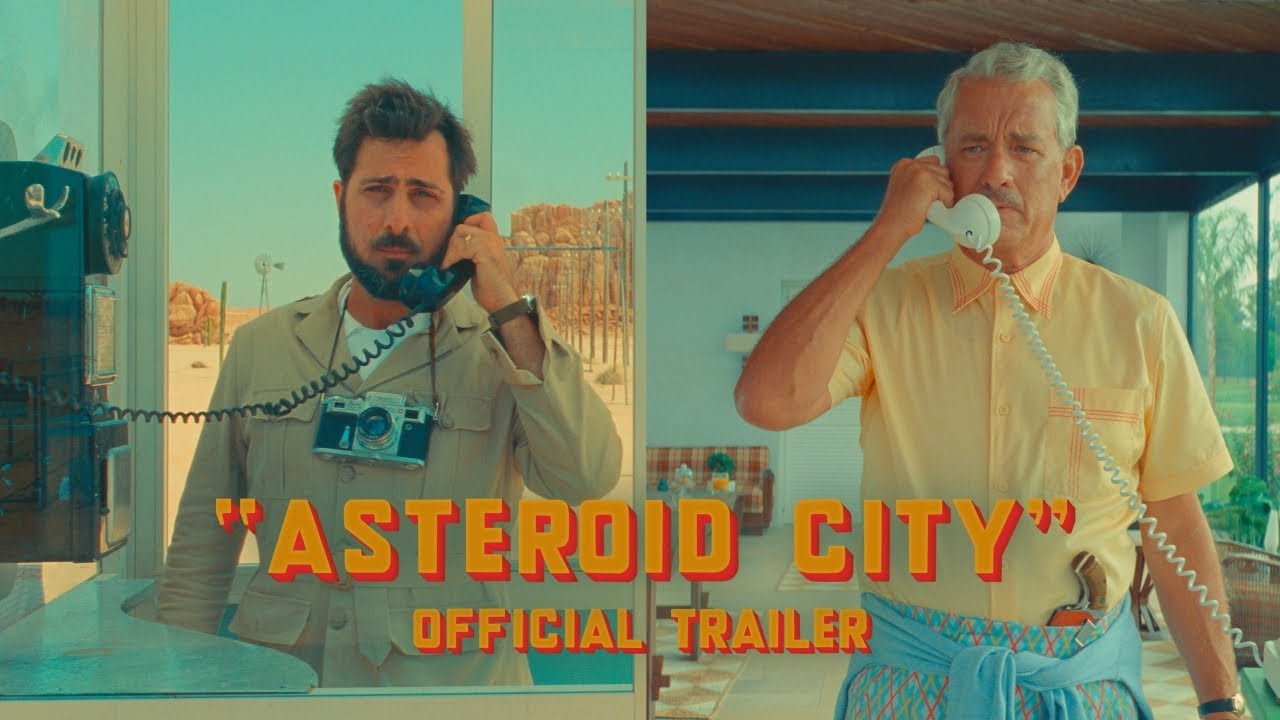
The other main reason an audience might be enticed to come and watch your film is that they’re a fan of a certain actor or director who’s been working on it. Identify your star talent on screen and make them front and center of the trailer, showing off the depth and range of their performance in your film. Even if a “big name” isn’t the main character in the story, just showing their face can be enough — the stamp of approval that makes someone think “Yep, I’ll buy a ticket to see that.” Just look at the trailer for Asteroid City (2023). It’s stacked full of great actors!
Similarly, suppose the film has been produced or directed by a well-known name in the industry (Steven Spielberg, for example). In that case, you might want to feature graphics and text such as “from legendary director Steven Spielberg.” In the case of Wes Anderson, people know immediately because of his unique style, but usually, don’t assume people know the director without telling them.
Another way to do this is to highlight their previous work. For example, in the trailer for The Creator (2023), we’re told that this movie is from the director of Rogue One (2016). I didn’t know that beforehand, but I loved Rogue One, and now, I’m more inclined to go check this out.
When to use graphics and voiceovers
You only have one or two minutes to entice an audience into watching your film, so every second counts. Using graphics and voiceovers in your trailer can help deliver extra vital information, as well as help to aid the story the trailer is trying to tell.
Of course, there are some very overused, tired clichés with this. Hollywood certainly went through a moment where it felt like every trailer used that “voiceover guy” to deliver the cheesy line “in a world…”
His name is Don Lafontaine. While he’s awesome at his job, trailers have evolved and moved on from that style nowadays. Here’s a mashup of Don’s trailers, along with a few other iconic voices who worked the “VO trailer guy” circuit:
What could set your trailer apart and work quite well is to use the voiceover from one of your characters in the film. Leonardo DiCaprio does a great job in this recent trailer for Killers of the Flower Moon (2023). The “Can you find the wolves in this picture?” speaks directly to us, inviting us into this world and this story.
Notice the simple but effective use of graphic text, too. It gives us the following important details:
This is based on a true story
This is directed by academy award winner Martin Scorsese
It’s being released this October
A phrase summing up the story: “Greed is an animal…that hungers for blood”
The title of the film
How to use sound effects
Just like the film itself, music and sound effects can play a massive role in elevating your trailers. One of the most iconic, praised trailers is for the original Alien (1979). There’s no dialogue or music, just the use of terrifying sound effects, conveying the ominous, scary vibe of this iconic sci-fi horror.
Sound effects can go a long way in crafting the atmosphere and tone of a trailer. In what may be a homage to the Alien trailer, the teaser for Godzilla (2014) is equally intense, using simple but-terrifying risers that deliver us into this unsettling world before hearing that iconic roar at the end.
Notice how that trailer also utilizes sound effects that seem to dictate the cut. Various drones, otherwise known as “braaams” in the business set the pace of the trailer and reveal new scenes. This sound effect is now very common in the world of movie trailers, but it was originally used in Inception (2010).
And just to prove it really is being used everywhere, here’s a mashup…
Music matters
If your film is scored by someone as great as Hans Zimmer, then chances are you’d want to make use of that epic soundtrack in your trailer. On the other hand, some trailer editors go in another direction, picking out an iconic song that’s already well-known and either laying it directly over the trailer or remixing it. In The Creator(2023) trailer we hear a remixed version of “Dream On” by Aerosmith throughout.
For the John Wick: Chapter 4(2022) trailer, we’re treated to a very different version of Westlife’s “Seasons In The Sun”. If you listen to the original, there’s no way you’d ever dream of using it for a trailer advertising the heavy-action-thriller world of John Wick.
And yet, this cinematic remix works seamlessly…
Just like sound effects, music can be used as a tool to craft the tone and atmosphere of a trailer, delivering further information to the audience about what type of film this is going to be.
What’s a bumper?
Last but not least, a relatively new phenomenon has happened in trailers in recent years. It’s a trailer… for the trailer. Known as a “bumper,” these 5–10 second flashes happen immediately at the start of the video, showing what’s going to happen in the trailer before the full trailer then plays.
Why on earth would editors cut their trailers like this? In the highly-competitive world of social media, where it’s becoming increasingly hard to hold people’s attention, the bumper is a way to grab someone’s attention and convince them that it’s worth watching the whole 2-minute trailer.
Here are a few examples:
Wrapping up
So, that’s everything you need to know about how to make a great trailer. It’s a fine balance between showing off your best moments and top talent while ensuring the plot remains a mystery and entices your audience, leaving them asking questions and wanting more.
It’s not an easy task, but with an understanding of how to market your talent, master sound effects, perfect music choice, and know when and where to use your graphics and voiceovers (if at all), you can craft something truly memorable, and a whole lot better than some of the trailers currently out there.
MediaSilo allows for easy management of your media files, seamless collaboration for critical feedback, and out-of-the-box synchronization with your timeline for efficient changes. See how MediaSilo is powering modern post-production workflows with a 14-day free trial.
According to the FBI, businesses in the United States lost $10.3 billion last year through data breaches. On a global scale, those losses were as much as $600 billion, and while all businesses face virtual attacks, the dynamic, collaborative production practices of the media and entertainment industry make it especially vulnerable to cybercrime. This spring, the nonprofit Content Delivery and Security Association (CDSA) took a key step in combatting those risks with the creation of innovative industry-wide professional standards for film and TV production security.
Created by the CDSA’s Production Security Working Group, the new guidelines are a response to a growing breed of data leaks in the entertainment industry. Media companies have been swiftly adopting new digital technologies as they scramble to adapt to changing consumer viewing patterns, which are increasingly online and on-demand. Yet, as important and useful as these technologies have been, they also create new vulnerabilities.
Film and TV lag behind
Security practices in film and TV are frequently failing to keep pace with these changes. Perhaps the most well-known breach involved Sony Pictures during the production of The Interview, when executives scrambled to manage the circulation of pre-release movie content alongside key financial data and sensitive personal information, giving the world a taste of the high stakes involved in serious media-security leaks. CreativeFuture, a nonprofit that focuses on protecting artists and creative workers from for-profit piracy, estimates that 700 million people seek pirated content from 13.9 billion web pages every month, generating an annual cost of $52 billion to the film industry.
And in the age of “fake news,” insecure data can also be repurposed to reappear in troubling locations, from misleading political content to unauthorized marketing or digitally manipulated pornography. Lori Loeb, director of the digital arts program at Dartmouth College, points out that data security risks are not only financial but go to the heart of media ethics. “For independent media makers, the threat of copying or using content for ‘deepfakes’ is increasing,” she reports. “I find it scary to imagine that content I produce could be used to create a fake news story or ripped off for someone else to use without permission from the actors or producers.”
Not to point fingers but . . .
While the Sony data breach was the product of malicious activity, many others are the result of accidental exposure through an unsecured device or file. These small-scale, low-tech data breaches are often an equal menace to media security. Office printers, for example, were a source of data leaks for 68 percent of businesses surveyed for a recent report by Quiroca.
A rising portion of digital threats come from within organizations too, according to Symantec’s 2022 Internet Security Threat Report, increasing the need for cybersecurity at multiple levels. Regardless of their size or source, all kinds of leaks can send data into the wrong hands. For smaller businesses or independent contractors, a single breach can compromise years of work or take a significant financial toll.
While the entertainment industry has a history of standardized practices in areas like safety, a lack of security norms has meant that workers have needed to adapt to a constantly changing assortment of methods and rules on each production, creating miscommunication and leaching production time. A lack of standard security training has also meant that important issues often go unaddressed; unattended phones or tablets, insecure servers, or unprotected cloud platforms can be an inadvertent source of disastrous leaks.
CDSA to the rescue
To address these issues, production, technology, legal, and security experts from AMC, Bad Robot, BBC, Marvel, NBCUniversal, Walt Disney, and others worked for more than a year in collaboration with online content providers such as Amazon, Netflix, and Hulu and members of the Producers Guild of America to create the CDSA’s industry-wide security standards. Their recommendations offer a blueprint to protect against cyberbreaches from a production’s start to its finish.
Alongside the complete draft of detailed recommendations, the CDSA has released a one-page production checklist, a general summary of guidelines to help with project planning and budgeting, and a sheet of individual responsibilities to be shared with all cast and crew members. They’ve also compiled a list of helpful websites with resources about regulations, international standards, and other data protection strategies.
As useful as these recommendations are, the Working Group cautions that they’re a first draft that’ll need to be constantly updated in response to developing threats. Media professionals need to stay alert to security issues that emerge with innovative technologies and practices. Creating new norms and awareness across the industry will be a crucial step in that process.
7 handy tips for securing your production
The CDSA understands and honors that every production is unique. Their guidelines are designed to be adaptable across the industry, from indie films to big budget studio productions and promos for small businesses. While some of these recommendations are geared for high-budget operations — for example, not every project has a dedicated security staff or a full-time IT team — practices like limiting file privileges and setting up remote data wiping are useful for big and small projects alike.
While the guidelines make many specific recommendations for best practices, they also lay out the reasoning behind each recommendation and often suggest reasonable, often lower-cost or lower-intervention alternatives that may make more sense for a particular production. For example, productions that don’t want to invest in web-filtering software can make clear policies about the use of unauthorized file-sharing sites or other sites known for malicious activities.
Taking a few key preventive measures in low-drama moments can help projects avoid high-drama outcomes.
The CDSA’s most important recommendation is to establish a security team composed of representatives from all parts of the production to familiarize themselves with the guidelines and adapt recommendations to their specific circumstances. Security teams should decide what strategies make the most sense in light of their resources and priorities, put a plan in place, and communicate strategies to the rest of the crew. Regardless of size, all productions should clearly assign security responsibilities to specific team members to prevent problems from falling between the cracks.
Advance planning, collaboration, and communication are essential to the security of any production. Taking a few key preventive measures in low-drama moments can help projects avoid high-drama outcomes.
1. Define what matters.
Take time at the beginning of production to identify all of the assets that need protection, such as key documents, like scripts and call sheets, and media and design files. Other examples of confidential or protected data include financial records and contracts, personal information, and all electronic communications about the production, including text messages and collaboration tools like Slack or Webex. Once they’ve been identified, they should be tagged ASAP so appropriate action can be taken to protect them. Minimizing the numbers of copies decreases opportunities for theft.
2. Secure the physical environment.
Cybercrimes are digital, yes, but many have a tangible component to them, one that usually involves unauthorized access to hardware. Network routers, switches, and ports should all be identified and secured. All devices associated with pre- and post-production should be password-protected and physically secured when not in use. If the hardware is in an office, then the office should also be locked when not in use. Private devices like phones and tablets should be collected and secured on set to prevent unauthorized recordings of sensitive material. During principal photography, put one or two people in charge of a locked location where devices can be stored and returned at appropriate times.
3. Secure the virtual environment.
Make sure all networks and devices involved in the production have up-to-date firewalls, anti-virus software, and anti-malware. Choose secure servers for email and text communication about your production. If a production site relies on a shared network, use a restricted network for confidential information and offer a separate Internet-only guest network for other users. Use passwords and multifactor authentication whenever possible. If possible, maintain a data-system access and transfer log to track the activity of confidential information.
4. Limit access.
Access to data should always be on a need-to-know basis. Establish which individuals or groups require particular materials to complete their work and use password protection to restrict the circulation of sensitive files or folders to only those members of the crew. Limit privileges to view, edit, or share within file-sharing systems and cloud applications. Only share confidential data via approved channels, never over private email or social media. Just think what ignoring that protocol did for Hillary Clinton.
5. Look out for irregularities.
Be alert to unusual activity. If the production doesn’t have a dedicated tech team, designate a point person for tracking data activity. Be sure to check that email or social media links and attachments come from a reliable source before you click.
6. Be ready for worst case scenarios.
Prepare for the possibility that, despite all your best efforts, something might go wrong. Establish a remote lock and/or remote data wipe function for devices; “find my phone” services often offer these functions in the event that a phone ends up in the wrong hands. Always back data up to a secured cloud service or external drive. Have a response strategy in place in case sensitive material is released. Plan the who, when, why, and how for reporting and addressing incidents and concerns.
7. Respond, review, and revise.
If an incident does occur, put your response plan into action and then review and revise your systems to address weaknesses that have come to light.
Huge strides have been made for black filmmakers in the past decade, with growth in representation, critical acclaim, and box office revenue. Some examples include Ryan Coogler’s 2018 Black Panther, once the most-tweeted about movie of all time, ranked as the #3 all-time domestic-grossing film. Then there’s Ava DuVernay, who became the first black woman to direct a $100-million feature with A Wrinkle In Time, while Barry Jenkins (Moonlight), Peter Ramsey (Spider-Man: Into the Spider-Verse), and Jordan Peele (Get Out) became the first African Americans to win Academy Awards in their respective categories. Game-changing TV shows like Insecure, Atlanta, and Queen Sugar have also made a splash.
While celebrating this progress is important, there’s a long way to go towards a more inclusive film industry. According to a report by the USC Annenberg Inclusion Initiative, 22 percent of the directors of 2021’s top 100-grossing movies were black. That’s a 270 percent increase over 2017 and a 200 percent increase from 2007, but it’s still nowhere as high as it needs to be in terms of representation. It’s clear that more executives and producers of color are needed to help greenlight and fund black film projects.
Social media has helped bring attention to the lack of representation in the film industry with campaigns like #OscarsSoWhite while also acting as a powerful promotional tool. In a 2019 New York Times interview, a group of 1990s black filmmakers were asked: “What’s different now for black directors who are breaking through?” Social media was a resounding answer. “Social media is a game changer. People can know what you’re doing in real time, without hiring a publicist,” said Julie Dash, director of Daughters of the Dust.
“I think it’s also a cultural shift,” added Leslie Harris (Just Another Girl on the I.R.T.). “The culture is changing. The racist statues are coming down. Black Lives Matter. Even #MeToo has changed things a bit . . . It’s going to be forced to change by the culture, by young people. Now social media can amplify some of the injustices that are going on.”
In hopes of helping the next generation of black filmmakers rise up, we’ve compiled a list of African-American filmmaker associations and collectives, networking and mentoring resources, information on diversity in the industry, and more.
Professional and membership organizations
The Blackhouse, founded in 2006, helps black creative voices and executives gain a better foothold in film, TV, digital, and emerging platforms. It’s committed to highlighting the power of black writers, producers, directors, and executives telling black stories. The Blackhouse uses its extensive relationships in the film and television industries to help educate, inspire, and support budding and experienced filmmakers, producers, and executives on the craft and business of filmmaking. The organization also has a fellowship program for young, aspiring black filmmakers and film producers, in addition to hosting member events and promoting Blackhouse at film festivals.
Started in 2014 in the New York City area, the nonprofit Black TV & Film Collective aims to create opportunities for artists of color to achieve their long-term career goals in TV, film, and digital entertainment. The collective leads professional development events and programs, coordinates relationship-building events, and provides opportunities for artists of color to showcase their talent via original content production. Register as a member to connect with other members or recruit crew for your project.
The Black Association of Documentary Filmmakers – West (BAD West), formed in 2003, is a professional organization providing people of African descent working in documentary film, video, or other media the opportunity to network professionally, share resources, exchange ideas, and meet socially to enhance the development, production, promotion, and exhibition of documentaries. BAD West also advocates for the recognition and professional advancement of black documentary filmmakers.
Cast and Crew of Color is an online professional network developed by and for people of color to facilitate collaboration and empowerment. Membership offers opportunities to connect with employers working to diversify their productions and workplace, find collaborators, post jobs and information about funding, and more.
Established in 1986, the Organization of Black Screenwriters addresses the lack of black writers in the entertainment industry. It helps film and TV screenwriters create — through classes, writers’ groups, and cold table reads — and present their work to the industry.
Opportunities and funding
Black Public Media develops, produces, funds, and distributes media content about the African-American and global black experience. For forty years, it’s addressed the historical, contemporary, and systemic challenges that traditionally impede the development and distribution of black stories. It offers scholarships for emerging filmmakers as well as funding for projects at R&D or completion stage.
The Sundance Institute offers the excellent Inclusion Resource Map, a searchable database of opportunities and programs available to U.S.-based artists from underrepresented communities.
The Garrett Scott Documentary Development Grant, now in its fourteenth year, funds first-time documentary directors for travel and accommodations to attend the Full Frame Documentary Film Festival, where they get to present short excerpts from their works-in-progress and have access to films, discussions, and mentorship by experienced filmmakers.
Cinereach develops, produces, finances, and supports feature-length fiction, nonfiction, and hybrid films crafted for the big screen, offering grants and fellowships. They work with unknown and established filmmakers who may face creative, financial, or systemic obstacles to realizing ambitious visions.
For the past twenty-five years, Film Independent’s Project Involve has been a leader in the ongoing fight to build a more inclusive and equitable industry by supporting emerging filmmakers from underrepresented communities. It pairs participants with mentors at the top of their respective fields and provides hands-on filmmaking experience from pre-production through premiere. It offers fellowships and funding for short films and showcases them at various events.
History, resources, and information
Started in 1978, the Black Filmmaker Foundation designs and administers programs that address the institutional disenfranchisement of black filmmakers and black audiences. It produces an annual film critics symposium at the Museum of the Moving Image in New York City.
The Black Hollywood Education and Resource Center, a nonprofit founded in 1996, advocates, educates, researches, develops, and preserves the history and future of African Americans in the film and television industries. It also organizes film festivals and provides educational programs and scholarships.
Black Film Center/Archive at Indiana University in Bloomington holds a library of films and related materials by and about African Americans. Its newsletter, Black Camera, serves as an academic, professional, and community resource.
Danielle A. Scruggs founded Black Women Directors, an online resource, in 2015. It’s an ever-growing digital library where people can learn more about black women filmmakers and discover the diversity of the community in terms of genre, styles, and types of stories told.
Guided by its mission to promote and support diversity in filmmaking, Blackfilm publishes film, television, theater, and digital editorial, news, and entertainment content. Since 1999, it’s also presented a film screening series showcasing the works of independent filmmakers of color.
Film festivals
In addition to the bigger-name festivals such as Sundance and the Toronto International Film Festival, a few that cater to black filmmakers include: the American Black Film Festival, called “the nation’s largest gathering of black film and television enthusiasts”; the Pan African Film + Arts Festival, a well-established (started in 1992) festival that showcases high profile and emerging filmmakers; the Black Harvest Film Festival, highlighting independent films ; the African Diaspora Film Festival, which screens in four different cities; and Urbanworld (started by HBO), which showcases film, digital, and music works.
Inclusion research and advocacy
Need statistics and reports on diversity and inclusion in entertainment? Turn to the Annenberg Inclusion Initiative. It produces insightful research papers and reports, like the one mentioned earlier, and develops targeted, research-based solutions for tackling inequality. The organization also created the Inclusion Rider, which Frances McDormand famously called out at the end of her 2018 Oscar acceptance speech. The rider has language that actors, producers, and directors can bake into their contracts to legally bind the movies and shows they make to engage in a good-faith effort to employ minorities on screen and on their production staff.
Did we overlook a resource? Send it to us on Twitter, Facebook, or Instagram, and we’ll see how we can promote it. We’re @madewithSHIFT across all platforms.
Spotlight, a completely unique digital experience builder fully integrated into MediaSilo’s asset management functionality, allows content owners to present assets with professional, branded microsites and presentations. With enterprise-grade security, in-depth activity tracking and analytics and the ability to live stream events, Spotlight gives sports teams and networks the power to instantly deliver content to fans.
Better Presentation Tools
Spotlight connects to all your MediaSilo projects and assets, enabling your team to dynamically create and customize a branded, secure digital experience for your fans and media contacts. No need to shuffle files between various systems – just drag and drop assets directly into your Spotlight design. Your Spotlight page updates instantly as you add or remove files from synced playlists, removing the need to generate new playlists with fresh assets after every update. This means your audience will always have instant access to the latest press releases or highlight clips.
Go Live for Special Events
You can live stream any event to fans directly from Spotlight, such as post-game press conferences, court-side commentary or even off-season training camp updates. Just add our livestream element to your Spotlight template, allowing audiences to stream your event without leaving the customized viewing experience of your Spotlight. You can even include a library of past events to keep fans engaged and updated on all the latest news.
Simplify Media Logistics
Spotlight allows you to see how your content is performing in real-time with one central Insights dashboard. Measure engagement, performance and drop-off pointsso you know which plays are hitting home with your audience and which have been banished to the bench. You can also review user access logs to see which viewers are most active and what content keeps bringing them back, helping you better understand your audience’s behavior and plan future content that will keep them engaged. Search Spotlight insights by date range, title, URL, viewer or file type, and export that data in a variety of formats.
Enterprise-Level Security
Spotlight also delivers on the studio-grade security practices of MediaSilo. This makes having a secure platform that protects against cyberattacks and intellectual property theft mission-critical. Spotlight provides multiple security options, such as custom user access policies, password protection, dynamic personalized visible and forensic watermarking and workspace permission customization. Ensuring your content is seen only by those who are supposed to see it when they’re supposed to see it.
No Coding Required
Unlike other platforms that require coding and UI/UX experience, Spotlight provides no-code, professionally designed and completely customizable templates to users. Either start with a blank canvas or use one of our premade templates that you can quickly update to include your team’s unique font, colors and logo. You and your team can reuse the same template multiple times or create one-off templates for special events like special team announcements or promo packages.
Available exclusively to MediaSilo customers, Spotlight lets you present work-in-progress projects professionally, simply and securely.
MediaSilo allows for easy management of your media files, seamless collaboration for critical feedback and out of the box synchronization with your timeline for efficient changes. See how MediaSilo is powering modern post production workflows with a 14-day free trial.
More Info
Cloud Editing Costs Demystified
Stephen Tallamy, looks into the benefits and cost efficiencies of Cloud workflows with FLEX, Tyrell Cloud and AWS
MediaSilo offers full-fledged review and approval for multiple file and document types to accelerate the feedback process. Watch our Account Executive, Lindsay, demonstrate how users can generate branded links to internal and external users, version assets and set share preferences. She also discusses the various ways users can effectively utilize comments.
Hey, everyone. I’m Lindsay with Shift Media, here to go over review and approval workflows within MediaSilo today. Here we have our MediaSilo workspace with all of our projects. I’ll go ahead and click into a project here. You can see you have your basic folders, subfolder organization, all of your different files, and all different file types supported, from images to video to documents, and we’ll go ahead and go through a few different share paths.
When it comes to sharing work for review and approval, we have a review and approval workflow within the app. For example, if you are going through review and approval with users within the workspace with your own team members. We also have the option to share content out for review and approval via an external link. So here you can see you have your folder and sub-folder organization, all of your different files within MediaSilo, including videos, images and documents.
We also have the option to version your assets within MediaSilo, as you can see by this little layered icon here, which is achieved simply by dragging and dropping to layer files one on top of the other. We have a few different ways to approach review and approval within MediaSilo. You can jump right into review and approval directly within the app. For example, if you’re going through review and approval with your team members, with other users within the workspace, and you also have the option to generate a review link and share that out externally as well.
I’ll start by capturing a few assets here to share out. So we’ll capture some folders and go ahead and drop that into my collection bin as well as single assets, and I’ll share this out as a review link. You have a few settings here when it comes to generating your link. You can set your access preferences, whether you want that link to be accessible via users within the workspace only, if you want that link to be publicly accessible or if you want that link to have password protection for added security. You also have the option to expire the link, taking that offline within a certain timeframe if you’re working with a deadline or for security purposes. We’ll go ahead and make this link public for now. You have the option to toggle on and off whether you want recipients to be able to download the content on that link and then enable your feedback, which refers to the commenting for review and approval. When you’re ready, you’ll go ahead and create this link which will be copied to your clipboard.
And here you have your review link within MediaSilo. So here you can see this [page] is MediaSilo branded. You would, of course, be able to set your branding preferences within the administration panel, and when you’re sharing out review links, this would reflect your own branding, color scheme, everything to match your preferences.
And again, you can see we have the folders here that are shared as part of the review link. We have all of the different individual files. I’ll jump into this versioned asset here just so you can see what that looks like. So here we have the different versions, which you would be able to toggle on and off. The most recent version is the one that’s going to appear first.
And then, when you’re ready to begin your annotation, go ahead and pop your comments in there. All of your comments will appear on the side panel to the right here. You have the option to edit those comments, reply to them, delete them, and you can resolve them as well. And if it’s useful, you can also export those comments in order to view them all, organize them, and see all of that feedback on how to resolve that comment there.
And then, when the asset is approved, we also have this little thumbs up here so that you can track that the asset has been approved by the recipient and it’s good to go. So that is sharing our review link through MediaSilo, and that’s what the workflow would look like on the recipient side.
Going into another way to approach review to people directly within the platform, I’ll hop into this asset and go into review mode. Again, your time-based commenting will pop out the comments bar here, and then you can see all of the comments that were previously made by your team and all of their time codes as well. So that’s what it looks like directly within the app.
Again, you can see all of the comments and all of the work from your previous team members, whereas those review links that you share out externally will be unique to that user, and the comments will start fresh. So that’s the review and approval workflow within MediaSilo. For more information or to schedule a demo or get into a trial, check out MediaSilo on our website at MediaSilo.com.
Miss our interview with Mark Turner, Project Director of Production Technology at MovieLabs? Watch it now to learn more about their 2023 Vision.
MediaSilo allows for easy management of your media files, seamless collaboration for critical feedback and out of the box synchronization with your timeline for efficient changes. See how MediaSilo is powering modern post production workflows with a 14-day free trial.