** This webinar has passed. Please fill out the form to access the recording.
May 12 Session 2: 3:00 PM USA Eastern Time (duration 1 hour)
Join EditShare’s VP of Business Development, Tom Rosenstein, and Lead Pre-sales Engineer, Nathan Rausch, as they outline the pragmatic steps toward a complete end-to-end production workflow in the cloud. Each stop along the way brings maximum value for an incremental investment. We’ll share sample diagrams, demos, and cost comparisons for cloud production workflows to help begin your Journey to the Cloud.
Save Your Seat
Webinar Speakers
Dan Schaffer, Director of Partner Strategy and Enablement, EditShare
Tom Rosenstein, VP of Business Development, EditShare
** This webinar has passed. Please fill out the form to access the recording.
May 12 Session 1: 9:00 AM USA Eastern Time (duration 1 hour)
Join EditShare’s VP of Business Development, Tom Rosenstein, and Lead Pre-sales Engineer, Nathan Rausch, as they outline the pragmatic steps toward a complete end-to-end production workflow in the cloud. Each stop along the way brings maximum value for an incremental investment. We’ll share sample diagrams, demos, and cost comparisons for cloud production workflows to help begin your Journey to the Cloud.
Access the Recording
Webinar Speakers
Dan Schaffer, Director of Partner Strategy and Enablement, EditShare
Tom Rosenstein, VP of Business Development, EditShare
Wednesday, February 17 Session 1: 9:00 AM ET (duration 1 hour)
Join us as we explore using logging and automation to maximize the value and efficiency of your media production workflows. We’ll set the stage, view the architecture in a workflow diagram, and see first hand what it’s like to use day to day. As always, we’ll finish with a Q&A where our Solutions Architects will answer your questions and discuss matching these capabilities to your unique needs.
Save Your Seat
Webinar Speakers
Dan Schaffer, Director, Partner Strategy and Enablement
**This Webinar Has Passed. Please Fill Out The Form To Access The Recording.
Details
Wednesday, February 17 Session 2: 3:00 PM ET (duration 1 hour)
Join us as we explore using logging and automation to maximize the value and efficiency of your media production workflows. We’ll set the stage, view the architecture in a workflow diagram, and see first hand what it’s like to use day to day. As always, we’ll finish with a Q&A where our Solutions Architects will answer your questions and discuss matching these capabilities to your unique needs.
Access The Recording
Webinar Speakers
Dan Schaffer, Director, Partner Strategy and Enablement
David Bourke, Pre Sales Engineer
Today’s content creation landscape is complicated. Media producers have to embrace new production workflows and increasingly diverse options for viewing video. In addition to traditional cable and satellite, streaming services (OTT) are claiming an ever-increasing share of viewers’ attention, often in new formats like HDR and 4K. There is no “one size fits all” solution. The best approach is an open solution that splits workflows into different layers, weaving best of breed technology to create an agile platform that simplifies and facilitates media creation, management and distribution while providing flexibility for growth.
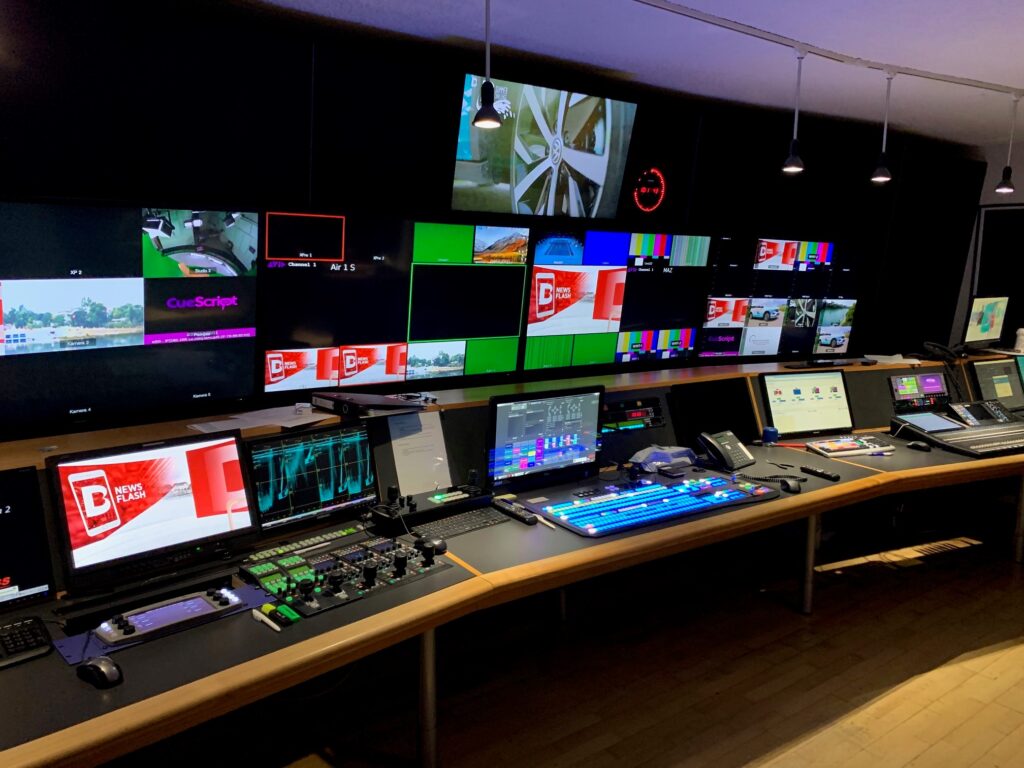
This approach is exemplified by the solution chosen for a complete overhaul at Telebasel, the oldest private broadcaster in Switzerland. The broadcaster’s goal was to create a future-proof infrastructure that would lead to dramatic improvements in cross-department collaboration and overall productivity. Importantly, Telebasel wanted to offer its Adobe Premiere Pro users a familiar experience while boosting efficiency across the media enterprise.
Interchangeable Media Content for Traditional, Social, & Digital Channels A key component of Telebasel’s programming is the “Newsblock,” a live news format show where news stories are developed and moderated in-house. News packages need to be visually engaging and contain the latest information. In addition to live news, Telebasel produces lifestyle shows and entertainment programs that run on a 24/7 loop as well as digital and social channels that need to keep sync with programs while promoting deeper engagement with audiences.
“Our material needs to remain flexible and adaptable, right up to the point of broadcast,” said Pascal Jacot, head of technology at Telebasel. “It’s important for us to be able to exchange content between our channels and react quickly to developing stories. We also need to include reaction from the audience in the form of video clips.”
Telebasel required a solution that would integrate its digital, social and linear channels under one seamless media production and distribution workflow. Off the shelf products were not suitable. What was needed were deeper level integrations that simplified complex tasks, enabling Telebasel to interact with audiences, customers, and external media outlets.
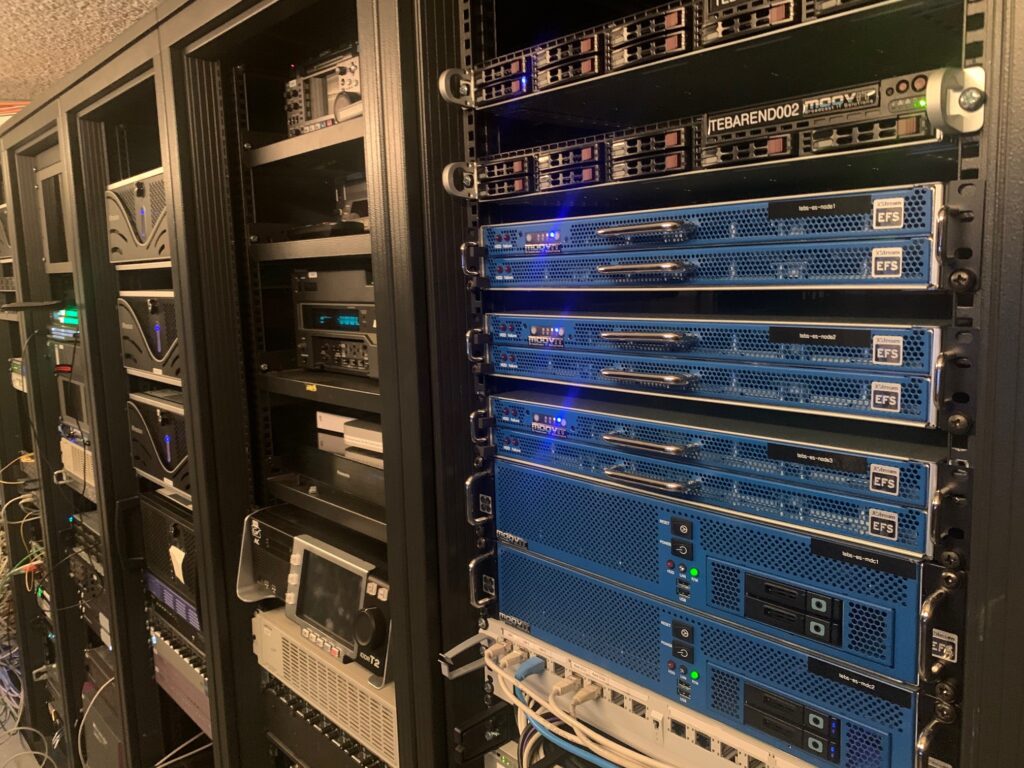
Open Solutions Integrate Channels and Remove Complexities for Storytellers| To connect its channels and simplify its enterprise workflows, Telebasel opted for open solutions from EditShare and MoovIT. Based on Adobe Premiere Pro, the new workflow is centralized around EditShare’s high performance, media optimized storage environment. With centralized storage in place, EditShare’s asset management platform, FLOW, and MoovIT’s workgroup administration tools, Helmut, combined to optimize the media creation process. They automated, simplified, or made unnecessary manual steps or complex procedures that were common during the sharing, creation, and distribution of content at Telebasel.
Open APIs, from EditShare and MoovIT, enabled Telebasel to not only integrate its channel workflows but customize them as well. The unique assignments and administrative structures are clearly defined while their finely tuned collaborative and technical processes are seamlessly automated, yielding powerful results.
The Adobe editing process is more open, collaborative, and interchangeable. With content centralized, Telebasel editors can view and edit video directly from their desks or remote external locations. Material is processed in real time, with editors accessing proxies in FLOW and Helmut, synchronizing the data for the high-res cuts in the background. Once editing is complete, Helmut automatically renders and adds clips to the channel’s schedule. All the media is stored centrally with rich metadata on EFS enabling control and administration of media assets at scale.
“The centralized management capabilities were crucial to the entire system,” Telebasel’s Jacot added. “The new workflows have helped us to quickly integrate live reports and news reports into the newly adapted transmission formats.”
The Telebasel rollout is a perfect template for other organizations, of any size, looking to deploy integrated centralized storage, “under the hood” administration and orchestration, and highly collaborative media and project management for Adobe enterprise workflows.
You don’t need me to tell you that 2020 was a year we’d rather have skipped. We didn’t have that option, so we’ve had to deal with it – just like our colleagues and friends across the industry. By staying true to our values and with the phenomenal talents of our team, we’ve been able to keep innovating and help our customers continue to create engaging and compelling stories.
#WinTogether
In addition to the pandemic, 2020 was a year characterized by tumultuous events and widespread unrest. But when I looked more closely, I found humility. It wasn’t always there, but when we all put others in our community first, it was amazing to see.
One of the things that I’ve seen is our team, our clients, and our partners really unite with a common goal: to emerge from these experiences with determination and an eye to the future. When I look back at 2020, I see collaboration with our partners and customers, showing and feeling empathy, and asking the question ”what can we do to win together” was the strongest and best thing we could have done. We listened, and, where we needed to, we evolved.
We made a strategic decision to accelerate and intensify our shift to the cloud
Fast Followers Cross the Chasm
Cloud innovation was not new to EditShare. In 2015, we introduced our first cloud solutions and in 2019 we embarked on a more aggressive investment in cloud. At that time, not everyone was ready. One customer even told me “you’ll take my content out of my house and into the cloud when hell freezes over”. But, 2020 validated our decision as the cloud quickly became a necessity for everyone. The market needed us to complete the journey and reinforce our cloud efforts as a strategic focus of the company. The pandemic was the catalyst for doubters to “cross the chasm” and become mass adopters. As existing cloud users were able to continue with their business of remote working and collaboration, the fast followers saw that it was time to make the jump.
Our overall feeling was to go back to our core values and tenets – flexibility, scalability and openness – and build a much broader solution. We designed seamless proxy editing and all the services around it. The cloud has enormous potential and we are just at the beginning. What we can do now is phenomenally useful, but the best is still to come.
No One Has a Monopoly on Innovation
As organizations are being forced by the circumstances to cooperate in the cloud, most are doing it because they want to, and that’s because it’s the best way.
The cloud is a fundamental shift in the computing paradigm. It has empowered buyers. It’s as far as you can get from the jaded approach of “Here’s my solution. Pay me some money and I’ll install it. Pay me some more money and I’ll upgrade it. Pay me still more money and I’ll make sure it keeps working”. The cloud changes this to a far more cooperative model, where multiple vendors open their products to integration, making it easier, not harder, to work with third parties. In this environment, it makes sense for there to be open standards; open APIs where integrations can happen as need and innovation dictate.
Nobody has a monopoly on innovation. Other vendors have products and services that can enhance our workflows. It means that customers can use the “best of breed” products in their workflows and still be confident that they’ll be supported and supportable into the future.
The cloud gets better because it’s always getting broader and wider. It encourages collaboration. It means that we can add our or another vendor’s services easily and without breaking anything. It means that we can issue upgrades every quarter and know that it’s not going to cause problems. Clients are always up to date. It’s a virtuous circle, where it’s in everybody’s interest to work together.
All Bets on Cloud
I’m seeing an upswing in the industry, even at this early stage. Spring is just around the corner. We don’t have the pandemic put to bed yet but – at last – there are some promising signs. By the middle of the year, we’ll be able to put what we’re learning right now into practice. For our customers this means savings and efficiency.
As the value of our clients’ content grows, so does the need for flexibility to cope with doing business in an era of dramatic and unexpected change. We’re on the side of anyone who is facing up to these challenges.
It would have been wrong to bet against Moore’s law. It was wrong to bet against the web. And now you should absolutely not bet against the cloud.
Ultimately, we give our clients flexibility, continuity and confidence. If you want to engage with our software, you can run it on any suitable hardware or you can take it with you into the cloud.
We’re going to take with us what we learned in 2020. Empathy with our customers – not a new thing, but number one going forward. And guiding customers towards the cloud. We’re there, ready for them: it is no longer a question of “if”, but “when”.