5 Reasons Why Your Post Production Team Needs Collaboration Software in a Forever-Remote World
Before the pandemic, remote work was a luxury enjoyed by employees in higher-level management or IT-type roles. Today, remote or hybrid workplaces are the norm in many organizations, with millions of workers conducting business while dispersed across geographies.
For example, tech giants Microsoft and Facebook offer flexible hybrid options, while Twitter maintains a fully remote business model and offers office space in key markets for workers who want it.
It’s clear that we will be living with COVID-19 indefinitely. However, for many businesses, embracing a remote work environment is about more than navigating a public health crisis.
The Pros and Cons of Remote Work
As businesses chose—or were mandated—to shift to a remote work model, the benefits of this new way of working quickly became apparent.
With no office space to maintain, businesses realize significant cost savings, including a reduction in operational costs and—for the truly committed—the elimination of real estate expenses.
And for employees, working remotely increases productivity and flexibility, improves job satisfaction, and positively impacts employee retention.
Companies that offer remote work opportunities also have access to a broader talent pool. With no geographical constraints, remote organizations can source skilled employees from anywhere in the world.
Although there are many reasons to appreciate a remote workplace, the model isn’t without its challenges.
For example, some employees miss the personal connection of working face to face with their colleagues. Others find communication breakdowns are more likely in remote environments. Another common complaint when working from home is that it is harder to “switch off” at the end of the day, leading to burnout.
Those in leadership positions cite security as a leading concern when supporting a remote workforce and find employee oversight more challenging in this type of environment. Executives have also found that setting up and supporting a non-centralized workforce can increase equipment and infrastructure expenses significantly.
Challenges of Managing the Post-Production Process Across a Distributed Team
According to some digital production experts, many post-production teams plan to permanently adopt remote or hybrid work environments.
Like so many workers, these teams switched to a remote model out of necessity but found that the flexibility of working remotely has made them more productive and efficient.
That said, achieving this efficient workflow isn’t seamless. There are several factors post-production teams must address to keep video content flowing in a remote work environment.
Structure
Without a centralized workspace, it is imperative to ensure that users at every stage of the post-production process have the equipment they need.
Due to the nature of this type of work, the team will need access to high-quality audio and video technology, the appropriate software and hardware, and a reliable and secure network connection.
Accountability
Post-production is a multi-step process, with each step dependent on the others to succeed.
In a remote work environment, accountability and visibility are key. To ensure the process stays on track, the team needs highly efficient project management, automated versioning capabilities, and reliable progress tracking.
Security
Securing remote post-production activities is challenging but essential. These teams work with valuable intellectual property frequently targeted by cybercriminals and would be extremely expensive to replace if lost or damaged.
To ensure the post-production process is secure, remote teams need to implement cybersecurity and data loss prevention initiatives that include:
Role-based permissions
Access management protocols
Comprehensive data protection strategies
Secure storage
Multiple backups
Connectedness
Post-production teams must work closely with colleagues and stakeholders throughout the entire process.
Remote workers may find it difficult to communicate when they aren’t sharing a space with their team. Because collaboration is such an essential part of the post-production process, it’s important to invest in collaboration tools and file-sharing solutions that enable and encourage open communication.
Five Ways Collaboration Software Enhances the Productivity of Your Remote Post-Production Team
For many post-production teams, remote or hybrid work environments are here to stay. With the right tools and infrastructure, this evolution has the potential to supercharge efficiency and create a streamlined process that saves both time and money.
Collaboration software is an essential ingredient in a remote post-production team’s success. By providing these five core capabilities, the right collaboration software allows teams to work together seamlessly regardless of where members are located.
1. Management
Housing all of your video production assets on one platform makes it easier to manage the post-production process using features such as:
File tagging and metadata
Versioning
Role-based user management
Webhooks
2. Collaboration
Maintaining open communication channels between the post-production team and stakeholders keeps everyone apprised of project progress. It also ensures everyone knows when they need to provide input by using:
Internal and external review options
Tag-driven sharing
Distribution list management
Automated notifications
3. Presentation
In addition to facilitating creative cooperation, good collaboration software allows users to turn content into remarkable visual experiences that can be shared using presentation capabilities like:
Templates
Access controls
Automated publishing and updates
4. Security
By the time your video gets to post-production, there are many costly resources involved in the project. A security-focused collaboration tool will protect your investment with industry-best features, such as:
Visible, forensic, and multi-level watermarking
Multi-factor authentication
Single sign-on (SSO)
Role-based project permissions
5. Analysis
No matter how much data you collect, it is only valuable if you can turn it into actionable insights. Good data can be a key driver of decision-making, so be sure your collaboration software is equipped with robust analytics. Ideally, your solution will allow you to:
Track user activity across review links and presentations
Track asset activity to gauge popularity and interest
Export data in multiple formats
Pinpoint dropoff points to measure user engagement
According to a recent survey conducted by MediaSilo, 94 percent of our customers are doing their post-production work in fully remote or hybrid environments. MediaSilo’s feature-rich, all-in-one collaboration platform helps post-production teams work together seamlessly, from delivering dailies to finishing the final cut. Download MediaSilo’s Guide to Post-Production Workflows to see how MediaSilo is taking the lead in remote post-production collaboration software.
In a time when production teams have to be comfortable collaborating remotely to meet tight deadlines and increasing customer expectations, scenarios like this can seem eerily familiar:
Your audio engineer is tasked with creating the final cut of your latest video project for a new client, working against a rapidly approaching deadline in their home office. When they look for the approved audio clip to add to the project, they can’t find it. They search Dropbox, hunt through their email, and try to contact team members via text, email, and Slack—all to no avail.
Now flip the script:
What if your team had one source of truth that helped each member of your team stay organized, collaborate, and share files, drafts, and communications, all with an intuitive, secure interface?
That’s what today’s industry-leading post-production collaboration tools are built to deliver.
So what are post-production collaboration tools, and how can they help your team?
What are post-production collaboration tools?
Simply put, post-production collaboration tools provide a centralized and secure place for your team to store, manage, and shape production assets.
Having “too many cooks in the kitchen” can be a hindrance in other industries. However, when it comes to creative projects that involve film, audio, and other visual arts, having as many experts in editing, sound, color, and other specialties as possible makes for even more impact.
Post-production tools are designed to help teams coordinate and integrate these perspectives and skill sets into the project. This is especially crucial now, with everyone in different work environments or even different time zones.
What can post-production tools offer your creative team?
At any given time, your creative team is juggling multiple campaigns with creative assets in various stages of completion. Add in the complexities of collaborating with teammates and customers worldwide, and the limits of email, chat, and video conferencing are quickly surpassed.
Post-production tools like MediaSilo provide the benefits of modern collaboration, secure storage, file sharing, and asset management solutions, all in one platform.
Utilize built-in tools to present content to both select and wide audiences.
Enhance integration with other creative software and applications to boost productivity.
The result is less time spent on inefficient workarounds and administrative tasks and more time delivering high quality content.
How can you pick the best post-production collaboration tools for your team’s needs?
Although every team and creative project is unique, there are design and collaboration best practices that are consistent across the industry and help teams boost their productivity.
So what are the features that should be at the top of your post-production collaboration tools must-have list?
You should seek a solution that:
Is designed for your industry, offering the roles, tools, and features your team needs (e.g., editing, branding, review, annotation) in a remote-friendly, intuitive interface.
Offers advanced file uploading and management (e.g., file tagging, metadata).
Take your post-production process to the next level.
Choosing a post-production platform isn’t easy, especially for teams still adjusting to remote work and cloud-based environments.
However, platforms like MediaSilo are designed to offer your team members new ways to share, collaborate, and grow their post-production workflows no matter where, when, and how they choose to do their best work. From offering a variety of file-sharing features to providing a source of truth without time-consuming workarounds, MediaSilo is trusted by some of the biggest names in entertainment and advertising.
If you and your team are ready to learn more about how MediaSilo can enhance your post-production workflow with additional security and productivity features, then we recommend you take a look at MediaSilo’s Guide to Post-Production.
For this next step in our journey we review cloud video storage as it can be one of the biggest sources of confusion and costs when it comes to post-production storage. All major cloud providers offer a range of storage solutions, all optimized for different uses and price points.
In this article we’ll review some of the primary cloud storage options for editing in the cloud as well as the tradeoffs and associated costs.
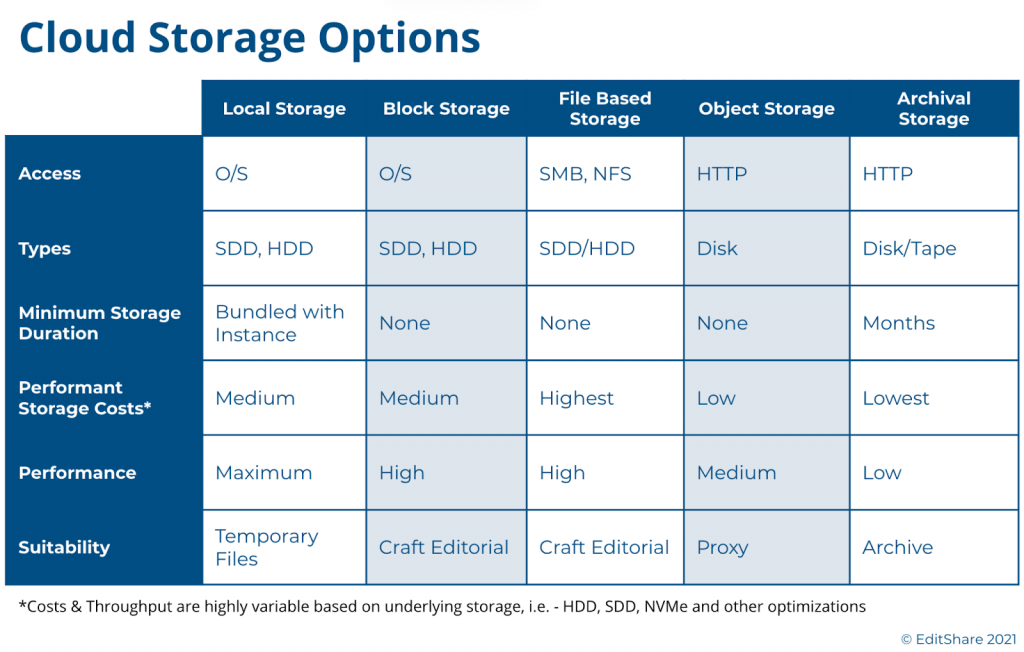
A Look into Cloud Based Storage Much like the traditional storage models, cloud-based storage options fall into one of five major categories:
Local Storage: Analogous to a local computer configuration, this is an HDD or SSD physically attached to the cloud compute instance.
Block Storage: This is network attached storage that must be provisioned against a compute instance during deployment time. Similar to local storage, it relies on the compute instance operating system to make it useful to applications. For those familiar with SAN’s (Storage Area Networks), block storage is similar in concept.
File Storage: These are storage systems that act similar to a NAS (Network Attached Storage), and provide higher-level file-based access to a shared network of computers, typically using NFS.
Object Storage: In this tier, files are stored as data objects referenced using an ID. The benefit is that there is no structural scale inhibiting storage growth. HTTP is the protocol for access.
Archive Storage: A type of object-based storage, this is a lower-cost tier that is typically less accessible and requires a commitment of storage duration for several months or longer.
With the exception of local storage, these storage tiers can be highly scalable and extend dynamically during run-time or via deployment scripts. All of the storage tiers have trade-offs between costs, performance, scalability, and availability. We explored a bit of this in our prior Journey to the Cloud blog, where we focused on backup and archival storage.
For the purposes of video editing, one must focus on the usefulness of these storage types to the needs of the application as well as the costs. This requires a storage layer with low-latency, that can ideally scale to multi-TBs, and can be used by the editing application in a cost effective manner. A general rule of thumb is the further down in the above list you go the cheaper the storage, but that is not always the case. Offerings of SSD, NVMe, HDD, highly-performant file systems, and other permutations offered in each of these tiers make price/performance reviews a very complex analysis.
While costs are generally based on storage sizes and performance, other factors typically apply. As an example, depending on the vendor and storage tier, transferring content out of a tier may incur a fee and so will the actual I/O calls themselves, such as an HTTP GET and PUT, which read and write the data.
Video Editing Storage Choices These considerations leave us with three choices for editing: Local Storage, Block Storage, and File Storage. Let’s review the usefulness of these choices.
Local storage has long been the tried and true means for editing workstations. These local disks come in a variety of sizes and speeds, and while they may be useful for a single, stand-alone editor, there are a few drawbacks. First, they can’t be resized dynamically so as a project grows you could find yourself short on space. Perhaps more importantly in this virtualized cloud world, once you shutdown the system you lose all your data, applications, and settings. This is not a factor in the on-premise world, but in a virtual environment the cost of running virtual workstations full-time is significant and you will want to shut-down these instances when not in use. Unless you can finish your project in one sitting or you have money to spare, this may not be the best option.
Block-based storage is a far more effective solution for video editing environments. In a virtual environment, you can provision the exact amount of low-latency storage you require and attach it to your editing environment when you spin up your system. Done correctly, you can even expand it as your needs grow. In addition, all of the public cloud vendors provide various types of block storage optimized for different performance and cost points so you can dial in exactly what you need for your editing applications.
From a cost point of view, block storage can have a permanence distinct from the compute instances. When you shutdown your cloud compute instances, whether that’s a virtual editing workstation or an asset manager, you can continue to maintain your storage so you don’t lose anything. Yes it’s not free, but it is far more economical than having to keep your entire environment running all of the time.
File storage is another possible option for video editing environments. Much like your NAS in the office, these systems provide a shared storage pool to multiple clients. They typically rely on NFS as the protocol. These file-based storage systems are sometimes offered with different performance characteristics, some optimized for higher throughput, but at a cost. These NAS-like systems, however, have limited storage capacity and performance. They are fine for IT applications, but video production environments can quickly run into issues.
Finally, object storage is a popular and cost-competitive storage tier, and you only pay for what you use, however for video editing it has its drawbacks due to latency and native application support. And while there are solutions for translating object storage to file-system calls, these gateways will continue to be hampered by the latency issues and often require caching workarounds. This is not ideal for professional or collaborative editing purposes.
The Best of all Worlds For many teams exploring cloud production for the first time, the choices are overwhelming. Between the major cloud vendors, there are hundreds of choices of cloud storage tiers, performance choices, and tradeoffs. Too many choices can result in analysis-paralysis and leave organizations behind in the technology curve.
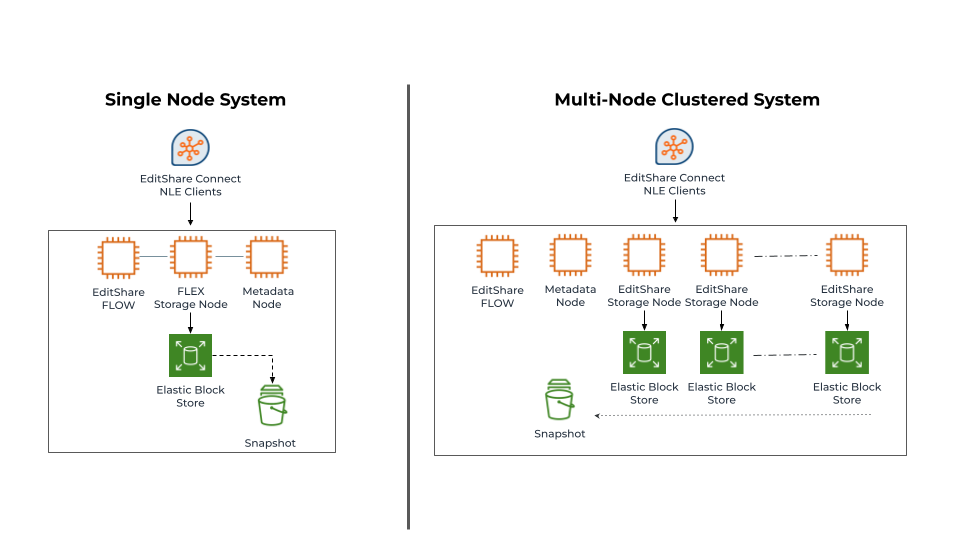
EditShare developed FLEX Storage as a software-defined-storage layer to abstract these complexities and provide high-performance, cost-optimized, video production storage. FLEX uses a mix of both block storage and object storage to provide that balance between storage performance and costs, and this mix can be altered to meet any workflow or budget. We’ve also benchmarked and tested the various storage performance types within these tiers – such as SSD, HDD, etc – to find the right balance for different application mixes.
As many of our customers require editing libraries of 10’s or 100’s of TBs of media, often captured at high bit-rates, we found a need to be more clever about storage cost optimizations. In 2020 we began offering FLEX Seamless Proxy Editing, which provides a cost optimized workflow that leverages proxy editing, but in a unique simple workflow. For those interested in learning more, you can read more here.
EditShare offers FLEX as both a standalone node or a cluster of nodes. Both configurations can be scaled out or scaled up to meet different performance requirements. The important thing to note, is FLEX is not a one size fits all solution. At EditShare we focus on openness and choice, giving our customers the ability to deploy what’s right for them, as well as the ability to adapt their environments as their needs change.
With remote work environments now more common, modern media management tools and technologies empower post-production teams by providing a flexible, secure way to work and collaborate across time zones and geographies.
To better understand today’s workflows, we are taking a closer look at each stage of the post-production process and how today’s tools support a distributed, often global, workforce.
In part three of the series, we explore the final post-production phase: delivering and distributing the content.
Workflow Stage 5: Delivery
Once the creative work is finished and all of the elements are in place and approved, the finished piece is ready for final touches and the transition into the distribution, sales, and marketing workflows.
Versioning
At this point in the post-production process, it may be necessary to create different versions to meet the specifications of the various end users and applications. An assistant editor, editor, or output specialist will conform and create generic masters and multiple versions based on the anticipated requirements. This can often require dozens of different versions and file sizes, all of which can be organized and tracked in an all-in-one media management tool, such as MediaSilo.
Archiving
Many hours of work go into creating video assets, so it is crucial to ensure the outputs and elements used in the piece are stored appropriately. Your archiving strategy should include everything—original camera footage, camera logs, XML files of metadata, sound elements, visual effects elements, graphics, and all versions of the masters.
A cataloging and naming convention and a versatile, robust storage platform are critical to being able to find assets later for revisions or to create future versions if needed.
Localization and Captioning
If a film, show, or ad is going to be shown in multiple regions or countries, the post-production team will often create different versions for each audience based on language, political climate, or accessibility. For example, the team may add dubbing or subtitles for non-U.S. audiences or closed captioning for audiences who are deaf or hard of hearing and viewing platforms that exhibit without sound.
Marketing Materials
In addition to the work itself, promotional materials are often generated that may include trailers and teasers; photographic assets; printed posters and artwork; and even tie-in promotional products, such as T-shirts, mugs, and hats.
Many of these materials are in the works throughout the post-production process, and they are often subject to versioning and team approvals, similar to the film. Centralizing storage and access to the marketing and promotional content and the associated stakeholder input ensures that marketing creates promo content from the latest version of the film.
Distribution and Traffic
When the finished work is ready for distribution, a traffic manager or broadcast business manager should oversee the process. The piece will likely need to be sent to multiple recipients, including networks, studios, theaters, and digital portals, each of which is likely to have its own preferred specifications.
Although remote production workflows are new to many people, distribution and traffic teams have been remotely coordinating delivery to end users long before the pandemic.
Although remote production workflows are new to many people, distribution and traffic teams have been remotely coordinating delivery to end users long before the pandemic. Media management tools let them deliver assets in the file size, format, or compression algorithm that is best suited to the client’s systems. These tools also help maintain file security at rest or in transit to protect proprietary content and intellectual property that might be attractive to overzealous fans, competitors, or hackers.
MediaSilo Supports Nontraditional Workflows
Today’s increasing use of remote collaboration makes nontraditional workflows almost mainstream. Because these new ways of working make designing workflows more challenging, flexibility is key to making sure work is done efficiently.
For example, time-consuming visual effects may have to get underway before the picture is locked. Or music may be composed before the shoot is even complete so that it can be played on set and the characters can react to it.
The key to managing a nontraditional workflow is organization. Without a well-synchronized team and a solid post-production structure, a huge amount of time, effort, and money will be wasted.
The MediaSilo platform was built for the flexibility and organization required by nontraditional workflows. It supports the creative team and provides ideal tools for keeping every team member up-to-date and working toward the same goal, even when the post-production situation is complicated.
MediaSilo provides robust solutions for managing, storing, versioning, and distributing all of your final assets and is a critical tool in the marketing of your project. It also helps to protect your intellectual property by ensuring it gets into only the right hands.
Start your free trial today and see how MediaSilo’s all-in-one media management platform empowers distributed post-production teams to deliver media content seamlessly and securely to marketing and sales teams, clients, and end users.
Once upon a time, post-production teams were colocated, working together in dark rooms staring at a screen. But new and innovative technology, and a global health crisis, have permanently changed our approach to post-production.
Today, it’s not unusual for key players to be sitting in a different country rather than a different room. Remote work environments and the production tools that support creative workflows have created a global talent pool and enabled successful collaboration across time zones and geographies.
Here, we continue to learn about post-production stages 3 and 4, video and audio finishing, and how an all-in-one media management solution streamlines the process from picture lock to final mix.
Workflow Stage 3: Video Finishing
The Online Edit or Conform
The online editing, or “conform,” step is when the original, full-size footage files are inserted into the final cut in place of the smaller, lower-quality proxies. This is the stage when visual effects are created and inserted into the sequence, replacing the placeholder graphics used in the rough cut.
Close collaboration between the offline editor and the finishing and online artists during this stage is critical. When working remotely, they will all need access to the same elements in order to transition accurately from locked rough cut to final online conform.
Visual Effects
Once the picture is locked, the final visual effects and CGI work will be completed by the VFX team. The creation of visual effects is a painstaking process that may require working on each frame of the footage individually.
Tiny details, such as shadows and lighting, can throw off the realism of an effect for even the most casual viewer.
Tiny details, such as shadows and lighting, can throw off the realism of an effect for even the most casual viewer. To ensure every effect is convincing, each visual effect or piece of CGI work will go through multiple rounds of revisions and approvals before being inserted into the online edit.
Graphics and Credits
The online phase of post-production is when the placeholder credits and title cards are swapped out, and real type treatments, fonts, and logos are designed and chosen and overall composition is determined for any graphic elements.
A separate company is often in charge of the titles and graphics. They will provide options of graphics to the entire team, and the team will give input, just as in the other phases of the cut. Once reviewed and approved, usually remotely, the finished elements will be placed into the final piece.
Color Grading
When the colorist and director collaborate during the color-grading phase, they can bring a whole new level of magic to the piece. Good color grading can bring out unseen details in dark scenes or add moodiness and depth to a scene that was overexposed.
At the end of the color-grading work, the team will view the project on monitors of all sizes and qualities to simulate the experience of viewers using a variety of devices. What might seem pleasantly dark and moody on one device may simply be impossible to see at all on another. So it’s usually a good idea to share color-corrected files with team members to view on as many screens as possible.
Workflow Stage 4: Audio Finishing
Scoring and Music
When the editor first starts composing the rough cut, temporary music is often used to give a sense of how the scene will feel with music in place. But once the picture is locked, the final music needs to be locked down too.
If original music is to be created, the composer will begin scoring the picture. This process often includes several rounds of compositions and revisions for each piece or scene, and tracking the versions and evolution of the score can be quite challenging. Team members may be able to visit the studio to hear the music as it’s being developed, but more often, they will access shared files remotely.
If an original music score isn’t used, the team will need to source an existing piece of music from a music library, artist, producer, or record label. As with the offline edit, it’s important to keep track of the score versions; the various edits that are used to demo different options of songs or tracks; and input from the editor, director, producers, and creative team.
Sound Design
In addition to the actual music in the piece, sound design is an important element in bringing a film, TV show, or commercial to life. While the natural production audio captured at the shoot often has the most realistic and natural sounds for the action taking place, filmmakers may need to add sound elements that were not captured on shoot day.
Choosing sounds is a creative endeavor, and having the team review and agree on them is an important part of the post-production process.
There are a number of ways that sound effects and sound design can be added to a film. The simplest is to use effects from a sound effects library. These are usually quite inexpensive and provide a wide range of options.
Sometimes, the perfect effect just doesn’t exist, or your requirements are too specific. In those cases, foley artists can create the unique sounds you need. Choosing sounds is a creative endeavor, and having the team review and agree on them is an important part of the post-production process.
Voice-over and Automated Dialogue Replacement
Voice-over recording happens during the final stages of post-production. Narration and voice-overs are done in tandem with the final mix to ensure the audio lines up with all the other elements of the cut.
Automated dialogue replacement (ADR) is done in a controlled studio environment, but unlike voice-overs, ADR also includes video playback so that actors can try to match dialogue to their own movements and timing of the shots being used. An automated system then helps insert the dialogue in a way that’s lined up as perfectly as possible with the action, so it is difficult to detect.
Final Mix
One of the final stages of finishing a film, episode, or commercial is the final sound mix. This process brings together all the audio elements and balances them so that they work well together.
The key members of the creative team will either attend the mix sessions or weigh in remotely. When working remotely, they can either be patched into the session in real time or use a remote online platform, such as MediaSilo, to help the team compare what was done to the mix with what the elements sounded like beforehand.
How MediaSilo Empowers Post-Production Audio and Video Teams
MediaSilo’s unified platform helps audio and video finishing teams manage all of the final elements of the project, including:
Music and sound design
Voice-over and ADR elements
Final mix assets
Camera source footage
Visual effects
Color-corrected footage
MediaSilo provides seamless collaboration and file sharing between post-production team members regardless of their location. MediaSilo provides a secure yet accessible platform for reviewing mix sessions, voice-over recording, ADR, and even testing final outputs on various platforms. It’s also an excellent platform for reviewing mix graphics and titles, VFX work, and color grading.
Start your free trial to experience firsthand how MediaSilo can help you stay ahead of the rapidly changing needs of your post-production audio and video finishing workflows.
Content production has undergone a sea change in recent years in ways that have impacted both innovation and workflow. In this new era of content creation where key players in the workflow may be scattered across different cities and time zones, production and postproduction have become more complex than ever.
To overcome this complexity and the inherent risk it adds to your projects, it’s time to take a longer view of your current workflows and embrace new approaches to managing assets, sharing works in progress, collaborating with stakeholders, and even selling your projects.
Let’s take a closer look at how post-production workflows are evolving to accommodate changes in how and where we work and the technology available to make it all run smoothly.
Workflow Stage 1: From Camera to Editing Bay
Getting the Dailies to the Editor
Although we no longer have to worry about actual physical cans of film or videotapes, there are still assets from the camera that have to be integrated into the post-production process. This requires obtaining the dailies, camera logs, and production notes from a shared storage platform or physical drive.
Keeping these assets where anyone on the team can review them is crucial in an era when remote workflows are often the norm. Ideally, all of the relevant files will be organized in one place, allowing project managers to add, revise, delete, and update documents as needed so that the entire team is always working from a single source of truth.
Reviewing Dailies
Once the dailies are collected and loaded in the system, the team can narrow down the footage into the best material and moments. Traditionally, the production team watched the dailies on set each day as they became available. But modern remote workflows now make it necessary for some team members to review the dailies from a variety of places and give their input without holding up the production and post-production delivery timelines.
Remote viewing of dailies has become increasingly popular as productions reconsider the need to have a large number of people on set at one time.
Remote viewing of dailies has become increasingly popular as productions reconsider the need to have a large number of people on set at one time. Everyone on the team being able to access the dailies as soon as they are available, whether on-set or remotely, means that input can happen while there’s still time to address any issues.
Logging and Digitizing Footage
After dailies have been viewed, the editing team starts preparing the footage for editing. This may involve creating smaller versions of the footage files for editing so that the offline editing system isn’t slowed down by huge file sizes. These smaller files, or proxies, are used by the offline editor until larger ones are required for finishing, visual effects, color correction, and mastering.
The assistant editor will usually be in charge of logging and digitizing all of the footage as the proxies are created and creating related databases, metadata collections, tags, naming conventions, and storage plans.
Workflow Stage 2: From Raw Footage to Rough Cut
Creating a Rough Cut
The rough cut, or offline edit, is where your show, commercial, or film becomes a story rather than just a sequence of shots. But before the rough cut is complete, it must be reviewed and commented on by multiple team members who are often in different locations.
After the first assembly is created by the editor, the next step is usually to bring in the director, who will work with the editor in creating a “director’s cut” version of the project for review. That collaboration can happen in person in the editing room or remotely by either posting work in progress or using a real-time screen-sharing system. Regardless of whether you are in person or not, all of the comments and input need to be collected and tracked so that revisions can be made efficiently.
Temporary and Placeholder Elements
The rough cut phase is also when temporary or placeholder graphics, sound elements, music, visual effects, and color correction are introduced to the cut for reference. The editor will often source the materials from font libraries, stock footage collections, music libraries, and sound effects catalogs. Other team members may also provide music samples for reference, graphics or copy to try out, or images for visual reference.
Many of the placeholder elements will have temporary visual or audio watermarks from the companies that own them. The watermarks prevent the files from being used in a final piece without official permission and are removed if the element is licensed for use in the final product.
Testing and Versioning
Managing the element selection process is a big part of post-production. As the different ideas are tried, the editor and assistant editor must keep track of all the versions as well as the elements for each option until the final ones are chosen.
Careful file organization, detailed database management, and a well-thought-out naming convention can make the process run more smoothly. Because there are almost always changes made after versioning, using a naming convention that incorporates dates, revision numbers, and sometimes even colors—instead of simply “final”—can help manage a project that has had a large number of changes made to it.
When all of the elements are in place and agreed upon in the rough cut, the cut is locked. This “picture lock” stage means that there will be no more changes made to the overall structure of the edit and that it’s time to move on to finishing.
How MediaSilo Simplifies Post-production
MediaSilo’s unified platform provides a seamless way for the whole team to collaborate during every step of the post-production process, wherever they may be. MediaSilo provides centralized file storage, frame-specific commenting, and intuitive tagging, so it’s easy to keep track of footage, compile input, and create a single, always-up-to-date version of the asset that is accessible to all.
Start your free trial to experience firsthand how MediaSilo can help you stay ahead of the rapidly changing needs of your post-production workflows.
Safer collaboration, easier asset recordkeeping, and a few new commenting fixes – these are a few improvements you’ll find in the latest release of Shift.
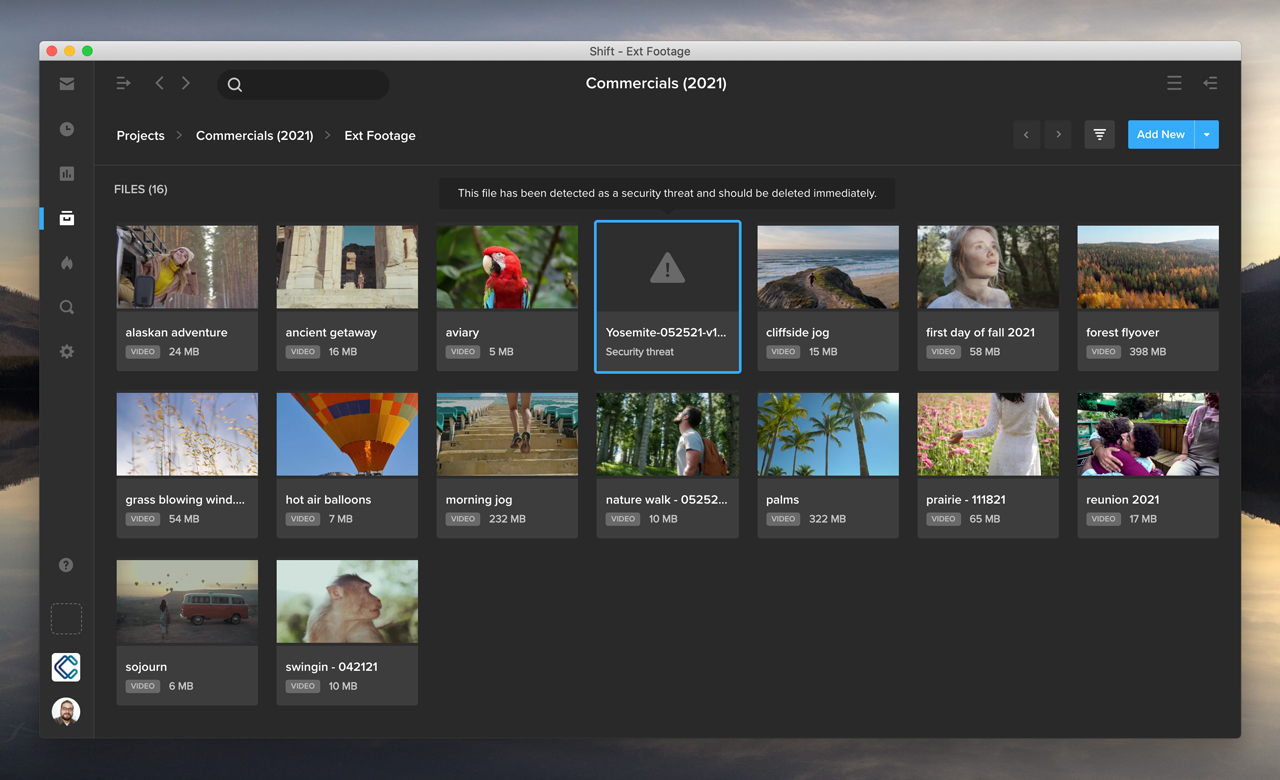
Eliminate risky files: Shift now performs an automatic scan for viruses whenever you upload files. If a security threat is detected, a warning message is displayed on your asset thumbnail, and users are prevented from opening, downloading, sharing, or interacting with the infected file in any way, except to delete it.The virus scanning happens automatically – behind the scenes during upload – eliminating extra steps in the quality control process. This prevents team members from inadvertently passing along a malicious file to others in the organization or to external reviewers and clients.
Additional Updates
Simplify recordkeeping: You can now export asset lists from both the Projects and Search Results pages. For example, you can search for assets matching a particular tag, click the Filter icon in the top right, and select Export to export your list of search results in a CSV or XLS file.
Never miss a comment: This release resolves an issue that displayed only the first ten Review Link comments in Review Mode if more than 10 comments were made.
Make comments easier to read: Users will now be able to add line breaks to their comments when commenting on static files such as documents and images.
We’ve been living in a “digital age” long enough to see our entire virtual ecosystem change, compound, and evolve – not just once, but over and over and over again. And it adds up.
A recent study by market intelligence firm IDC estimates that the sum of data generated globally by 2025 will exceed 175 zettabytes (175 trillion gigabytes). That’s a lot of ones and zeros, in the form of photos, videos, websites, music, audio files, documents, and so much more. And that number will just keep growing, each and every year.
The digital universe has evolved beyond the fringes of our lives. For many living and working in the modern age, the digital world is our life. We work, play, socialize, date, create, and share in a virtual space. It is our primary place for connection.
And not only for connection, but accumulation. Think about it: our events are captured online, our media is created online, our work projects are stored online. We rely so heavily on the storage of the virtual world to hold our most critical assets, to continually add more and more of them, and to recall them for us whenever we need them.
The IDC estimates that more than two-thirds of digital stored data is not readily searchable or available for access after initial use.
Online data asks the ultimate existential question: if you created a digital asset (be it video, photo, text, document, song, email, or otherwise) but you can’t find it, does it really exist at all?
Sadly, this is not a trick question — as the IDC estimates that more than two-thirds of digital stored data is not readily searchable or available for access after initial use.
Gone in a Flash
Imagine if two-thirds of the books on your shelves — *poof* — simply disappeared, or two-thirds of the photos from a lifetime of summer vacations vanished as soon as you put them away. You’d consider that an unacceptable amount of data loss. And it’s not because the items no longer exist – but simply because you don’t know how to find them again.
And that’s why storage is only half of the conversation. You don’t need something rightthis instant, so you put it away. But storage is only as good as its retrieval system. Otherwise, what’s the point of storage at all?
New Generation of Organization
There are two major schools of thought when it comes to digital asset management, structure, and retrieval — and these schools fall very squarely along organizational lines.
People who are accustomed to traditional operating systems often follow the folder hierarchy model. You put a file inside a folder, stick that folder into another folder, label it properly, and save it in the right drive. Want to find that file again? All you have to do is connect to the drive, navigate to the folder in a few clicks, and open the file. It’s easy! This group views asset retrieval as a logical path rather than a magic button.
But what about people who never were indoctrinated into files and folders (electronic or physical)? For these generations, the ability to search for something and simply find it is a basic expectation. There is no folder, no subfolder, no drive — the file just exists. Where? It doesn’t matter. It’s somewhere. And how do you find it? The same way you find anything else in the digital world, you search for it.
For the younger group, the question of somewhere wasn’t even relevant. The assets exist, period. You should be able to find anything with a few simple keystrokes.
This divergence has led to a great deal of frustration between college professors and their young students. The students didn’t understand the concept of folder structures because they never had to use them – but professors didn’t understand any other way to talk about it, because navigating to a file stored somewhere made logical sense to them. For the younger group, the question of somewhere wasn’t even relevant. The assets exist, period. You should be able to find anything with a few simple keystrokes.
We’ve all been in the unfortunate situation of interacting with a digital platform where the search functions simply do not work, and few things are more frustrating. Digital giants like Reddit and Slack have worked tirelessly in the past year to improve their search engines, and turn around their negative image as unsearchable platforms. Bad search can quickly kill a user experience, no matter how amazing the rest of the tool may be.
Just find it
For MediaSilo, finding the media assets you are looking for is one of the most important tasks a video team needs to tackle, and we take it seriously. Our professional cloud platform is designed with robust tools and settings that give you total control over the search process, ensuring that it’s effortless for your users – wherever on the search spectrum they may fall.
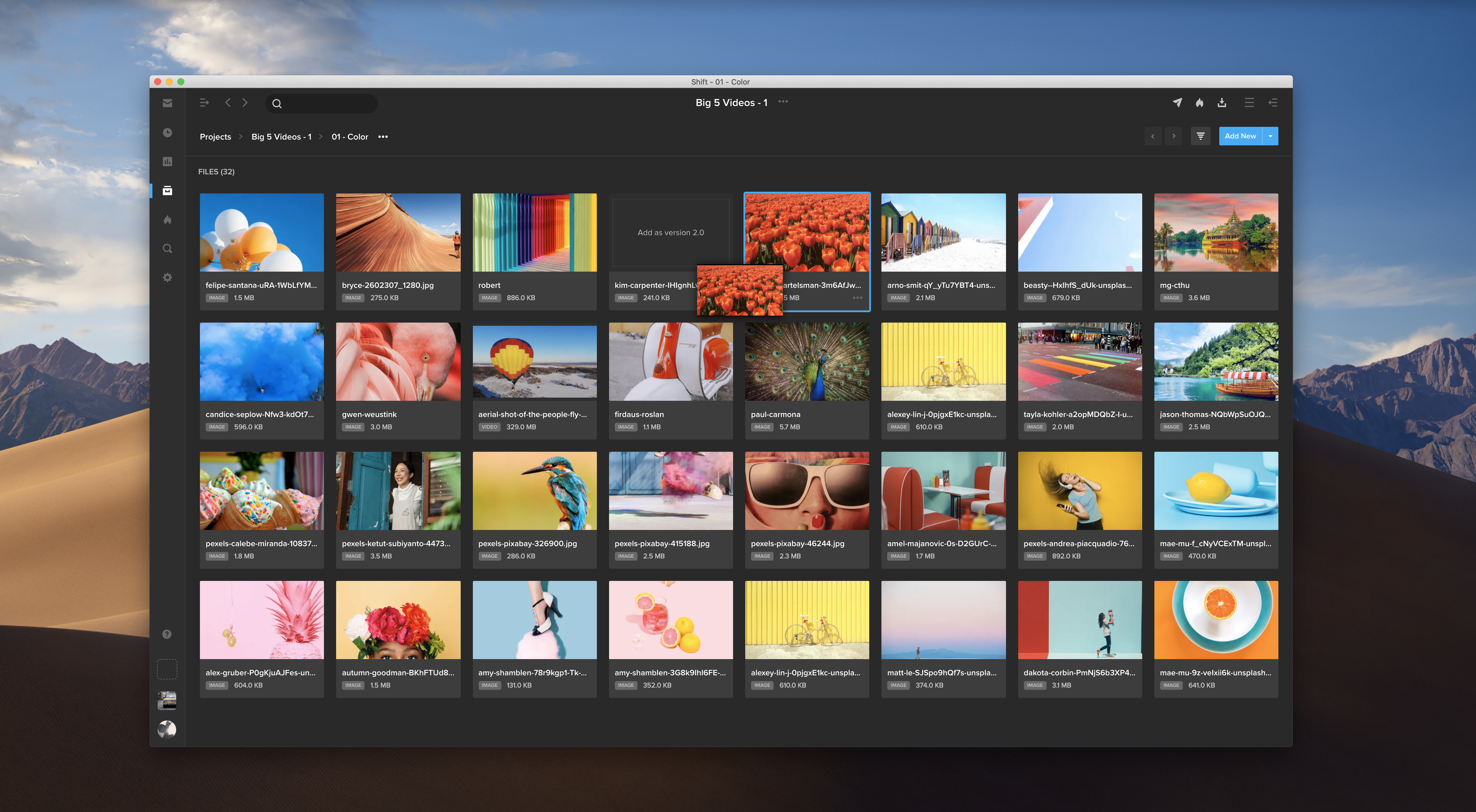
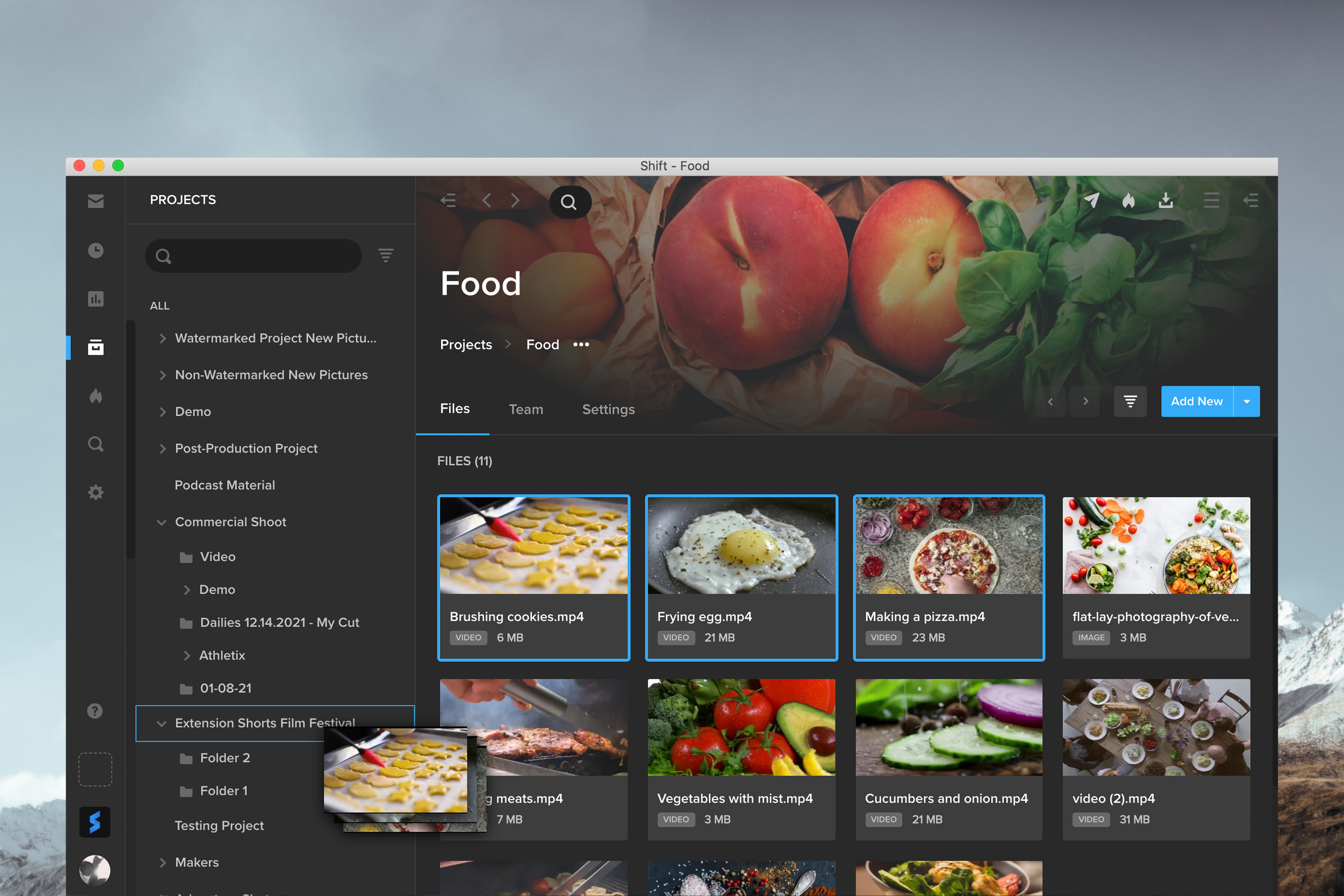
For folder navigators Are you more of a traditional thinker? Manage and organize your assets with ease within our standard Projects and Folders, where everything you are looking for is exactly where you left it. The project tree gives a visual representation of your organizational structure in one simple place, and allows you to move or copy individual assets or entire folders into new locations using basic drag-and-drop controls.
For freeform finders The latest updates in MediaSilo now streamline the search process even further to fulfill any query, with just a few keystrokes:
The search bar defaults to “Starts With” queries, to better deliver the files you are looking for.
Looking for something else? You can easily change this option to “Contains”, “Ends With”, or “Exact Match”
When searching for tags, toggle between “matches all” to see a specific set of criteria or “matches any” for a broader search field
Multi-select search parameters using an easy check-box list, or select “only” to hone in on one field
Toggle between “is” and “is not” queries to narrow your focus, for example “is in Project A” or “was not uploaded by Bob”
We’ve seen that search functions optimally when it’s an extension of the way people intuitively think and communicate, and have built our tools to make that process as streamlined as possible.
We’ve seen that search functions optimally when it’s an extension of the way people intuitively think and communicate, and have built our tools to make that process as streamlined as possible. Working on video projects with other collaborators in your group? MediaSilo is the all-in-one place to not only manage your important content, but also keep it secure, share it with your collaborators, and of course easily find all the assets you need without any hassle.
Keep them close
In this ever more complex digital world, don’t risk losing track of two-thirds of your important assets – especially if those are the foundation of your business, as it is for our customers. Whether you navigate to them logically, or find them intuitively, it’s time to embrace better searches as the next phase of digital organization.
Interested in giving our asset storage and search features a try? Sign up for a free 14-day trial of MediaSilo today!
In March, 2020, as COVID-19 hit, most game industry employees were sent home from the office. Companies scrambled to compensate for the loss of their central office spaces where workers could interact, ideate, and create together.
As the pandemic begins to diminish, it’s become clear that many workers – and even some employers – appreciate the benefits of working from home (WFH), while at the same time, still grappling with its challenges. A core challenge is the ability to maintain the culture and productivity altered by a remote or hybrid workforce.
Tools that seek to bridge physical and temporal distances between workers make remote work possible. But they also bring their own problems. According to Asana’s recent Anatomy of Work report, 60 percent of a person’s time at work is spent on “work about work” and not on skilled work. In other words, people are spending huge amounts of time on communications apps that don’t directly contribute to the worker’s actual function.
The report found that the average knowledge worker spends “103 hours in unnecessary meetings, 209 hours on duplicative work, and 352 hours talking about work.”
The games companies we spoke to invariably reported the same issues, with a tension growing between individual preferences for certain apps, how those apps were being used, and how much time and energy is going into unnecessary communications. Many reported confusion about which apps were best for the constant back-and-fro of creation and approval, as assets are shared, modified, and reshared.
In this report, we’ll dive into what the game industry has done to bridge this gap, some of the remaining issues leaders in the gaming industry face to balance productivity and culture, and tips on how to excel in the new hybrid world.
Disclaimer — We are grateful for the participation of the companies we spoke to, and their candid observations and insights. Their participation does not reflect any endorsement of MediaSilo.
Introduction
The game industry’s technical prowess and culture of innovation proved to be advantageous when the world faced lockdowns and other consequences of the pandemic. Mainly staffed by computer-sophisticates, game companies were able to continue their operations.
But video game companies also found many unexpected problems during COVID, often rooted in the game business’s cultural history, as well as the unique nature of video games as extremely complex artifacts of creation. A rising consumer demand for video game entertainment during the pandemic added pressure to unexpected pain points, as game companies failed to hit milestone targets, and release dates were shifted out of the most lucrative times of the year.
Gaming’s Cultural Singularity
All industries, including creative industries, were forced to cope with lockdowns. Many are now working their way into a future in which many workers are likely to opt for WFH, rather than attending an office every day, if practical and if offered the opportunity.
So why do the experiences of game companies differ from other similar businesses in the entertainment industry?
While it is certainly true that some games in the early years were made by individuals working from home, gaming’s creative culture rapidly morphed into an intensely in-person collaborative endeavor. In fact, game creation and promotion has traditionally relied heavily on multiple in-person teamwork.
Most game companies – whether developers, publishers or service providers – are formed by small teams of friends or colleagues who work closely together, constantly sharing each other’s work. Over-the-shoulder collaboration is central to how games are made.
When you read about the early days of a successful games company, the founders will almost always speak about how much time they spent together, bouncing ideas off one another, and critiquing each other’s work. They will invariably credit this approach to their success. Invariably, they seek to scale this dynamic as their employee base grows.
Any part of a game can be changed at any time during its development, right up to the game’s release, and even beyond (in the form of additional content, patches, modes etc). These alterations might range from a tiny, single sound effect, to the entirety of the lead character, to the very nature of the game itself. Sometimes, alterations can be made after feedback from early reviews to ensure the game delivers against massive expectations.
Venture capitalist Matthew Ball recently noted how much more content games companies offer compared with competitors in other entertainment industries. “Video games are a platform for multiplayer storytelling, rather than a linear narrative. Fortnite has only marginal changes each multi-month season, but the reliance on ‘your friends’ and unscripted narratives means that a player can spend dozens of hours satisfied. The Office is highly rewatchable, but over its nine-year run, it produced less than 75 hours of unique content. Game of Thrones ran for eight years and produced the same. ”
Late in their creation, mystery novels do not suddenly become comedies. Movies that make drastic late changes are assumed to be suffering from creative challenges, and expectations for commercial success are downgraded accordingly. But in games, radical and constant iteration is necessary to the process, and is viewed as financially advantageous.
Games are tactile. Their creators must touch them, in much the same way that a chef tastes a new dish.
Big changes must also be reflected in a game’s marketing, as emphases move from one innovation to another.
Games are tactile. Their creators must touch them, in much the same way that a chef tastes a new dish. Games are complicated amalgamations of processes and assets. But each ingredient can only be added by a specialist. All the other specialists are expected to ensure that any change works with their particular ingredient to the advantage of the whole. One change must necessarily lead to many other alterations.
In game development, iterations are a constant, and involve the agreement and participation of different people. From producers to gameplay designers, to artists and writers, to musicians and programmers, down to testers, this is often done in the moment, collaboratively.
Limitations of generic communications tools
Matt Casamassina is CEO of Rogue Games, a California-based publisher which employs around 20 people, most of whom he speaks to on a daily basis. His normal office routine is to do the rounds and check in on his team members, discussing the wide variety of development clients that the company handles. But when lockdown hit, he found himself having to use Slack as his primary conduit between himself and his staff.
While Slack is a useful tool, it is not a substitute for in-person communication. Many of the companies we spoke to said that its usefulness can be undermined when multiple channels are being created without much oversight, nested within one another, making navigation problematic.
Interested in seeing MediaSilo in action? Contact us to get started on a free 14-day trial today.
It is best understood as an asynchronous conversation. Casamassina learned this after fellow team members gently suggested to him that he was trying to use it as a live-chat device, and that he was too impatient and insistent for immediate responses.
“When you’re at home, sending an email or a slack out into the digital ether, I want a response right away. But sometimes I might not hear back for hours and I start to wonder, ‘hey, where’s my response?’.
“I learned that’s not good behavior from a leader. I’d worked in offices for a long time, and I was programmed for that environment. But those expectations don’t fit when you’re remote. I really had to address something that came across as me being unreasonable, while making sure that our workflow improved.
“So we talked with the team about how to create optimal communication practices, without too much rigidity. We put practices in place that allowed me to loosen up and unlearn those bad habits that I had to really grow out of. At the same time employees stepped up. We built a system together that everyone understands, and that has helped our workflow and our culture.”
Most of the companies we spoke to reported that their Slack usage has become more sophisticated and organized since lockdown, with a larger number of channels, generally serving hyper-specific purposes.
The future of feedback, approvals, and comments is likely to move away from generic solutions like Slack toward specific tools, like MediaSilo, which allows for on-screen annotations, frame-accurate comments, and one-click approvals for video and animated assets.
Most industries now make regular use of video meeting tools like Zoom, Microsoft Teams, Google Meet, and Skype, and Discord to gather ad hoc input throughout the creative process according to a company’s needs.
“I might sometimes be in a [virtual] meeting and I’ll take a screencap from Discord and transfer it into Slack,” said one. “We’re mixing and matching according to the needs of the moment.”
Zhenghua “Z” Yang is founder of Serenity Forge, a Colorado-based developer and publisher. “Our Discord server is a digital office space,” he explained. “Each person on our team has their own voice channel and when you’re working, it’s assumed that you’re on your channel, but if you’re not, that’s okay, it’s just like someone not being at their desk because they went out to get a sandwich or something.
“You can mute Discord, but if you’re there, anyone can pop into your channel and say ‘hey, what’s up … you know like … did you finish that one thing?’ And Kevin can quickly unmute and say ‘oh yeah I just finished it’, and then ‘okay, all right, cool. I’ll see you later’.
While these collaboration tools fill in some of the gaps, they are not without issues. Different functional teams have different needs and levels of adoption for collaboration tools, leading to a disjointed collaborative workflow.
“I might sometimes be in a [virtual] meeting and I’ll take a screencap from Discord and transfer it into Slack,” said one. “We’re mixing and matching according to the needs of the moment.”
Security Protocol Changes
Game companies are notoriously secretive, and for good reason. Releases are highly visible, competition is fierce, ideas are premium, and assets are valuable. Partnerships rely on discretion. Most of the companies we spoke to talked about how they invested a great deal of time and energy into making sure their security was able to withstand entire teams suddenly logging in from home. For some, it took months to get to a situation where they felt comfortable.
Christina Seelye is founder and CEO of California-based publisher Maximum Games, which employs around 50 people. “Making sure that everyone can get into the VPN [Virtual Private Network] properly was an early priority,” she said. “Cybersecurity issues are really important for us. When people are working from home, they all have their own challenges, and it’s essential to talk those over, individually.
MediaSilo works with some of the most sensitive pre-release content on Earth, so security is paramount. We emphasize security from content protection to protecting our client’s Personal Identifiable Information.
“Sometimes it’s just little stuff like people who might let their kids play on the computer, or who have roommates. What is the right thing to do when you’re in a Zoom call and talking about something that isn’t publicly disclosed? So we had to make sure that we were being really careful about understanding that confidentiality and security practices, which work fine in the office, work differently at home. Security has become a major priority over the past year.”
MediaSilo security director, Simon Lamprell, believes that security is crucial internally and externally. “We work with some of the most sensitive pre-release content on Earth, so security is paramount. We emphasize security from content protection to protecting our client’s Personal Identifiable Information (PII). Also, whenever we engage with a new vendor or third party we perform a full security assessment and review their protocols and practices around PII to ensure they meet our security standards.”
Protect and Share the Build
Part of game company security is managing the latest build, or version of a game, or of the various assets that make up the game. Allowing employees to access the most recent version of the game means they need very fast internet connections, while the company must ensure that the build is both easily accessible by the right people and protected from the wrong people.
Many companies use their own servers, or version-control cloud depository services like Perforce. Some use online retail portals like Steam, where they can upload new builds every day which are easily downloaded by team-members. Many use a combination of resources that make sure that every version of the build is protected.
“As a producer I can look at all the graphs and all the data points in the world, but the real progress is the game itself,” said Kerry Whalen, production manager at Piranha Games, which is best known for its Mechwarrior action games.
“We spend a lot of our time looking at the game and playing the game and talking about the version of the game that we’re working with. When lockdown hit, we tried to [play the game] via remote desktop, but that’s no good if you’re at home with a laptop on the kitchen table and a terrible internet connection.
“So we resolved that problem by putting our games on Steam. We set up all kinds of different beta branches and delivery systems so people can access anything securely, play it, and give their feedback.”
Control Meeting Madness
When they were forced into social separation, many companies overcompensated by instigating too many video meetings. Partly, this was driven by a well-meaning anxiety that employees might not be coping with isolation. Another reason cited by interviewees was a concern that, outside the milieu of the office, people might not all be on the same page. Information gaps might start to appear, hampering progress.
“We believe in the creative energy and the synergy of being physically together,” said EA Motive’s Patrik Klaus. “When we’re apart, we message each other when it’s needed. We’ve come a long way in getting better at that, but it remains a challenge to find the right cadence of meetings. Having a tool like Zoom is awesome, but Zoom fatigue is a real thing.”
Having a tool like Zoom is awesome, but Zoom fatigue is a real thing.
Zach Truscott at ArenaNet said: “We’re very used to having hallway conversations in the office, instead of meetings. But when you’re remote, they’re gone. So we set up meetings instead, and what we found is we went from a moderate amount of meetings to so many meetings that nobody was getting any work done. We were overbooking ourselves with meetings.”
Truscott said that the company is resolving the problem by creating working pods which have a responsibility to keep stakeholders informed, while minimizing the amount of time spent in meetings. This is leading to more efficient means of noting and disseminating action points.
“Communication is an important part of game development,” said Farah Coculuzzi, producer at Capy Games, a Canadian developer, currently enjoying success with mobile hit Grindstone. “We want to make sure that everyone has the capacity to do what they need to do [for work] and also to take care of their home life.”
“A big thing for us is the realization that stand-ups don’t always have to be at the same time every day. A few days of the week they’re in the mornings and a few days they’re in the afternoons. If someone regularly misses one or two because of other commitments, that’s just part of how we do things.”
Respect Camera Anxiety
On-screen meetings are now a normal part of office life, but some people dislike being on camera. This can cause friction between managers who want to literally see how their people are doing, and employees who are either naturally shy, or who wish to protect their own privacy.
Joel Burgees at Capy Games said: “One of the great things about Capy is we don’t have a lot of braggadocio and peacock energy in the studio. But we do have some really soft-spoken folks on the team who are introverted. They are mega-talented, big-brains-big-hearts types of people and it’s very rare that they will put their cameras on [during meetings].
“The people who are comfortable having their cameras on are more likely to be social and outgoing and it’s very easy to hear their ideas because they are broadcasting it.
I have to give people space to be heard, especially if they don’t want to be seen.
I have to be more proactive about making sure that the quiet people whose faces we can’t see are encouraged to speak, without feeling like they have to turn on their camera. I have to give people space to be heard, especially if they don’t want to be seen.”
Respecting each employee’s camera sensitivities while still wanting and respecting their feedback during creative sessions is something that can be solved asynchronously through shared collaboration platforms.
MediaSilo provides a simple review and approval process letting stakeholders provide feedback without the hustle and anxiety of live, camera-on sessions.
Meeting in the Middle
A constant refrain from our interviews was the sense that the last 18 months have been a sharp learning curve for everyone, and that business leaders were no more prepared for the shock of the pandemic than anyone else.
The lessons that have been learned did not come from managerial theorists, or from super-bosses, but from trial and error. Most important of all is that physical isolation has only intensified a growing sense in the game industry that companies that try to dictate policy to employees will likely find it difficult to maintain a healthy working culture, and will struggle to retain and to hire talent.
The lessons that have been learned did not come from managerial theorists, or from super-bosses, but from trial and error.
EA Motive’s Patrick Klaus summed up this thinking: “Our evolution during this time has been relatively organic, and I think we’ve succeeded because it was always super important for us to be listening to our teams, and being flexible in our approach.
“The situation needed a bottom-up approach and not a top-down approach. We talked. We listened and we figured the best way forward by meeting in the middle. One of the biggest things that I’ve seen is just an intense level of collaboration and communication at all levels.”
Electronic Arts employs more than 10,000 people around the world, while the Motive studio is around one hundred strong. Klaus said that this presents a challenge, but that a local approach is essential.
“We had some great support coming from the head office but we’ve also been empowered to make our own decisions and to create our own destiny in terms of how we do things. We have found guiding principles that are applied to the whole company but then there is a flexibility built in at a local level.”
Conclusions
In some industries, WFH is leading to anxiety that workers might take advantage of the situation, and decrease their commitment to work. In a competitive, passionate, creative industry like gaming, that is not an issue.
Those leaders we spoke to who are looking forward to “getting back to the office” are all working on plans to allow employees to work from home for either part, or all of the week. Creativity is at its peak in a person-to-person setting and it’s a simple fact that some people prefer to work in a social environment.
There is also a common notion that when a game is in its conceptual, brainstorming stage, stakeholders work better in-person. On the other hand, the specific productivity of content creation – art assets, programming, music, level design, trailers – can just as easily be done from home, if that’s the worker’s preference.
All that explains why gaming is likely to move to a hybrid model in the years ahead. How that happens will be a continuing evolution of best practices, and of useful tools.
Every interview in the report mentioned multiple tools that they were using more extensively when they were away from the office, than when they were in the office. Most of these are familiar to us all, such as Slack, Zoom, Microsoft Teams, Trello, Asana, and Google Docs. But there are plenty of other tools that are either especially suitable for the game industry, or are coming to the fore as particularly good for specific, essential tasks.
We at MediaSilo work with some of the biggest names in gaming to bring the power of visual feedback to life. MediaSilo brings together assets and minds for in-progress creative projects. For example, concept artists use MediaSilo as a place to manage and share files, and marketing teams collaborate and approve campaign assets on their way to promoting highly anticipated titles.
As evidenced in the feedback and insights provided throughout this report, bringing collaboration out of non-stop meetings and chat clients allows for a cleaner feedback loop where everyone can participate. Please contact us to see how MediaSilo can take your workflow to the next level.
Latest Improvements:
The newest release makes some of the most common functions you perform in Shift even faster and more streamlined than before, from typing-ahead recipients’ names to sorting your projects.
You can quickly add auto-suggested users to a Recipients field by hitting the comma, enter, space, or tab keys. This applies to the Distribution List and Share windows.
When you open an options menu by clicking the three dots on a project or asset tile, no need to carefully move your cursor to stay inside the box – the menu will stay open until you either select an option or click outside the menu.
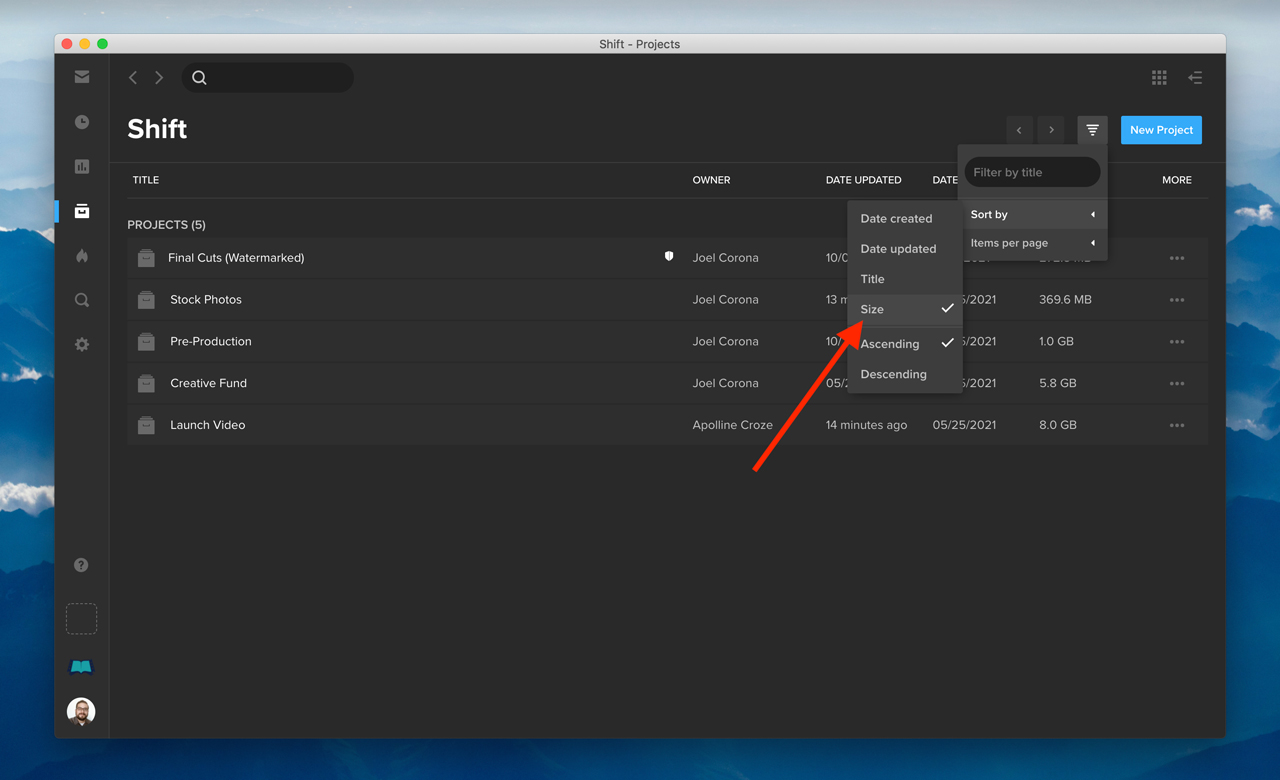
Find what you’re looking for faster. You can now sort your projects according to size. On the Projects landing page, click the filter icon in the top right, and select Sort by > Size. Or, if you’re using list view, just click “Size” in the Size column.
The search menu has been updated to display your newly created asset tags.