EditShare’s MediaSilo Achieves TPN Gold Shield Status
Independent validation from the MPA’s Trusted Partner Network gives studios and production teams added confidence when sharing pre-release content through MediaSilo
BOSTON, 14 October 2026 – EditShare®, the technology leader that enables storytellers to create and manage collaborative media workflows, today announced that MediaSilo has achieved Gold Shield status from the Trusted Partner Network (TPN).
MediaSilo is EditShare’s cloud-based platform for connecting media workflows, helping production and post-production teams access, organize and securely share content across storage systems, tools and organizations, with integrated review, collaboration and content protection. TPN Gold provides further independent assurance around the security practices supporting those workflows.
Owned by the Motion Picture Association (MPA), TPN is the industry-wide content security program that gives content owners and service providers a common framework for assessing security across the media and entertainment supply chain. Under its current Shield framework, Gold status recognizes that all applicable Best Practices identified through the assessment process have been remediated by the provider and reviewed by TPN.
“Our customers are regularly working with cuts, dailies, screeners and marketing assets long before that content is released,” said Brad Turner, CEO, EditShare. “TPN Gold gives the studios, agencies and production partners they work with another level of assurance that MediaSilo has been assessed against TPN’s established Best Practices for content security.”
MediaSilo combines media management and creative collaboration with security controls designed for professional content workflows. Teams can organize and search media, manage versions, gather time-coded feedback and approvals, and securely share content with reviewers inside or outside their organization.
Security capabilities include forensic and visible watermarking, single sign-on (SSO), multi-factor authentication (MFA) granular user permissions and controlled Review Links with configurable access and expiration. MediaSilo also holds SOC 2 Type II attestation.
TPN Gold Shield status adds another important layer to MediaSilo’s security credentials and reflects EditShare’s continued focus on helping media teams collaborate in the cloud while maintaining control over valuable content.
###
About EditShare
EditShare is an Emmy® Award-winning leader in collaborative media workflows for on-premise, cloud, and hybrid environments. Its solutions scale with media businesses at every stage, offering open architecture, seamless third-party integration, and secure content sharing. The EditShare suite includes multi-tiered storage, asset and workflow management, review features, secure previews, and branded pitch tools for a streamlined, end-to-end production experience.
Press Contact: Katharine Guy katharine.guy@editshare.com
New release brings private AI-powered search, intelligent media discovery, expanded archive workflows and workflow enhancements across FLOW and EFS
Boston, MA, 8 July 2026: EditShare®, the technology leader that enables storytellers to create and manage media, today announced the availability of EditShare 2026.2.0, a major software release. The update introduces FLOW AI, a new generation of search and discovery capabilities built directly into FLOW.
The release marks a significant step forward for teams managing growing volumes of media across storage, archive and active editorial environments, helping them find the right content faster without relying on manual tagging or external cloud-based AI services.
“Media teams do not need AI as a separate experiment. They need intelligence built into the tools they already use every day,” said Brad Turner, CEO of EditShare. “With FLOW AI in 2026.2.0, we are making every asset easier to understand, search and use, while keeping media and metadata under the customer’s control. This release reflects the direction of the EditShare platform: faster discovery, more open workflows and fewer manual steps between ingest, archive and edit.”
FLOW AI: media intelligence, built in
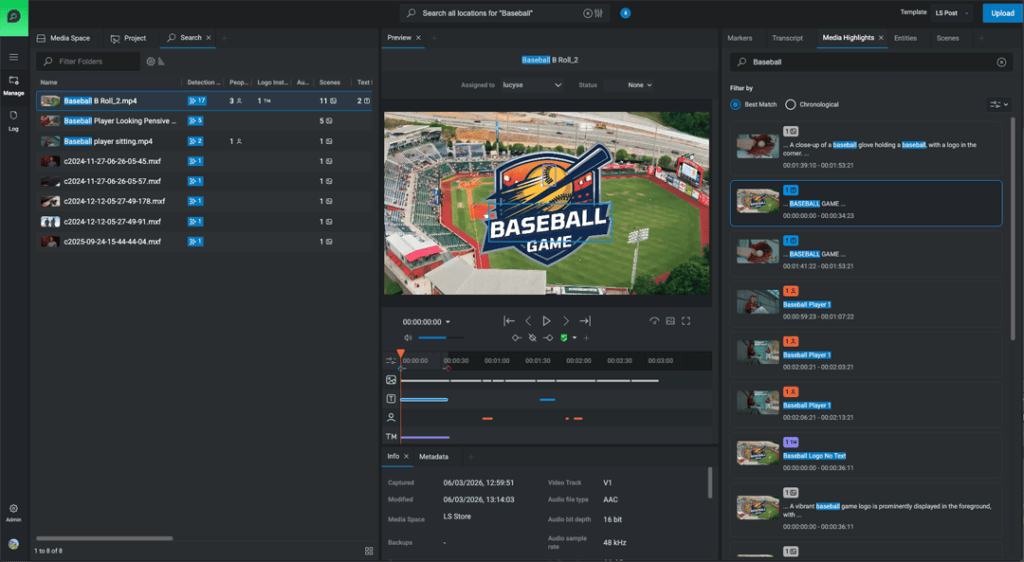
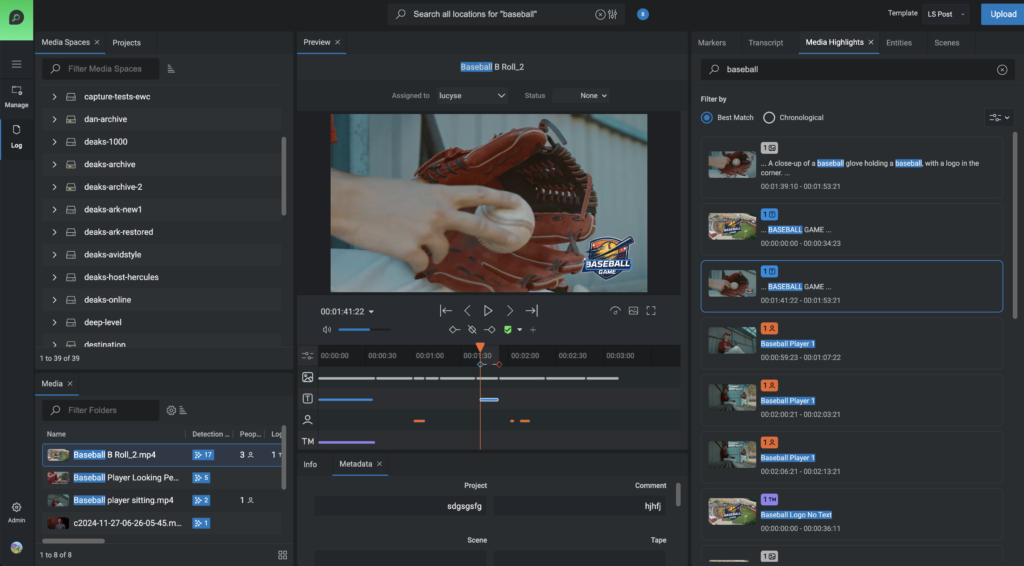
FLOW AI analyzes media to make dialogue, scenes, faces, logos, text in picture and metadata searchable from within FLOW, combining AI-powered semantic search with traditional keyword search in a single hybrid search experience.
Rather than searching one detection type at a time, users can query across all of them at once. Search results include detection counts, highlighted matches and direct navigation to relevant moments in the asset, allowing users to move quickly from discovery to review and editorial action.
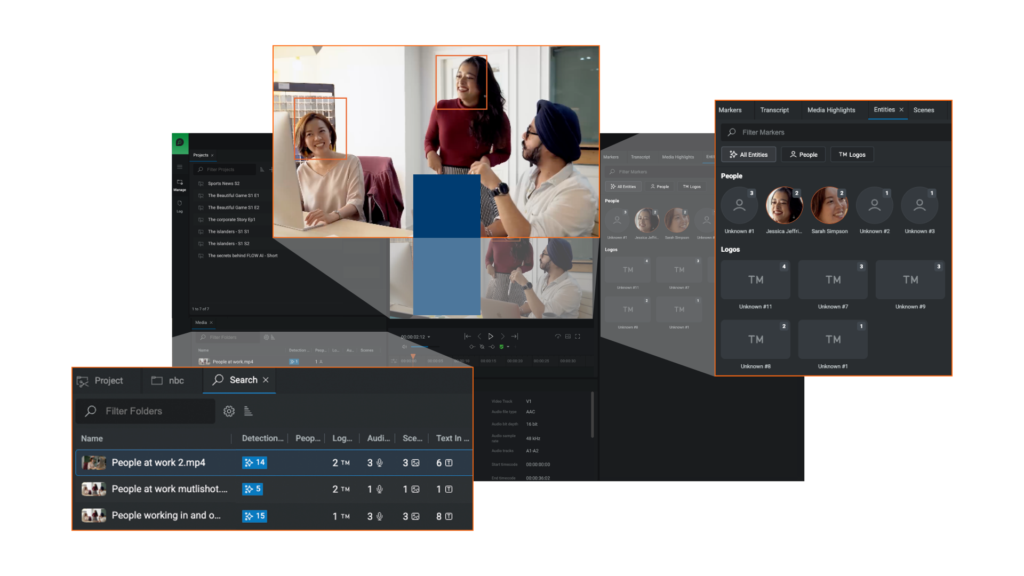
New media intelligence views provide faster ways to explore and navigate content. The Media Highlights panel gives users a unified view of matching moments across different detection types, while dedicated Entities, Transcript and Scenes tabs make it easier to locate specific people, brands, dialogue or visual moments within an asset.
FLOW AI detection points also appear on the media player timeline, giving users a visual map of where relevant moments occur. For detected people and logos, bounding boxes show where the entity appears in frame, helping teams verify results quickly during search, logging and review.
Administrators can manage known people and logos through dedicated databases. Because FLOW AI indexes detections during processing, newly identified people or logos can be associated across the existing database without requiring media to be reprocessed.
Built for private, on-premises AI workflows
Processing runs on dedicated EditShare GPU-enabled infrastructure. Media, metadata and detection data remain within the customer’s own secure environment. Content is not sent to the cloud and is not used to train external AI models. FLOW AI also integrates with Scan, Upload, FLOW Control and FLOW Automation, allowing AI processing to be initiated during ingest, triggered manually or incorporated into automated workflows.
Workflow improvements in EditShare One
EditShare 2026.2.0 also introduces a series of improvements across EditShare One, helping users move faster through common media management tasks.
Users can now archive and restore entire media spaces or folders directly from EditShare One, making it easier to manage larger collections of media without handling assets individually. Direct asset URL sharing allows users to send colleagues a link to a specific asset, reducing time spent searching or navigating through media spaces.
The release also improves metadata editing, search result behavior, panel reopening, file browser navigation, media player zoom controls, marker handling and drag-and-drop workflows. Users can drag assets, subclips, markers, media highlights and scenes into projects, bins or sequences, reducing manual steps between discovery and editorial preparation.
Expanded archive and platform integrations
EditShare 2026.2.0 extends FLOW’s role as a central operational layer for media lifecycle management, connecting FLOW directly to enterprise archive platforms for teams managing content across active, nearline and archived storage.
The release adds integration with Telestream DIVA Archive and Spectra Logic Rio MediaEngine, allowing organizations using these enterprise archive platforms to initiate archive and restore workflows directly from within FLOW. This helps teams keep existing archive investments while giving users a more connected experience for managing active, nearline and archived media.
EditShare is an Emmy Award-winning technology leader, supporting storytellers through collaborative media workflows across on-premise, cloud and hybrid architectures. It offers scalable storage and collaboration for media businesses and at every stage of the video production process from storyboarding to screening.
The software is inherently open, encouraging workflow collaboration, third-party integrations and content sharing across the entire production chain. Where required, the software is backed by high performance, high availability designed specifically for the demands of media storage, management and delivery. The comprehensive offering covers multi-level content storage for production and post, along with innovative asset and workflow management software, plus specialized and highly valued tools for content review and distribution, the creation of customized and branded pitch reels, and secure preview of high-value pre-release content.
Press Contact Katharine Guy katharine.guy@editshare.com
The dust has officially settled on the 2026 NAB Show in Las Vegas, and the atmosphere across the newly renovated halls of the LVCC was unmistakable. This wasn’t just another trade show; it was a pivot point. If 2025 was about the industry asking, “What can AI do?”, then 1,100 exhibitors just spent five days answering, “Here is how it earns its keep.”
The overarching theme of the show was the “Great Media Reset.” After years of “growth at any cost,” the industry has shifted its gaze toward sustainability, operational efficiency, and the practical execution of technologies that have finally moved from pilot projects to production mainstays.
Here is what defined the landscape of NAB 2026.
From AI Pilots to Full-Scale Execution
The most visible shift was the doubling of exhibitors in the AI Pavilions compared to last year. We are no longer looking at “experimental” generative tools in isolation. Instead, AI is now natively embedded into the hardware and software we use every day, from AI noise cancellation in Saramonic’s new wireless audio systems to AI-powered subject tracking in the latest 4K ENG cameras from Sony and Canon.
In the world of asset management and collaboration, the conversation has moved toward automating the “boring” parts of creativity. We saw this trend play out across the floor as teams looked for ways to eliminate manual tagging. It’s why we were so energized to show how MediaSilo AI and FLOW AI are fitting into this new era, focusing on making content searchable and actionable without adding to the editor’s plate.
The “Be Your Own Cloud” Movement
While cloud production is the standard, a fascinating counter-trend emerged this year: “Be Your Own Cloud.” Attendees were highly focused on tools that allow for secure, direct streaming and file access from local drives.
This hybrid mindset acknowledges that while the cloud is essential for distribution and scale, there is immense value in maintaining control over local high-performance storage. This is driving a new demand for infrastructure that bridges the gap between on-prem speed and cloud-based flexibility.
The Professionalization of the Creator Economy
The Creator Lab in Central Hall was no longer a side-show, but a destination. The expansion of this area reflects a massive shift: creators are now building scalable, revenue-generating media businesses. Today’s creators are moving away from broad appeal in favor of hyper-focused niche authority, building sustainable businesses around specific, loyal communities. This evolution is driving a demand for “agentic” production models, where AI serves as a unified stack to handle the heavy lifting of organization and formatting.
This professional pivot is exactly where the industry is seeing the value of intelligence-driven workflows like MediaSilo AI and FLOW AI. These tools are becoming essential as creator businesses scale, helping them manage the transition from simple content production to complex multi-platform distribution without losing agility. The barrier between high-end professional post-production and the creator economy has effectively vanished, with both sides prioritizing AI-native ecosystems to automate metadata and streamline the path from capture to monetization.
The Bottom Line
NAB 2026 wasn’t about the “next big thing,” it was about the “right big thing.” The industry has stopped chasing every shiny object and started investing in tools that provide a clear path to profitability and creative freedom.
As we look toward the rest of 2026, the goal is clear: build workflows that are smarter, faster, and more sustainable. We’re proud to be in the game, helping navigate this reset.
Did you miss us at the show? Reach out to see how we’re helping teams bridge the gap between production and post with intelligence and speed.
We have a big week ahead! As the team prepares to head to Las Vegas for NAB, the excitement is building. While the industry is buzzing with talk about new releases and the latest in AI, it’s the perfect time to remind our community that EditShare is built to support your entire media lifecycle from ingest to archive.
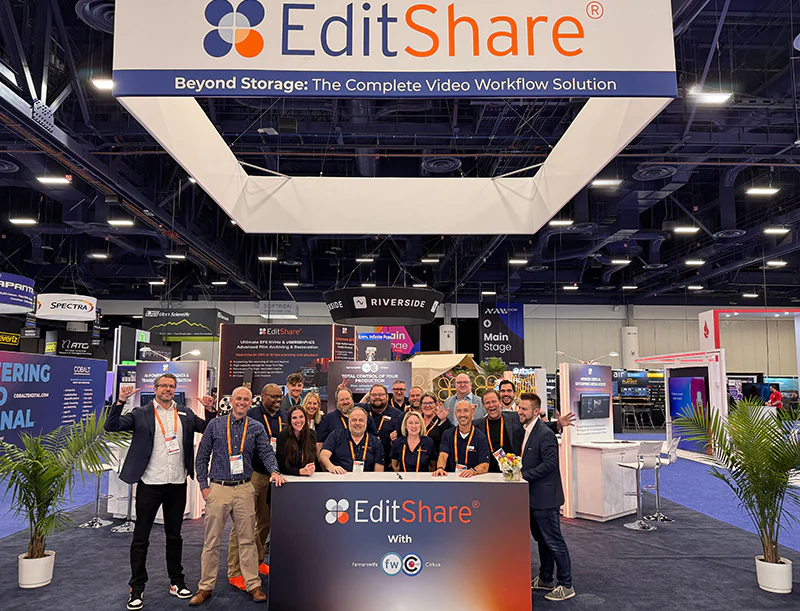
Here is a look at what we’re highlighting this year at Booth N1251.
1. Supporting Your Entire Workflow
EditShare isn’t just a storage provider; we provide the foundational infrastructure for your entire production lifecycle. We play across every stage of the process to ensure your team stays creative and productive:
Production & Ingest: Seamlessly ingest your content into a system built for collaboration.
Search & Discovery: We are currently focusing our AI innovation on search. Whether you need to find content on-premise with FLOW or in the cloud via MediaSilo, our AI helps you locate the right clips instantly.
Review & Approval: Use MediaSilo to share your work externally and gather feedback through a streamlined, professional gateway.
2. AI Security: Sovereignty Over Your Content
Security is a top concern across every industry. We approach security with a multi-layered strategy to give you total peace of mind:
Cloud Security: MediaSilo is SOC 2 compliant and now a member of the TPN (Trusted Partner Network), meeting the rigorous standards required by major studios.
Zero-Training Policy: Our AI is highly secure. We do not train our models on your content, and your data never resides in the open public cloud.
On-Premise Protection: With tools like EditShare Guardian, you have a complete audit trail. You’ll always know who has touched a file and where it has gone, eliminating the risk of files “disappearing” without a trace.
3. Storage for Every Scale: From 100 Terabytes to Petabytes
At EditShare, hardware is our foundation. We believe every team deserves high-performance storage, regardless of their size or industry. We offer tiers for every need:
The Right Fit: Whether you need a small cloud footprint for external collaboration or a robust on-premise setup, we have a solution.
Scalable Performance: Our offerings range from affordably priced 100TB EFS systems to massive, petabyte-scale configurations.
NVMe Innovation: For those requiring high-speed editing and finishing, our NVMe offerings deliver ultimate performance, while our proven spinning-disk solutions offer reliable, large-scale capacity. We even provide integrated archive solutions to protect your content for the long term.
See You in Vegas!
We can’t wait to show you these innovations in person. Stop by Booth N1251 in the North Hall to see our storage and AI tools in action.
Book a demo today to see how we’re making your workflow more searchable, secure, and scalable than ever before.
Moving past the “cool factor” to find the tipping point where search friction starts costing you real money.
AI indexing is rapidly becoming a standard feature in media workflows. It’s easy to assume that adopting it is simply part of staying current. But at EditShare, we believe that’s the wrong starting point.
The more useful question isn’t “What can AI do?” but rather: Does it change the economics or throughput of your specific operation?
The Tipping Point: From “Annoying” to “Expensive”
We’ve all heard the complaint: “We produce more than we can find.” For a small team, that’s a minor annoyance. For a high-volume production house, it’s a business failure.
The “tipping point” occurs when search friction manifests as a tangible loss. We’ve seen it happen in three specific ways:
The Duplicate Shoot: A team flies a crew out to capture “generic city b-roll” because no one can find the high-quality drives from six months ago.
The Missed Deadline: An editor spends six hours “scrubbing” through raw footage to find a specific interview soundbite, pushing the delivery past the broadcast window.
The Lost Opportunity: A brand wants to do a “throwback” campaign, but the archive is such a “black hole” of unindexed data that the creative idea is killed because the labor cost to find the clips exceeds the project budget.
When AI Indexing Doesn’t Make Sense
If your team produces one-off projects that are delivered and rarely revisited, the long-term value of indexing every frame is limited. An archive that is rarely accessed does not suddenly become valuable just because it has more metadata. Searchability enables reuse, but it does not create reuse on its own.
When the Math Changes
Where AI indexing begins to make financial sense is in environments where volume and reuse are structurally important.
The Scalability Gap: At a modest scale, manual logging is manageable. At a large scale, it’s either ignored or becomes a massive labor expense. AI converts unstructured video into searchable metadata (faces, objects, speech) at a fraction of the cost of human labor.
The Inventory Mindset: An indexed archive behaves like inventory. An unindexed archive behaves like storage. If you regularly repurpose content, localize material, or monetize archives, searchability directly affects your margins.
Creative Throughput: Editors are your most valuable (and expensive) assets. When a skilled editor spends 45 minutes looking for a clip instead of cutting, that is an opportunity cost. AI doesn’t replace their judgment; it simply narrows the search space so they can get back to storytelling.
The Reality Check
AI is a lever, not a magic wand. It is brilliant at pattern recognition, like finding a logo, a specific face, or a spoken word. It still struggles to interpret emotional nuance or “vibe.”
Furthermore, the technology only works if the workflow changes. Media must be centralized, and metadata must be visible exactly where the editors work. Without adoption, indexing is just background noise.
Boston, MA –11 March 2026 – EditShare®, a leader in collaborative media workflow solutions, will demonstrate its latest advancements in AI-powered media operations and high-performance NVMe storage at the 2026 NAB Show (Booth N1251). The showcase will focus on how broadcasters, post facilities, and production teams can manage growing content volumes without increasing operational complexity.
EditShare’s approach centers on Analytical AI, technology that analyzes media to identify and structure information such as speech, faces, text, and scenes. Unlike generative AI systems that create new content, Analytical AI focuses on understanding existing media, automatically enriching files with metadata that makes video searchable and easier to find. Integrated across the EditShare platform and accelerated by high-bandwidth shared storage, these capabilities allow teams to quickly find the clips they need across their media libraries.
“At NAB 2026, we’re showing how analytical AI has moved from an interesting tool to a foundational part of the EditShare platform,” said Brad Turner, CEO of EditShare. “The real opportunity is the ability to analyze video at scale and make that intelligence usable across the entire workflow. Whether media lives on-premise with our FLOW asset manager or in the cloud with MediaSilo, teams can instantly search their libraries and find the moments they need.”
AI and Intelligent Workflows Across the Platform
EditShare One: The latest version of EditShare’s unified interface will be showcased at NAB, providing a streamlined operational view across storage, asset management, and AI-powered workflows..
FLOW AI: Within the FLOW platform, AI-generated metadata enables automation and management workflows to operate without manual tagging. FLOW AI transforms media libraries and archives into dynamic, discoverable assets. Instead of spending hundreds of man-hours on manual data entry, creative teams can reclaim their time for high-value production, confident that every frame is indexed and searchable the moment it enters the system.
MediaSilo AI: At NAB 2026, EditShare will also introduce new AI capabilities within MediaSilo, extending intelligence directly into review and collaboration workflows. MediaSilo AI helps teams locate moments of interest, navigate content faster, and streamline feedback cycles by making media immediately searchable and context-aware for stakeholders across the production process.
MediaSilo: Intelligent Review and Approval for Modern Production Teams
Alongside the new AI capabilities being introduced within MediaSilo, EditShare will also unveil new MediaSilo bundles: Teams, Pro, and Enterprise – providing scalable options for organizations of any size. These bundles bring together core collaboration capabilities including forensic watermarking, single sign-on (SSO), and unlimited AI, giving production teams access to advanced functionality without the pricing barriers traditionally associated with high-end review platforms.
MediaSilo also enables teams to collaborate with unlimited external stakeholders, making it easy to involve clients, partners, and reviewers throughout the production process.
Visitors to the booth will see how MediaSilo integrates with the FLOW asset management platform, allowing teams to move directly from ingest and media management into secure review and approval workflows.
Infrastructure Built for Intelligent Workflows
The continued evolution of the Ultimate EFS lineup will be on display, engineered to support demanding media workflows across leading creative applications including Avid Media Composer, Adobe Premiere Pro, DaVinci Resolve, Final Cut Pro, Autodesk Flame, and Baselight:
Ultimate EFS NVMe Lite: A compact 8-drive NVMe storage node delivering up to 14 GB/s throughput per node with up to 122 TB raw NVMe capacity. NVMe Lite provides cost-efficient, ultra-low-latency performance for boutique post, finishing, and VFX environments, with the ability to scale across multiple nodes for increased bandwidth.
Ultimate EFS Hybrid: A unique,flexible and cost effective storage node combining an ultra-fast NVMe tier and a high-capacity HDD tier in a single system. The NVMe tier delivers up to 9 GB/s throughput with up to 122 TB NVMe capacity, complemented by up to 192 TB of HDD storage for compressed media and longer-term project storage.
EditShare will again partner with Lasergraphics to showcase high-resolution film scanning captured directly into an Ultimate EFS NVMe storage node. Attendees can watch 4K and 8K DPX image sequences ingest in real time and move immediately into playback and grading in DaVinci Resolve, illustrating the huge sustained shared read and write bandwidth required for film restoration and archive workflows.
Commitment to Enterprise-Grade Security and Compliance
As content security becomes increasingly critical for high-stakes productions, EditShare continues to invest in rigorous protection for its users’ intellectual property. MediaSilo has officially joined the TPN+ (Trusted Partner Network) community, signaling a commitment to the industry’s highest standards for content security. The company is also undergoing the assessment process for the TPN+ Shield certification, with completion expected in the coming months. This initiative ensures that MediaSilo users can collaborate with confidence, knowing their workflows adhere to the most stringent security best practices defined by the Motion Picture Association (MPA).
From Capture to Collaboration
EditShare is also pleased to welcome farmerswife to the booth, showcasing how its resource scheduling and management tools complement the EditShare ecosystem. “At NAB, we’re showcasing how farmerswife and Cirkus bring greater structure and visibility to production planning and project execution,” said Jodi Clifford, CEO, farmerswife. “By leveraging EditShare’s Open API, organizations can connect operational data with their media workflows, helping teams stay aligned from acquisition through delivery.”
Attendees are invited to visit Booth N1251 to see these workflows in action. To schedule a meeting with the EditShare team, visit: https://editshare.com/event/nab-2026/
Press Contact Katharine Guy katharine.guy@editshare.com
SwiftLink and the End of VPN Headaches
The “office” is no longer a single building when it comes to media production. It’s a global network of edit suites, home offices, and field locations. But for years, the barrier to seamless collaboration has been the dreaded VPN (Virtual Private Network).
Traditional VPNs are often the “bottleneck” of creativity. They are notoriously difficult for IT departments to manage, confusing for freelance editors to set up, and, most importantly, frequently underperform when handling high-resolution media.
That’s why we created SwiftLink, powered by our partnership with ZeroTier. Here is how we solve the remote access puzzle for good.
The Problem: The “VPN Wall”
Remote production usually hits one of two walls:
The Enterprise Wall: Corporate IT departments are often reluctant to grant external freelancers access to the main corporate VPN due to security risks or complexity.
The Capability Wall: Smaller production houses may not have the technical “wherewithal” to build or maintain a high-performance VPN that can handle the rigors of real-time video editing.
When connectivity fails, editors resort to shipping hard drives or struggling with “SMB over WAN,” which simply doesn’t work for professional workflows.
The Solution: SwiftLink + ZeroTier
SwiftLink integrates ZeroTier directly into the EditShare ecosystem to create a “Private Cloud” that is secure, affordable, and incredibly fast.
1. Instant Access for Freelancers
Instead of a complex manual setup, an admin simply generates a 16-digit network ID.
Ease of Use: The freelancer installs the ZeroTier stack, enters the ID, and is “off to the races.”
Security: Access is “fine-grained.” Even with the ID, an admin must manually authorize the freelancer’s machine in the dashboard before any media is visible.
Affordability: This isn’t an enterprise-cost solution. At roughly $2 per month per user/node, it’s a professional-grade tool at a fractional price point.
2. “Peer-to-Peer” Performance
Unlike traditional VPNs that route all traffic through a slow central server, ZeroTier acts as a “cloud broker.” Once the connection is made, it gets out of the way.
The Result: A direct, peer-to-peer connection between the editor’s laptop and the EFS server.
Workload: You can browse media spaces performantly. If your local bandwidth is low, you can seamlessly switch to proxy workflows in Adobe Premiere Pro, then relink to high-res—all through the same secure tunnel.
3. Connecting the Global Studio (Site-to-Site)
SwiftLink isn’t just for individuals; it’s for entire facilities. You can link up to nine distinct sites (e.g., LA, London, and a field unit) into a single ecosystem.
Disaster Recovery: Automatically synchronize media between a master site and a DR site.
Follow-the-Sun Editing: Pass media effortlessly between global offices so production never stops.
The Bottom Line
SwiftLink removes the “IT middleman” and the “physics bottleneck.” Whether you are a solo freelancer needing to mount a media space as if you were in the room, or a global studio syncing terabytes of data, SwiftLink makes the connection invisible so you can focus on the story.
“We can’t violate the laws of physics… but we’re going to make the most efficient use of that pipe.”
In the high-pressure landscape of 2026, media teams are constantly tasked with delivering more content in less time. To stay ahead, your infrastructure needs to do more than just store files, it needs to act as a force multiplier.
In this installment of our Cut to the Chase series, EditShare’s Shanna is joined by FLOW product expert Lucy Seaborne to dive into three features that turn FLOW into the ultimate “Swiss Army Knife” for post-production efficiency.
1. EditShare One: Ending the “App Juggling” Era
For years, media professionals have been forced to bounce between different applications to search, log, and ingest media. This “context switching” is a silent productivity killer. EditShare One solves this by providing a unified, browser-based experience that serves as a single point of entry for the entire team.
Rather than managing a fragmented toolkit, users access tailored modules designed for their specific roles. Whether it’s a producer checking a simplified dashboard or a media manager scheduling complex ingest feeds, the interface remains consistent and accessible from any browser. By centralizing these tasks, teams can eliminate the friction of software silos and focus entirely on the creative output.
2. Speed Over Friction: The Seamless Proxy Workflow
Remote work is no longer a luxury; it’s the standard. However, the biggest hurdle for remote editors has traditionally been the “relinking drama” between low-res proxies and high-res masters. Lucy highlights how FLOW removes this bottleneck by automatically generating high-quality proxies the moment media hits the system.
This allows editors to begin cutting on a standard Wi-Fi connection immediately—even for 8K projects—without waiting for massive file transfers. The real magic happens during the finish: with a single toggle in the FLOW panel, the NLE switches back to the high-res media for final color and export. This creates a friction-free bridge between the rough cut and the final delivery, regardless of where the editor is located.
3. FLOW Automation: The Assistant Who Never Sleeps
Manual “grunt work”—like transcoding, moving files to the correct folders, and sending “media is ready” notifications—can consume up to 20% of a creative team’s day. FLOW Automation functions as a background assistant that handles these repetitive tasks without human intervention.
By building customizable, “set it and forget it” workflows, administrators can ensure that every file is QC’d, renamed, and delivered to the right department automatically. With hundreds of possible configurations, this engine doesn’t just save time; it virtually eliminates the risk of human error in file management, keeping the creative team focused on the story rather than the folder structure.
Reclaim Your Creative Time
The goal of FLOW isn’t just to manage assets—it’s to return hours to your production schedule. From a unified interface to an automation engine that handles the heavy lifting, these features are designed to help your team work smarter, not harder.
Watch the full episode below to see these features in action and learn how to get your creative time back.
Learn how to store, search, automate and analyze your assets in EFS and FLOW.
EFS Video Tutorials
Media workflows are changing fast, not because of hype cycles, but because the volume, velocity, and expectations around video keep rising. Sports teams, brands, and enterprises are producing more content than ever, with distributed teams and tighter margins.
To understand what that means for 2026, I sat down with our CEO, Brad Turner, to talk through the trends he sees most clearly in customer conversations and how those realities are shaping EditShare’s roadmap.
Below, we break down the three trends that matter most and the practical implications behind them.
Trend 1: Sports teams and brands are becoming media companies
Sports organizations and large brands aren’t dabbling in content anymore, but running full-time production operations. What used to live with agencies is increasingly moving in-house, driven by the need for quicker turnaround, more control, and content tailored for dozens of distribution channels.
This shift has real staffing and workflow implications.
As Brad explains, editors are moving into non-traditional media roles and taking on different types of work than they did a decade ago. Agencies are still part of the ecosystem, but they’re no longer the default for day-to-day content. Instead, internal teams are being built to support always-on production, especially in sports and large corporate environments.
That shift creates a second-order problem: infrastructure that wasn’t designed to scale.
Most of these teams start small: a few editors, a handful of tools, and external drives stitched together with cloud services. That approach works early on, but over time, it becomes expensive, fragile, and hard to manage. Media sprawls. Costs creep up. Finding assets turns into a guessing game.
What Brad emphasizes here isn’t a single “right” architecture, but sustainability. Teams need to understand where their content volume is heading, how much work is local versus remote, and how often assets will need to move between storage tiers.
Rebuilding infrastructure every few years isn’t just disruptive. Migrating media is slow, costly, and risky.
The takeaway: content operations need systems that can grow with them, not quick fixes that collapse under scale.
Trend 2: AI is everywhere — but practicality matters more than promise
AI has become unavoidable in media technology conversations. But for most production teams, the question isn’t whether to use AI, it’s whether it actually saves time, reduces cost, and fits within security requirements.
Analytical AI — transcription, scene detection, logo, and facial recognition — directly addresses real production pain points: finding footage, reusing content, and eliminating manual busywork. But even those use cases come with constraints.
Cost, speed, accuracy, and security all matter, and optimizing one often impacts the others. Many teams are uncomfortable sending media offsite, even proxies. Others have been burned by AI services that fail, misidentify content, or charge repeatedly for reprocessing.
The result is skepticism, and rightly so.
EditShare is approaching this problem differently: integrating analytical AI directly into asset management workflows, rather than bolting it on as a separate service. The goal is simple: search once, find what you need, and move on, without duplicating effort or introducing new security risks.
This applies both on-prem and in the cloud. As Brad notes, customers don’t all want the same thing, and forcing them into a single deployment model creates friction. Practical AI needs to work where the media already lives, at a cost and speed that make sense for production teams.
Trend 3: Remote and hybrid work isn’t going away — complexity is increasing
Remote work isn’t a temporary adjustment anymore. Freelancers, agencies, in-house teams, and compliance stakeholders all need access to the same content, often at the same time.
The challenge isn’t just remote editing. It’s secure, reliable access across a fragmented workforce.
Most organizations now operate with mixed teams: internal staff, freelancers, and external partners. That means more people need access to content, and not all of them are on the same network, or even in the same time zone.
What customers consistently ask for is simple: the link should work, and it should point to the right version of the asset.
Security requirements complicate things further. Some organizations want everything on-premise, while others are cloud-native and don’t want to manage infrastructure at all. Most sit somewhere in between.
Brad’s key point is that there’s no single buyer profile anymore, and systems need to accommodate different security models without breaking workflows. That means fewer links, clearer versioning, and access that’s secure without being cumbersome.
When remote sharing fails, it doesn’t fail quietly. It slows reviews, creates confusion, and introduces risk, especially when multiple versions of the same asset are circulating.
What this means for 2026
Across all three trends, the pattern is consistent: media teams are being asked to do more, with more people involved, across more platforms, all without increasing complexity or cost.
Brad’s perspective reflects what customers are already experiencing:
Content volume is growing faster than infrastructure plans
AI must be useful, not experimental
Remote collaboration has to be reliable and secure, not improvised
These realities are shaping how EditShare is thinking about product development in 2026, with a focus on sustainability, practicality, and workflows that hold up under pressure.
Want the full conversation?
This post only highlights a few moments from the discussion. If you want deeper context on each trend, click the link below.